AI Tools for Fashion / Sustainability
AI and Fashion Sustainability
Fashion’s environmental problem is, in large part, an information problem: brands make more than they can sell because they cannot predict demand, garments are landfilled because nobody can tell what fiber they are made of, and fabric sits in warehouses because the factory that could use it never learns it exists. Artificial intelligence is genuinely good at exactly those information problems — which is why it is now being applied across the footprint, from forecasting to recycling. This guide explains where AI helps, with real systems named, and then gives the counterweight the same honest treatment: AI’s own energy and water cost, its role in accelerating micro-trends, and the greenwashing risk that comes with any fashionable claim. For the wider picture, see the Apparel Search sustainable fashion guide.
Where AI Helps
Forecasting: Making Less of What Won’t Sell
The single largest sustainability lever in fashion is not a new fiber — it is not producing the garment in the first place. Unsold stock is waste that consumed water, energy, chemicals and labor before it ever met a customer, and it exists because buying decisions are made months in advance on partial information. AI demand forecasting attacks that gap directly: it reads sell-through by size, color, store and region as a season unfolds, folds in search and social signals, and recommends depth, allocation and reorder decisions earlier and more precisely than a spreadsheet season review can. Used well, it means smaller initial runs, faster reaction to what is actually selling, and fewer containers of clothing discounted, destroyed or dumped at season’s end.
The mechanism matters more than the marketing. A forecast only cuts overproduction if the business acts on it — ordering less, later, and closer to demand — rather than using better prediction purely to chase more sales. The systems themselves, and how trend signals feed them, are covered in the AI trend forecasting guide. Closely related is fit: a large share of online returns is size-related, and every return is a parcel shipped twice for a garment that may never be resold as new. The sizing and fit guides in the More to Explore section below cover the tools working on that side of the problem.
Resale, Sorting and Grading
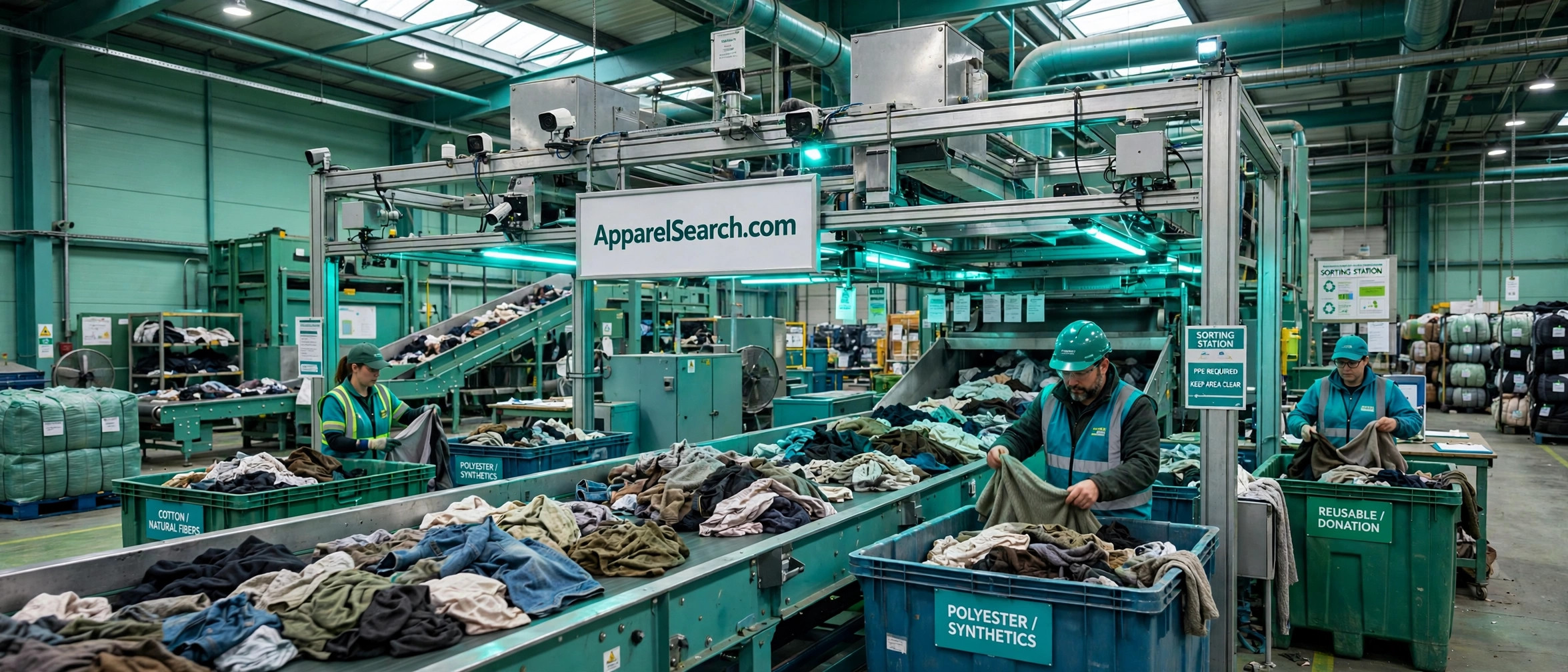
A used garment’s most sustainable next step is usually another wearer — but resale at scale runs on human judgment applied garment by garment: What is it? What condition is it in? What is it worth? AI is absorbing the routine layers of that work. Image recognition identifies brand, category and style from photographs; condition-grading models flag stains, pilling, fading and damage; pricing models estimate resale value from comparable sales. That automation is what lets resale and re-commerce operations process high volumes without every item passing through an expert’s hands, and it is also being turned inward by recyclers to separate the rewearable from the truly worn-out before either stream is processed further.
Knowing the Fiber: Identification for Recycling
Textile-to-textile recycling has a bottleneck that has nothing to do with chemistry: sorting. A recycler needs feedstock of known composition — a load of pure cotton or pure polyester behaves predictably; a load of unknown blends does not — and the traditional ways of knowing (reading care labels, burn tests, lab analysis) are slow, and labels are often missing or inaccurate. This is where AI paired with spectroscopy has changed the economics. Near-infrared and hyperspectral sensors read how a fabric reflects light across wavelengths, and machine-learning models interpret that signature as a fiber composition in about a second.
Two real systems illustrate the approach. UK company Matoha makes FabriTell scanners — handheld and bench devices that use near-infrared spectroscopy with on-board AI to identify textile composition, including blends, in under a second, designed so sorting staff need no specialist training. US startup Refiberd, a 2023 winner of the H&M Foundation’s Global Change Award, combines hyperspectral imaging with AI to detect fiber composition and contaminants for automated sorting. Neither system recycles anything by itself; what they do is create the clean, verified, single-fiber streams that mechanical and chemical recyclers actually require — the unglamorous precondition for recycling rates to rise.
Deadstock Matching and Traceability
Deadstock matching. Mills, factories and brands sit on surplus fabric and components that are perfectly usable — by someone else. AI-driven marketplaces and matching systems catalogue that surplus with searchable attributes (fiber, weight, color, quantity, location) and match it to designers and manufacturers who can use it, turning a warehoused liability into someone else’s raw material and displacing virgin production in the process.
Take-back and repair triage. The same identification and grading tools are finding a second use at the start of the reverse pipeline. When a customer returns or trades in a garment, vision systems can identify the item, assess its condition and route it — resale as-is, resale after cleaning or minor repair, parts and material recovery, or recycling — in seconds rather than after a manual inspection queue. Routing matters environmentally as well as commercially: a garment routed to resale keeps its value and displaces a new purchase, while one routed late to recycling after weeks in a returns warehouse often ends up downgraded. Faster, more accurate triage is one of the quieter ways AI raises the share of clothing that stays in use.
Traceability support. Sustainability claims increasingly have to be proven, not just stated, and the proof lives in supply-chain data: which mill, which dye house, which certificates, which shipment. AI supports that work by reconciling documents across suppliers, flagging inconsistencies between a claim and the records beneath it, and structuring the product-level data that digital product passports and due-diligence reporting require. It does not make a supply chain honest — it makes dishonesty harder to hide in paperwork, and honest chains easier to document. The production-side systems are covered in the AI production and supply chain guide.
The Counterweight: AI’s Own Footprint
Any honest account has to put AI itself on the scale. AI models are trained and run in data centres that consume electricity and water at industrial scale. The International Energy Agency’s Energy and AI report (April 2025) estimated that data centres used about 415 terawatt-hours of electricity in 2024 — roughly 1.5% of global electricity consumption — and projected demand to more than double by 2030 to around 945 TWh, with AI the most significant driver of the increase. A typical AI-focused data centre, the IEA notes, consumes as much electricity as 100,000 households. None of that is fashion’s share alone, but every AI workflow a fashion company adopts draws on that infrastructure.
There is a second, subtler cost. The same forecasting and content tools that can cut overproduction can also be pointed the other way: detecting micro-trends earlier, generating more styles faster, and marketing them harder. If AI’s main effect at a given company is a faster trend cycle and more units sold, its efficiency gains per garment can be swamped by volume — the classic rebound pattern. The technology is a lever; the direction it pushes depends on the business model it is plugged into. That is why the credible question about any “AI for sustainability” program is not which tool it uses, but what it measures: unsold stock avoided, returns reduced, garments resold, tonnage recycled — against a stated baseline.
Claims vs. Evidence
The Greenwashing Risk
“AI-powered” has become a sustainability claim in itself, and it deserves the same skepticism as any other. Warning signs are familiar: vague language with no measured outcome, a pilot presented as a transformation, efficiency percentages with no baseline, and silence about the AI system’s own footprint. Apparel Search’s greenwashing and environmental claims guide sets out how environmental marketing claims are made, where they cross legal and ethical lines, and what substantiation should look like — the right companion read for anyone evaluating a vendor’s sustainability pitch, AI-flavored or otherwise.
A balanced verdict: AI is one of the more practical tools fashion has for its footprint — not because it is magical, but because so much of that footprint is waste created by bad information, and information is what AI processes. Its benefits are real but specific, its costs are real but shared, and the difference between the two outcomes is decided by what each company chooses to measure and optimize.
Common Questions
Common Questions
Can AI actually reduce fashion’s environmental footprint?
It can reduce specific, measurable parts of it: fewer unsold garments when forecasting improves, fewer returns when fit tools work, more clothing resold and recycled when sorting is automated. It does not reduce the footprint of making and selling ever more clothing — if AI is used mainly to speed up trend cycles and sell more units, its efficiency gains can be outrun by volume growth.
How does AI help recycle clothing?
Recyclers need to know what a garment is made of, and labels are often missing or wrong. AI paired with near-infrared or hyperspectral imaging reads a fabric’s fiber composition in about a second — UK company Matoha’s FabriTell scanners and US startup Refiberd’s hyperspectral system both work this way — so garments can be sorted into the clean, single-fiber streams recycling processes require.
Does using AI itself harm the environment?
AI runs on data centres that use real energy and water. The International Energy Agency’s Energy and AI report (April 2025) estimated data centres used about 415 terawatt-hours in 2024 — roughly 1.5% of global electricity — with demand projected to more than double by 2030, AI being the most significant driver of the increase. An honest sustainability claim for any AI tool has to weigh that cost against the waste it prevents.
How can I tell an AI sustainability claim from greenwashing?
Ask what the claim measures. A credible claim names a specific outcome — units of unsold stock avoided, share of returns reduced, tonnage sorted for recycling — and a baseline it improved on. Vague language about “AI-powered sustainability” with no numbers, no baseline and no mention of the AI system’s own footprint is marketing, not evidence.
Keep Exploring
More to Explore
AI Guides
AI and Fashion Careers
The other Grow-group guide: the roles and skills being reshaped as AI spreads through the industry — including sustainability work.
Read the guide ↗AI Virtual Try-On
Try-on technology that can cut fit-related returns and reduce the sample and shipping churn behind them.
Read the guide ↗AI Sizing & Fit
Fit recommendation tools aimed squarely at the returns problem — parcels shipped twice for garments never kept.
Read the guide ↗Sustainability on Apparel Search
Sustainable Fashion Brands
Brands working on lower-impact materials, repair, resale and more responsible production.
Explore ↗Sustainable Fabrics
The lower-impact fibers and fabrics that better forecasting and sorting are meant to keep in circulation.
Explore ↗Fashion Certifications
The labels and standards behind traceability claims — and what each one actually verifies.
Explore ↗Search Apparel Search