AI Tools for Fashion / Make
AI Quality Control in Garment Factories
AI quality control puts cameras and trained models on the inspection tasks garment factories have always done by eye — grading fabric, catching sewing defects and measuring finished garments. This guide explains what the systems check, how they work alongside the 4-point system, AQL sampling and human inspectors, and where their limits lie.
Where AI Fits
What AI Quality Control Actually Checks
AI quality control in a garment factory means computer-vision systems that inspect fabric and finished garments with cameras and trained models, flagging defects for people to confirm, grade or act on. It sits inside a quality system that still includes fabric grading standards, sampling plans and human inspectors — it does not replace that system. What it changes is coverage and consistency: a camera does not get tired at hour six of a shift, does not inspect faster as a shipment deadline approaches, and applies the same threshold to the first roll and the fiftieth.
Most quality failures in apparel are born early. A weaving defect, a shade variation or a stain that passes into cutting becomes a defective panel, then a defective garment, then a return or a rejected shipment — with sewing, trims, pressing and freight added to the loss at every step. That is why the first and most developed use of AI in factory QC is at the fabric stage, before any cutting happens, and why the same technology is then applied again on the sewing floor and at final inspection.
Fabric First
Computer-Vision Fabric Inspection
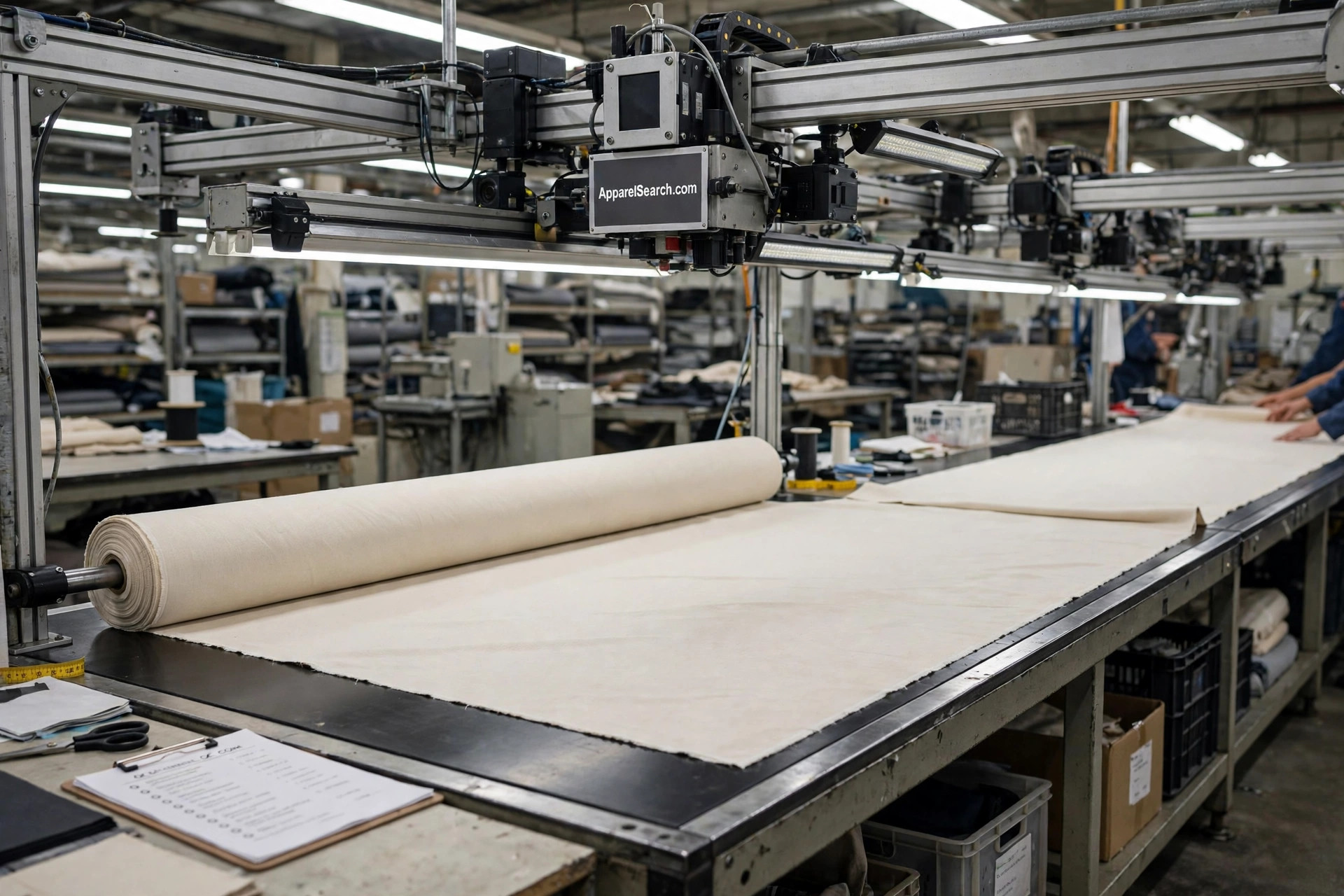
An AI fabric inspection station mounts cameras and controlled lighting over or under an inspection frame, or builds them into the fabric's path as a roll unwinds. As the cloth moves, the system captures images continuously and a model trained on examples of good fabric and known defects flags anything that breaks the pattern: holes, slubs and thick yarns, missing picks, oil and dirt stains, dye streaks and shade bars, misprints and registration errors, needle lines in knits and dropped stitches.
Each flag is logged with its position across the width and along the length of the roll, building a defect map of the whole roll. That map is more valuable than a simple pass or fail. Cutting teams can plan markers around serious defects instead of discovering them panel by panel, buyers receive a roll-by-roll record instead of a summary claim, and recurring defects can be traced back to a loom, a dye lot or a supplier. Because the inspection is recorded, a disputed roll can be re-examined from its images rather than argued over from memory.
The same vigilance problem that affects people affects deployment choices. Research on automated fabric inspection consistently frames the practical goal as a human-in-the-loop system: the model performs the tireless scanning, and trained inspectors verify and classify what it flags. Factories that treat AI as a second pair of eyes for their QC team generally get more from it than factories that treat it as a headcount decision.
On the Line
Defect Detection on Sewing Lines and at Final Inspection
In-line checks
Cameras at or after sewing operations flag skipped and broken stitches, uneven seams, puckering, open seams, wrong or missing labels, and stains picked up during handling — while the garment is still on the line and rework is cheap.
Final inspection support
At final inspection, vision systems compare finished garments against reference images and specifications: print placement, button and trim presence, embroidery position, and visible construction faults, presented to the inspector as prompts rather than verdicts.
Records that travel
Every flagged defect is stored with an image. Brands reviewing a shipment claim, and factories disputing one, can look at the same evidence instead of exchanging descriptions of a garment neither side still has in hand.
Measurement automation
Measuring garments by hand — laying each piece flat, finding each point of measure, reading a tape — is slow, and two careful people can still record different numbers on the same garment. Automated measurement uses a camera over a measuring table, or a structured scan, to locate the standard points of measure (chest, waist, length, sleeve, inseam and the rest of the specification) and record dimensions against the tech pack tolerances. The value is less the speed of any single measurement than the consistency across hundreds of them, and a data trail that shows whether a factory is drifting out of tolerance during a run rather than after it ships.
Old System, New Eyes
AI QC and the 4-Point System
The garment industry already has a shared language for fabric quality: the 4-point system, in which an inspector assigns each defect penalty points by its size — defects up to 3 inches score 1 point, over 3 to 6 inches score 2, over 6 to 9 inches score 3, and anything longer scores 4, with holes also scoring 4 — and the roll is graded in points per 100 square yards against a limit the buyer and supplier agree in advance. Apparel Search explains the method in full in its guide to the fabric inspection 4-point system.
| Defect length | Penalty points | Typical examples |
|---|---|---|
| Up to 3 inches | 1 | Short slub, small mark |
| Over 3 to 6 inches | 2 | Longer slub, short streak |
| Over 6 to 9 inches | 3 | Extended crease or dye bar |
| Over 9 inches, and any hole | 4 | Continuous defect, hole, tear |
AI does not abolish this system; in most factories it is asked to operate it — detecting defects, measuring their length and computing the same points score a human inspector would, roll after roll, with the images kept as evidence. The differences are coverage and temperament. A vision system can inspect every meter at production speed and never waves a borderline roll through to meet a truck. A human inspector brings judgment the model lacks: knowing that a faint mark will disappear in garment dyeing, that a defect sits in a seam allowance, or that this buyer's tolerance is stricter than the standard. The roles described in the Apparel Search guide to quality control managers in the apparel industry — setting standards, managing inspectors, ruling on borderline goods — remain human jobs; AI changes the evidence those people work from.
AQL in plain language
AQL (Acceptable Quality Limit) is the sampling rule used at final inspection. Instead of checking every garment, an inspector pulls a random sample whose size is set by the lot size under standard sampling plans (ISO 2859-1, also published as ANSI/ASQ Z1.4), sorts any defects found into critical, major and minor, and accepts or rejects the lot by comparing the counts with pre-agreed limits. Buyers commonly work to an AQL of 2.5 for major defects and 4.0 for minor defects, with zero tolerance for critical defects — but the levels are a contract choice, not a law of nature. AQL is a decision rule about a sample, not a promise that every uninspected garment is perfect. AI inspection complements it by widening what can be checked 100 percent — fabric, measurements, visible construction — while AQL sampling continues to govern the final accept-or-reject decision on finished goods.
The Limits
Where AI QC Still Struggles
- Novel defects. A model finds what it has been trained to find. A genuinely new fault — a new fabric, a new finish, a failure mode the factory has never produced — may pass unrecognized until a person spots it and the model is retrained.
- Lighting and presentation. Vision systems are only as good as their controlled lighting and flat, steady fabric presentation. Wrinkles, flutter, glare on shiny fabrics and shadows can all be misread as defects, or hide real ones.
- Fabric variety. Lace, open knits, heavy textures, busy prints, dark shades and high-stretch fabrics are all harder to inspect than plain mid-tone wovens. A system proven on shirting has not been proven on your fabric until it has run your fabric.
- False rejects. A cautious model flags borderline marks a human would pass. Set the threshold too tight and the factory drowns in re-inspection; too loose and the system is decoration. Thresholds are a quality-policy decision, not a factory default to accept unexamined.
- Everything a camera cannot see. Hand feel, odor, colorfastness, seam strength and durability still need laboratory and physical testing. AI inspection covers appearance and dimension, not performance.
There is also a genuine sustainability upside when the system works: defects caught on the roll never consume cutting, sewing, trims, pressing and freight, which is why early detection features in the guide to AI and fashion sustainability as one of the least glamorous and most real ways AI reduces waste.
For Buyers
What Buyers Should Ask Factories
- What exactly is inspected, and where? Incoming fabric, in-line, final — or only one stage presented as full coverage?
- Which standard does the system grade to? If fabric is AI-inspected, are the results expressed in the 4-point system, with roll-level defect maps you can see?
- What happens to a flag? Who verifies it, who can override it, and is the image record kept with the lot's paperwork?
- How was it validated on fabric like yours? Ask for detection performance on your fabric types and colors, not the vendor's easiest demonstration cloth.
- What are the thresholds, and who sets them? Insist the accept/reject settings reflect your quality manual, and ask how changes are approved and logged.
- How do AI records connect to AQL inspection? The strongest factories use both: full AI coverage upstream, and a properly run AQL final inspection whose results you receive with the shipment documents.
Common Questions
Common Questions
What does AI quality control check in a garment factory?
Computer-vision systems inspect fabric as it unwinds for holes, slubs, stains, dye streaks and shade variation, building a defect map of each roll. On sewing lines and at final inspection they flag stitching faults, open seams, print and trim errors and stains, and automated measurement systems record garment dimensions against the tech pack. Inspectors verify and classify what the system flags.
Does AI replace the 4-point fabric inspection system?
No. In most factories the AI is asked to operate the 4-point system — detecting defects, measuring their length and computing the same penalty points a human inspector would assign, roll after roll, with images kept as evidence. Human QC staff still set standards, rule on borderline goods and handle everything a camera cannot judge, such as hand feel and durability.
What is AQL in plain language?
AQL, the Acceptable Quality Limit, is a sampling rule for final inspection. An inspector checks a random sample sized by the lot under standard plans such as ISO 2859-1, sorts defects into critical, major and minor, and accepts or rejects the lot against pre-agreed limits. Buyers commonly use AQL 2.5 for major and 4.0 for minor defects, but the levels are a contract choice, and AQL is a decision rule about a sample — not a guarantee that every garment is perfect.
What should a buyer ask a factory about its AI inspection?
Ask what is inspected and at which stages, whether fabric results are reported in the 4-point system with roll-level defect maps, who verifies and can override a flag, how the system was validated on fabric like yours, who sets the accept thresholds, and how AI records connect to the AQL final inspection results you receive with the shipment.
Keep Exploring
More to Explore
Related Guides
AI Fashion — Term Guide
How the fashion industry uses the term AI fashion, defined in the Apparel Search glossary.
Explore ↗Quality Control Manager — Job Description
What a quality control manager in apparel production does, from the Apparel Search careers library.
Explore ↗AI Guides
Search Apparel Search