Quality Control Manager Job Description
Running inspection operations — inline and final checks, AQL sampling, pass and fail decisions on real shipments
A quality control manager runs the inspection operation that checks finished and in-production garments and decides whether shipments may leave the factory. Where quality assurance designs the system, quality control operates its sharpest instrument: inspectors at the end of sewing lines, at final inspection tables and in factories overseas, sampling cartons, measuring garments, classifying defects and applying the standard to real goods under real delivery pressure. The QC manager deploys those inspectors, calibrates their judgement, reviews their reports and makes — or upholds — the pass, rework or reject decision when a shipment fails. It is an operational role, measured in inspections completed and failures caught before customers find them.
More Production Job Descriptions by Letter:
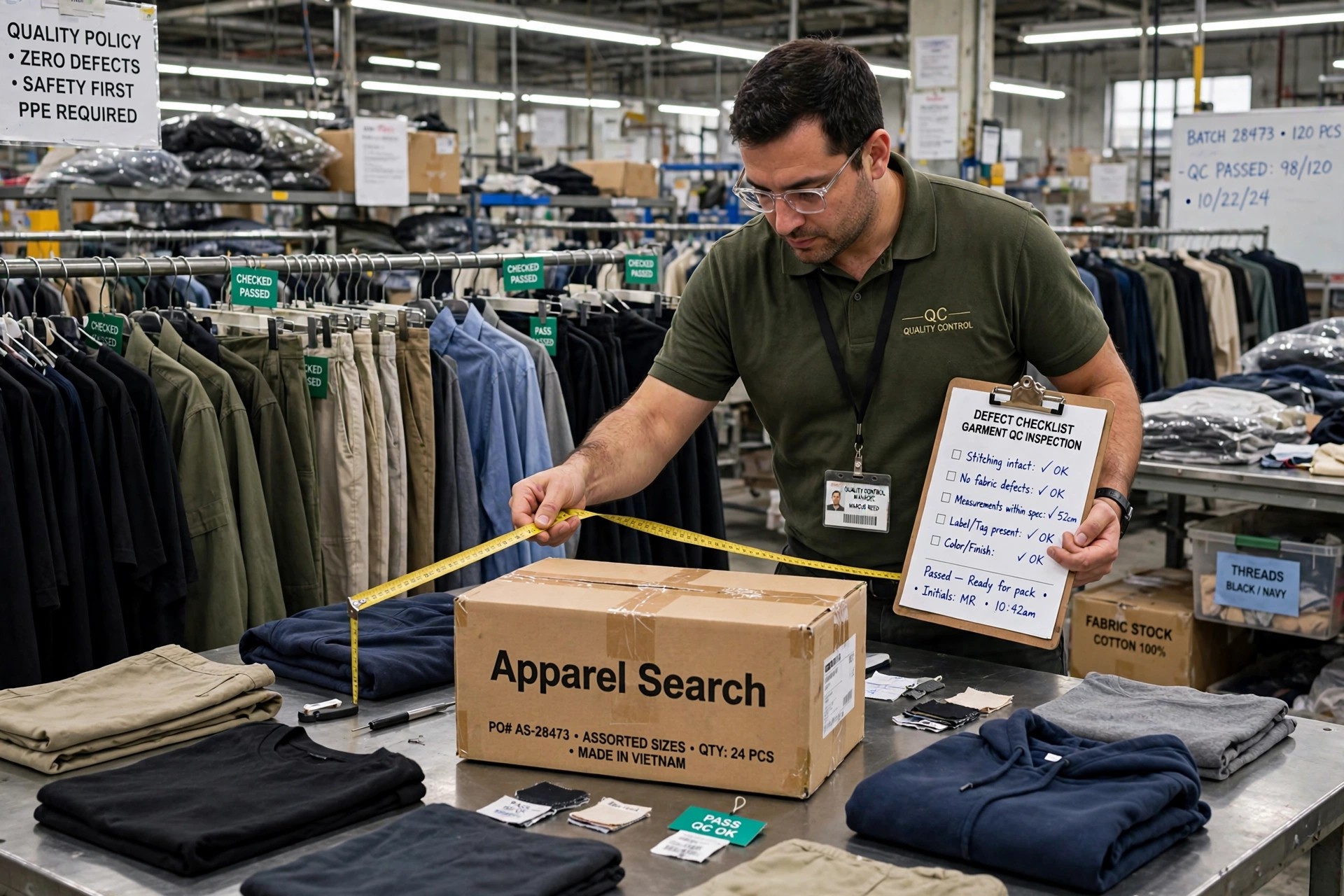
Running Inspection Operations
The QC manager organises inspection in layers. Inline inspection checks garments during sewing, when a fault found early saves a whole order from repeating it; end-of-line and finishing checks catch defects before pressing and packing; final random inspection, drawn from packed cartons to an AQL sampling plan, is the formal gate a shipment must pass before release. The manager schedules these layers across factories and orders — which shipments get full final inspection, which need an inspector resident in the factory, which trusted suppliers earn reduced inspection — and keeps the schedule honest against the shipping calendar, because inspection capacity, like sewing capacity, is finite and peaks exactly when deliveries peak.
The pass and fail decisions are the role's daily weight. A failed final inspection triggers the manager's judgement: re-inspect after the factory reworks the faults, accept a defined concession where the standard genuinely allows it, or hold the shipment — knowing that holding it may miss a vessel and a selling season. The QC manager documents each decision against the sampling evidence and defect counts, so the call can be defended to production, to the customer and, later, to anyone reading the returns data. Consistency is the discipline: the same fault must fail in every factory, or the standard exists only where it is convenient.
Defects, Inspectors and the Feedback Loop
Defect knowledge is the QC manager's technical language: major and minor defects, critical faults that can never ship, workmanship standards for seams, stitching, pressing and presentation, and measurement tolerances checked garment by garment against the size specification. The manager maintains the defect classification the inspectors use, trains new inspectors against sealed samples and reference garments, and calibrates the team with duplicate inspections — the same cartons checked twice — so one inspector's strictness does not become another factory's grievance. Disputed results are re-examined by the manager personally; the inspector network's credibility depends on its decisions surviving that review.
Inspection that only rejects is half a job. The QC manager feeds results back while production is still running: defect patterns reported to the factory and the production team the same day, recurring faults escalated to quality assurance with the data to force a process fix, and supplier scorecards updated so sourcing sees quality alongside price and delivery. Reports are the role's paperwork and its memory — inspection reports with photographs, measurements and defect breakdowns that let a head office on another continent see what the inspector saw. A QC manager whose reports are trusted can hold a shipment from six thousand miles away; one whose reports are vague cannot hold one from the next room.
Skills and Abilities the Role Requires
Garment fault expertise comes first: construction, fabrics and finishing understood at the level where a fault's cause — operator, machine, material or pattern — can be named from its appearance. Sampling and measurement competence follows: AQL plans applied correctly, tolerances checked without drift, and inspection maths that survives argument. The manager of inspectors also needs deployment skill — matching inspectors to factories by experience and integrity, rotating assignments, and protecting inspectors from the local pressures, social and commercial, that accumulate around a pass decision.
Firmness is the personal quality the role is hired for. Every failed shipment has a factory manager, a production manager and a delivery date arguing against the decision, and the QC manager must hold the standard with evidence and courtesy in roughly equal measure — and know the narrow ground where a concession is legitimate, because a manager who never concedes loses credibility as surely as one who always does. Organisation under volume, clear written reporting and the stamina for factory travel round out the profile; in import-heavy companies the role may spend much of the year in producing countries.
Qualifications, Training and Career Path
QC managers are promoted inspectors more often than not: final inspector, senior inspector or QC supervisor first, with a fault knowledge and a decision record the inspector network already trusts. Garment technology or textiles education supports the route, and training in sampling standards and inspection methods is widely provided in post; employers screen for inspection years, factories covered, and examples of shipments held — or passed — under pressure and defended afterwards. Experience across product types matters, because a manager who has only inspected T-shirts will be tested by tailored outerwear.
Progression leads to quality assurance manager, where the operational record becomes the foundation for owning the whole quality system, and onward to head of quality roles. QC managers also move into factory quality management on the supplier side, third-party inspection companies — where the same skills are sold as a service — and technical management. The through-line is judgement about garments: no other role in the industry makes as many evidenced pass and fail decisions, and senior quality careers are built on how those decisions aged.
Common Questions
What does a quality control manager do?
They run garment inspection operations: deploying inspectors across factories, organising inline and final inspections to AQL sampling plans, classifying defects, reviewing reports, and making or upholding the decision to release, rework or hold a shipment.
How is a QC manager different from a QA manager?
The QC manager detects: inspecting real garments and deciding on real shipments. The QA manager prevents: designing the standards, audits and corrective-action system the inspections operate inside. QC is the gate; QA is the framework around the gate.
What is AQL in garment inspection?
Acceptable Quality Level sampling: a statistical plan that sets how many garments to inspect from a shipment and how many major and minor defects may be found before the shipment fails. QC managers apply AQL plans and defend the decisions they produce.
More to Explore
Quality Resources
Production Directory Pages by Letter
References & Further Reading
More Job Description Categories
- Buying Job Descriptions
- Design Job Descriptions
- Marketing & PR Job Descriptions
- Miscellaneous Job Descriptions
- Planning & Allocation Job Descriptions
- Production & Sourcing Job Descriptions (current)
- Sales & Selling Job Descriptions
- Transportation & Warehouse Job Descriptions