Quality Technologist Job Description
The testing specialist — fabric and garment performance measured in the laboratory and proven against standards
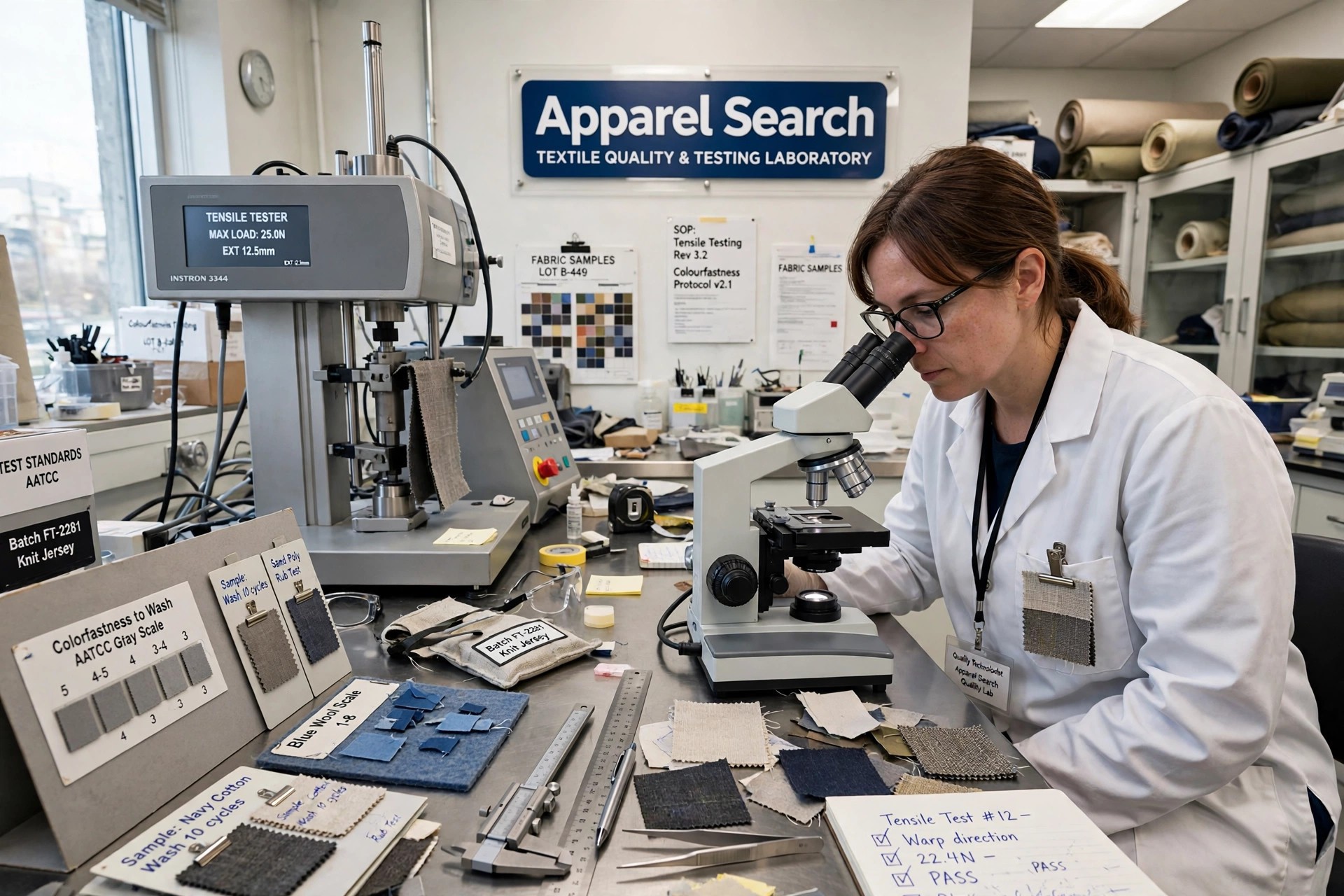
A quality technologist is the testing specialist of the fashion quality family: the person who proves, with laboratory evidence, whether a fabric or garment performs as it should. Where the quality control manager inspects workmanship and the assurance manager designs the system, the technologist measures properties — colourfastness to washing, light and rubbing; dimensional stability and shrinkage; seam and fabric strength; pilling and abrasion resistance; flammability and fibre content — against published test methods and the company's standards, and reports pass or fail on materials before they are cut and on garments before they ship. It is bench science applied to clothing, and its verdicts stop production as surely as any inspection.
More Production Job Descriptions by Letter:
Testing Fabrics and Garments to Standard
The technologist's work follows the product's life. At development, submitted fabrics are tested before approval: a cloth that fades in its first wash or shrinks beyond tolerance is rejected while it is still a swatch, not a season's stock. During production, bulk fabric is tested against the approved standard — the bulk-versus-submission comparison that catches a mill quietly changing a finish — and shade continuity is assessed alongside physical performance, because a fabric can pass every strength test and still fail the customer's eye. Finished garments receive confirmation testing where risk demands it: a new factory, a new fabric, a style whose construction stresses its seams.
Method is the technologist's discipline. Tests are run to recognised methods — ISO and AATCC procedures, retailer and brand protocols — with conditioned samples, calibrated equipment and recorded conditions, because a result that cannot be reproduced cannot be defended. The technologist maintains the laboratory's competence: equipment calibration, reference materials, and participation in inter-laboratory comparisons that prove this lab's numbers agree with other labs' numbers on the same cloth. When a supplier's test report disagrees with the in-house result, it is the technologist who works through method, sampling and conditioning to find whose number is wrong — and can show the working.
Approvals, Failures and Technical Advice
Between tests, the technologist is an adviser to the product teams. Care labels are written from evidence: the wash temperature a fabric tolerates, the ironing limit a finish survives. Performance claims — shower-resistant, easy-care, colourfast — are checked against results before marketing may print them. When production reports a problem, a seam slippage failure or a shade that will not match, the technologist investigates with the test data: is the bulk fabric out of standard, was the test at development representative, did a process change move the material? Failure reports distinguish material faults from garment-construction faults, a distinction worth money in every supplier claim.
Compliance testing is the growing edge of the role. Restricted-substance requirements, fibre-content labelling law, flammability rules for nightwear and children's clothing, and the chemical standards of destination markets all generate test programmes the technologist specifies and interprets, working with external accredited laboratories where in-house equipment cannot reach. The technologist also keeps the company's test standards current as methods and regulations revise — a standard frozen in time quietly stops protecting anyone — and trains buyers, designers and production staff to read test reports, so a failed colourfastness grade is understood in the meeting where the fabric is being chosen, not after it is cut.
Skills and Abilities the Role Requires
Textile science is the core: fibre and fabric behaviour, dyeing and finishing chemistry at the level testing requires, and the physics of strength, abrasion and stability — understood deeply enough to predict which tests a new material will struggle with before the results arrive. Laboratory precision follows: sampling without bias, conditioning samples properly, running methods exactly, and recording results so another technologist could repeat the work. A quality technologist's numbers enter commercial disputes, so they must be boringly reliable.
Interpretation is what separates the technologist from the technician. A result is a number against a standard, but the advice around it — approve with a care-label change, reject this bulk but accept the fabric for a different product, retest after re-finishing — is where the role earns its place between the laboratory and the buying floor. Communication must be plain: designers and buyers are not scientists, and a technologist who cannot explain why a fabric failed in garment terms will be routed around. Integrity closes the profile: results are reported as measured, especially when the whole room wanted a pass.
Qualifications, Training and Career Path
Quality technologists usually hold textiles, textile technology or related science education — the role is the most formally scientific in the quality family — and enter as laboratory technicians or assistant technologists, building method experience fabric by fabric. Employers screen for test-method knowledge (ISO and AATCC families), laboratory experience, and the judgement shown in interpreting borderline results; professional textile qualifications and institute membership support senior applications. Experience in a mill or dyehouse laboratory is valued alongside brand-side experience, because the technologist argues results with both.
Progression leads to senior technologist and technical manager roles owning a laboratory or a product area, and into quality assurance management, where testing knowledge becomes one pillar of the wider system. Some technologists specialise — compliance and chemical management, colour technology, performance and outdoor clothing — into expert roles the industry consults by name, or move to the independent testing houses whose reports the whole trade relies on. In every direction, the foundation is the same: measured evidence, honestly reported, about what clothing materials actually do.
Common Questions
What does a quality technologist do?
They test fabrics and garments in a laboratory against recognised methods and company standards — colourfastness, shrinkage, strength, pilling, flammability and fibre content — approve or reject materials on the evidence, investigate failures, and advise product teams on performance and care labelling.
How is a quality technologist different from a QC manager?
The QC manager inspects garments for workmanship and decides on shipments. The technologist tests material performance in a laboratory and decides on fabrics and compliance. Inspection judges how a garment was made; testing judges what it is made of and how it will behave.
What qualifications does a quality technologist need?
Usually textiles or textile-technology education, laboratory experience, and working knowledge of ISO and AATCC test methods. The role is the most scientific in the quality family, and employers test method knowledge and interpretation of results.
More to Explore
Quality Resources
Production Directory Pages by Letter
References & Further Reading
More Job Description Categories
- Buying Job Descriptions
- Design Job Descriptions
- Marketing & PR Job Descriptions
- Miscellaneous Job Descriptions
- Planning & Allocation Job Descriptions
- Production & Sourcing Job Descriptions (current)
- Sales & Selling Job Descriptions
- Transportation & Warehouse Job Descriptions