Production & Sourcing Job Descriptions
Production, manufacturing and sourcing jobs in fashion — page 1: letters A to M
Production and Sourcing is the making side of fashion: the people who turn designs and orders into finished clothing — pattern makers and cutters, colour and fabric specialists, factory managers and machinists' supervisors, quality teams and the sourcing specialists who decide where in the world each garment is made. This hub lists all seventy-eight of the category's role descriptions alphabetically across two pages. Page 1 covers letters A to M with thirty-six descriptions; page 2, linked prominently below, covers letters O to W with forty-two more. Each description explains the role's duties, skills, qualifications, work environment and career path.
Use the alphabet bar to jump to a letter on either page. Letters with no production role — B, H, J, K, N, R, U, X, Y and Z — are shown unlinked, honestly, rather than padded with invented titles; their letter pages in this category say the same and route you onward.
Browse Production Job Descriptions by Letter:
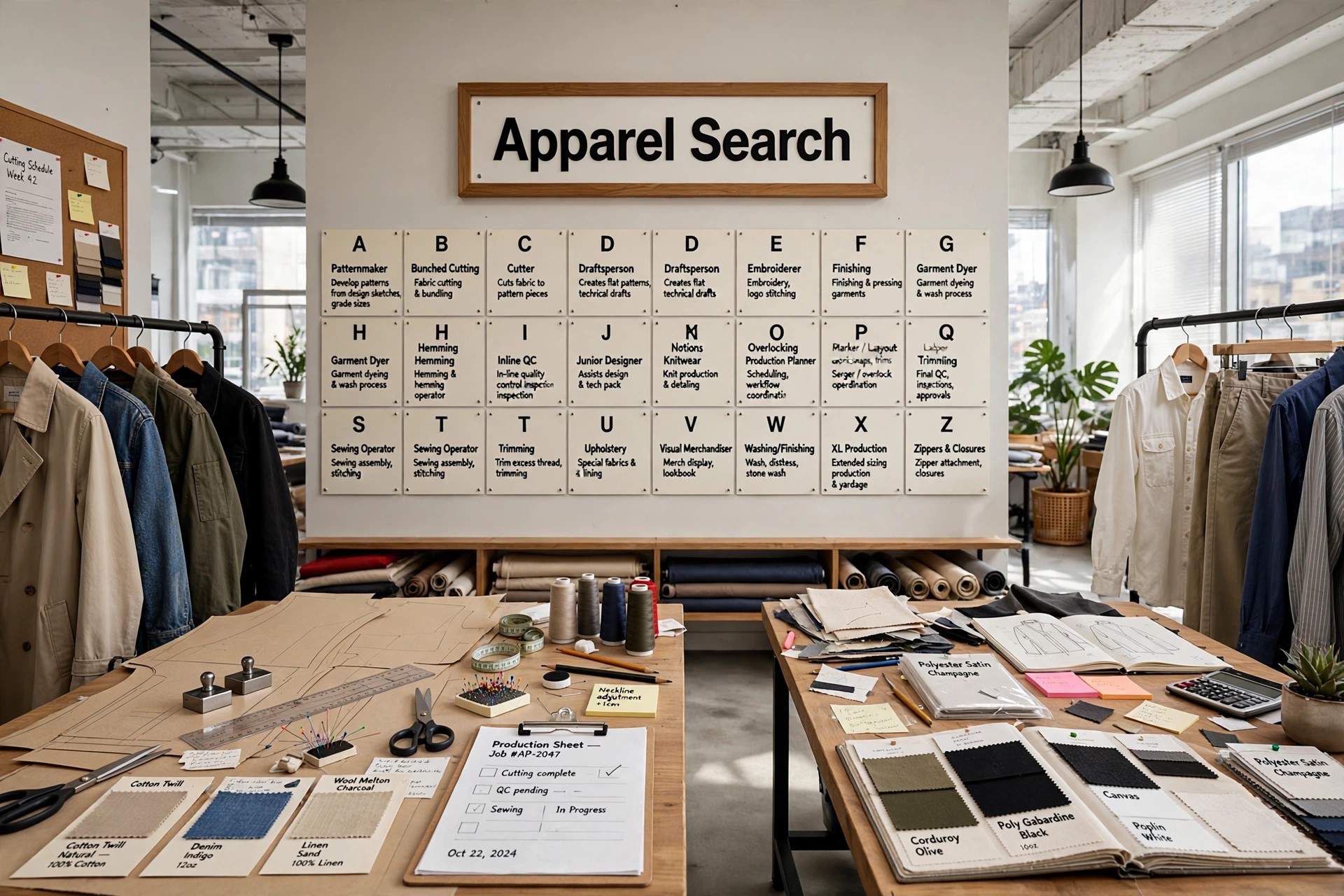
Production & Sourcing Job Descriptions — Both Pages
- Page 1 — Letters A–M (this page)
- Page 2 — Letters O–W
How This Category Is Organised
Roles are filed under the first letter of their established title, which groups real working families together. A holds the pattern, contract and management foundations — Apparel Pattern Maker, Apparel Production Manager and the alterations trio. F is the fabric family entire: cutter, developer, dyer, mill worker, printer, specialists and technician, plus the Fit Model. P, on page 2, is the largest letter of all — the production-office family of planners, coordinators, managers and supervisors. If a role you expect is missing here, it is probably filed by its work rather than its workplace: buyers sit with Buying, designers with Design, and warehouse roles with Transportation & Warehouse. The category links at the foot of this page lead to every family.
Reading the Two Pages Together
Page 1 runs from the pattern room to the factory office: the A and C letters cover pattern, colour and the contracts that place production, E and F cover embroidery and the whole fabric chain, and L and M close the page with the two lace crafts — knitting and weaving, carefully distinguished — and the manufacturing descriptions. Page 2 continues with the production office itself under P, the quality family under Q, the sourcing ladder under S from coordinator to senior vice president, and the executive tier under V. Read neighbouring descriptions before choosing a direction: the difference between a production planner, a planning supervisor and a production supervisor is the difference between three genuinely different working lives, and this category describes all three.
All Production & Sourcing Job Descriptions on This Page
Every production and sourcing role description in this half of the category, listed under the letter its title begins with, with a one-line guide to what each role does.
A — Production Roles
Alterations — Alters and repairs finished garments to fit — taking in, letting out, shortening and re-finishing clothing in workshops and stores.
Alterations Manager — Manages an alterations department: fitters and tailors, appointments, quality of alteration work and turnaround.
Alterations Specialist — Specialist in complex garment alteration — reshaping, resizing and reconstructing clothing beyond routine adjustments.
Apparel Contract Manager — Manages contracts with the factories that make a brand's clothing: terms, capacity, performance and compliance.
Apparel Manufacturing Engineer — Engineers how garments are made: methods, line layout, machine choices and production efficiency.
Apparel Pattern Maker — Creates the patterns from which garments are cut, by hand and CAD, and corrects them through fitting.
Apparel Production Manager — Manages a brand's garment production across factories: orders, schedules, quality and delivery.
Assistant Product Developer — Supports product development: samples, specifications, costing sheets and supplier communication.
C — Production Roles
CAD Pattern Cutter — Cuts and manipulates patterns digitally in CAD systems for sampling and production.
Color Chemist — Formulates and matches dye colours for fabrics, working between laboratory recipes and bulk dyeing.
Color Lab Manager — Manages the colour laboratory: lab dips, shade approvals, recipes and the colour team.
Color Specialist — Specialist in colour for apparel ranges: standards, matching and shade consistency across suppliers.
Colorist — Assesses and approves colour — lab dips and bulk shades judged by eye and instrument.
Cutting Fabric — The fabric cutting role: spreading lays and cutting pattern pieces accurately for the sewing lines.
D — Production Roles
Digitizer — Embroidery — Converts artwork into embroidery machine files: stitch types, densities and running order.
Dyehouse Manager — Manages fabric dyeing operations: machines, recipes, shade quality, water and chemical control.
E — Production Roles
Embroiderer / Embroidery — Operates embroidery machines and finishes embroidered garments and panels to standard.
Embroidery Digitizer — Digitises designs for embroidery production, testing sew-outs and refining stitch files.
Export Production Manager — Manages production for export orders from the producing side: factory orders, documents and shipment.
F — Production Roles
Fabric Cutter — Cuts fabric lays into garment pieces, by hand-guided knife or computer-controlled cutter.
Fabric Developer — Develops new fabrics with mills: constructions, finishes, performance and price for the range.
Fabric Dyer — Dyes fabric to shade and standard, running dye machines and correcting colour in bulk.
Fabric Mill Worker — Works in fabric production: weaving, knitting, dyeing and finishing mill operations.
Fabric Printer — Prints designs onto fabric, by screen or digital printing, to colour and repeat standard.
Fabric Specialists — Specialists advising on fabric selection, sourcing and performance for garment ranges.
Fabric Technician — Tests and approves fabrics technically: construction, performance, defects and specifications.
Fit Model — Models garments in fittings so technicians can judge fit, balance and movement on a standard body.
G — Production Roles
Global Sourcing — Matches products to countries and factories worldwide on cost, capacity, quality and compliance.
Grading / Grader — Scales the approved base-size pattern into every size in the range using grade rules.
I — Production Roles
Import Production Manager — Owns orders made overseas: critical path, inspections, freight, customs and delivery.
L — Production Roles
Lace Knitting Manager — Runs the warp-knitting machines, above all the Raschel, that produce knitted lace.
Lace Weaving Manager — Runs the looms weaving lace from warp and weft for bridal, lingerie and occasionwear.
M — Production Roles
Manufacturing Jobs — Apparel — The factory workforce as a whole: cutting, sewing, finishing and inspection roles and their entry routes.
Manufacturing Manager — Clothing — Manages a clothing factory's production: departments, output, workforce and delivery.
Marker Making — Lays pattern pieces into efficient cutting markers that minimise fabric waste.
Materials Consultant — Advises on materials selection, sourcing and performance for apparel products.
Common Questions
How are these production job descriptions organised?
Alphabetically by role title across two hub pages: page 1 covers letters A to M with 36 descriptions, and page 2 covers letters O to W with 42. The alphabet bar jumps to each letter section on whichever page holds it.
Are these job listings or job descriptions?
Descriptions. Each page explains what a role involves — duties, skills, qualifications, work environment and career path — so you can research a direction before searching current vacancies through the employment agencies and search engines linked below.
Which is the biggest family in production?
The P family on page 2: fifteen roles covering the production office — pattern, printing, product development, and the assistant-to-director ladder of production coordination, planning and supervision.
More Job Description Categories
- Buying Job Descriptions
- Design Job Descriptions
- Marketing & PR Job Descriptions
- Miscellaneous Job Descriptions
- Planning & Allocation Job Descriptions
- Production & Sourcing Job Descriptions (current)
- Sales & Selling Job Descriptions
- Transportation & Warehouse Job Descriptions