Grading / Grader Job Description
Turning one approved base-size pattern into the full size set — the precision discipline of pattern grading
A grader takes the pattern maker's approved base-size pattern and produces every other size the garment will be sold in. That transformation — grading — is not photocopy enlargement: a size 14 is not a size 10 scaled up, because bodies do not grow uniformly. The grader applies grade rules, point by point, moving each pattern point by the increments a brand's size system specifies — a little at the neck, more at the bust, a different amount at the hip, length added where bodies actually lengthen. Done well, every size fits its wearer the way the base size fitted the fit model. Done carelessly, the extremes of the size range quietly stop resembling the garment that was approved.
More Production Job Descriptions by Letter:
How Grading Works: Rules, Nests and Size Sets
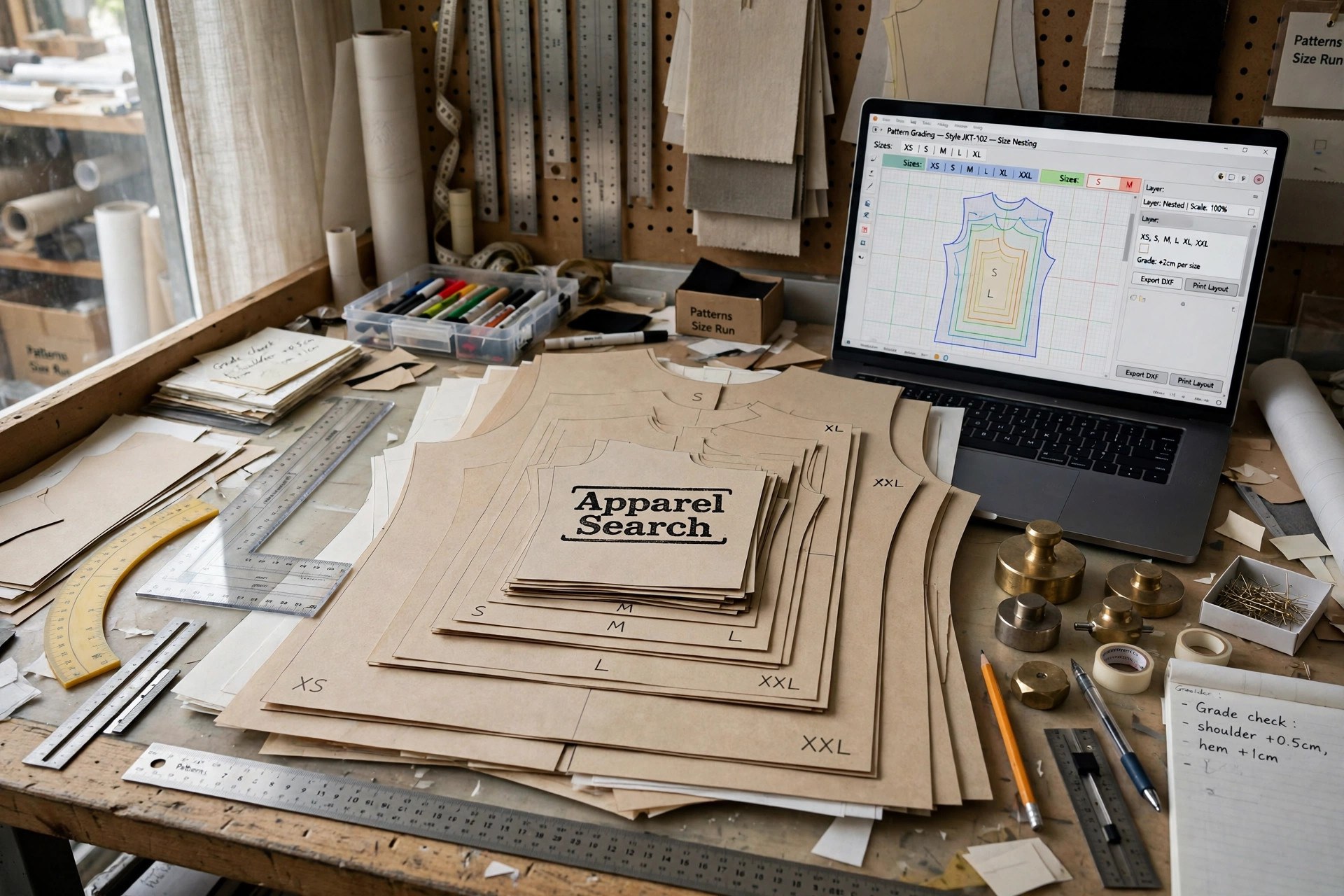
Grading starts from the base pattern, its specification and the brand's grade rules — the table of increments between sizes for each measurement point. The grader moves every point of the pattern by its ruled amounts, re-draws the curves through the new points, and checks that seams still match: a front and back side seam that walked together in the base size must still walk together in every graded size, with notches, drill holes and grain lines correctly placed on each. Armholes, necklines and collars are classic danger points, where simple increments distort shape fastest.
The graded sizes are laid over one another as a nest, so the grader can see the progression at a glance — each size stepping evenly from its neighbours, no point jumping or crowding. The nest is checked against the size specification measurements for every size, seam allowances and hem depths are confirmed, and only then is the size set released. A single wrong increment copied across a size set multiplies into thousands of garments, which is why grading carries a checker culture closer to engineering than to dressmaking.
Fit integrity across the range is the grader's quiet responsibility. The base size was fitted and approved on a fit model; sizes far from the base are fitted less often, sometimes only as a checked measurement set. A conscientious grader flags sizes where the rules produce a suspicious shape — a neckline growing faster than the shoulder that carries it — and asks for a fit check in that size rather than releasing on arithmetic alone. Brands learn, usually from returns data, that the sizes at the ends of the range deserve the same fitting respect as the base.
Tools: Hand Grading and CAD
Traditional grading is done on the table with grading rulers, set squares and the pattern notcher, the grader shifting the base pattern by the ruled increments and tracing each size — a method still used in small workrooms and tailoring, and still the best way to learn what grading actually does. Most production grading today is done in CAD pattern systems, where grade rules are stored as libraries and applied across a pattern digitally: faster, exactly repeatable, and able to re-grade instantly when a base pattern is corrected — provided the rules were built correctly in the first place.
Graded patterns feed directly into marker making and cutting, so the grader's output must arrive production-ready: every piece present for every size, named and coded consistently, with fabric grain, fold lines and pairing correct. Graders who understand markers and cutting catch problems the factory would otherwise discover with the cloth already spread — a mirrored piece missing, a size set incomplete — when fixing them is slowest.
Skills and Abilities the Work Requires
Precision is the defining skill: grading is applied arithmetic, repeated hundreds of times without drift, checked as methodically as it is performed. Pattern knowledge underpins it — a grader must understand how a pattern achieves fit to know which points may move by rule and which need judgment, because collars, cups and crotch curves resist pure arithmetic. Concentration over long, similar tasks, and the humility to re-check a size set one more time, are working requirements rather than virtues.
In CAD environments, system fluency joins the list — building and maintaining grade-rule libraries, managing pattern files and versions — along with clear communication with pattern makers about what the base pattern implies for grading, and with factories about what has been released. Experienced graders are often consulted before a base pattern is finalised, because a small pattern decision can make the size extremes grade beautifully or badly.
Training, Qualifications and Career Path
Graders usually come from pattern making: a garment technology or pattern-cutting course, followed by workroom experience, teaches the pattern knowledge grading stands on, and many pattern makers grade their own patterns in smaller companies. Dedicated grading roles in larger manufacturers and brands are learned alongside a senior grader, size set by size set, with CAD system training provided by the employer or the software vendor.
Career paths lead to senior grader and grading-room leadership, back toward pattern making with an unusually strong size-range perspective, or into CAD and technical management, where grade-rule libraries and size specifications for a whole brand are the responsibility. Freelance graders serve many small brands from a single workstation — a well-established pattern, since grading is project-shaped work that arrives in bursts a small label cannot staff for permanently.
Common Questions
What is the difference between a grader and a pattern maker?
The pattern maker creates the pattern for the base size and perfects its fit. The grader derives every other size from that approved pattern by applying grade rules. In small workrooms one person does both; in larger operations they are separate specialists who check each other's work.
Why can't a pattern just be scaled up proportionally?
Because bodies do not grow proportionally between sizes. Bust, waist, hip, shoulder, neck and lengths each change by different amounts, and some points barely change at all. Uniform scaling would distort necklines, armholes and balance — grading exists precisely to apply the right increment to each point.
What is a grade rule?
The specified amount a pattern point moves between one size and the next — for example the bust point moving a set distance across and down per size. A brand's grade rules embody its size system and fit philosophy, and graders apply, maintain and sometimes help develop them.
More to Explore
Sizing & Pattern References
References & Further Reading
More Job Description Categories
- Buying Job Descriptions
- Design Job Descriptions
- Marketing & PR Job Descriptions
- Miscellaneous Job Descriptions
- Planning & Allocation Job Descriptions
- Production & Sourcing Job Descriptions (current)
- Sales & Selling Job Descriptions
- Transportation & Warehouse Job Descriptions