Apparel Manufacturing Engineer Job Description
Engineering how garments are made — methods, line layout, time standards and factory efficiency
A garment factory turns design and cloth into thousands of finished garments through hundreds of small operations, and the apparel manufacturing engineer is the person who designs that process. Where the production manager runs output day to day, the manufacturing engineer decides how the work should be done at all: breaking a garment into its operations, choosing methods and machines for each, laying out the sewing line, setting the standard time every operation should take, and finding the improvements that raise output and quality without simply demanding more effort. It is industrial engineering applied to soft goods — part analyst, part inventor, part teacher — and it is where a factory's cost per garment is really decided.
More Production Job Descriptions by Letter:
Method Engineering and Operation Breakdowns
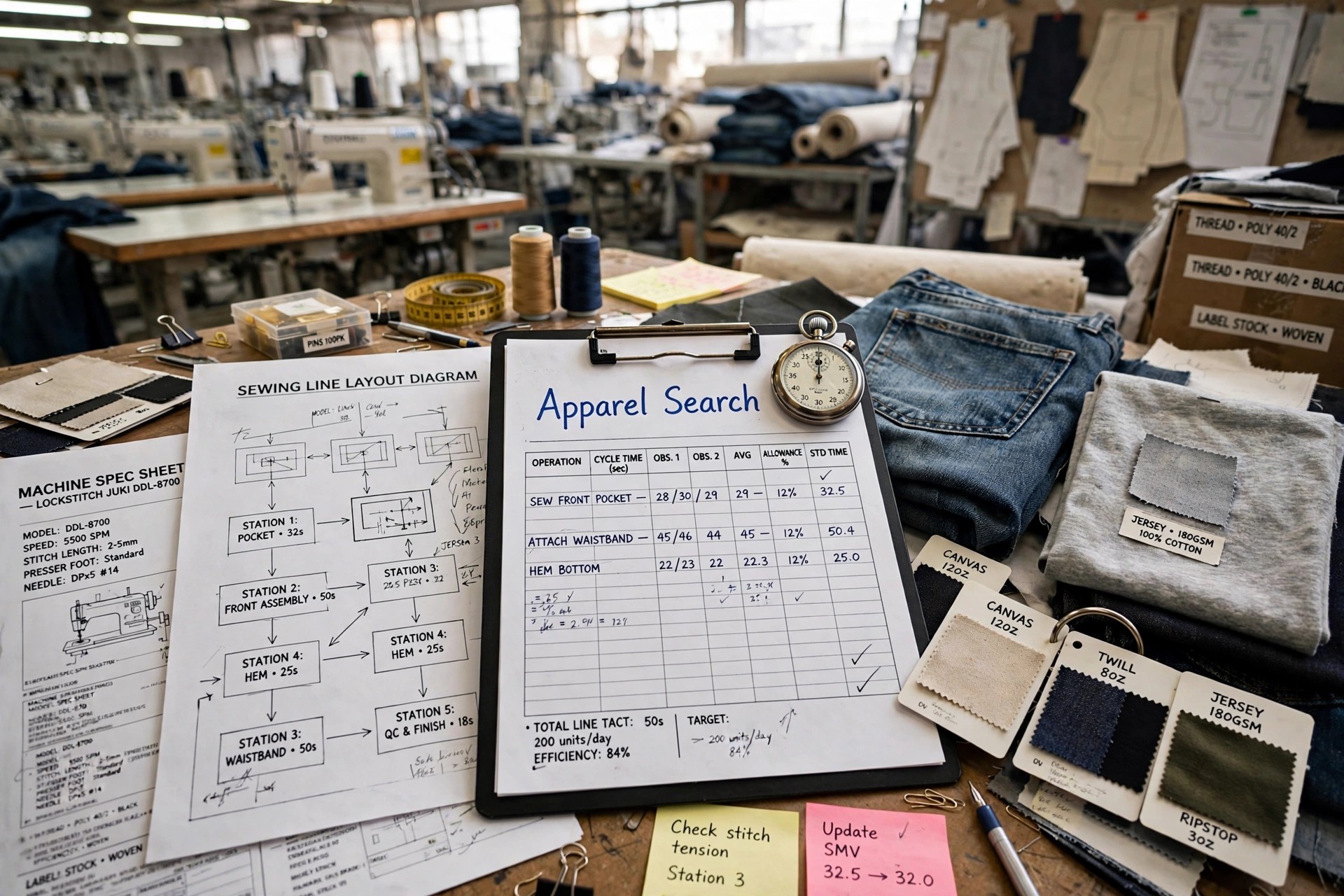
Every new style begins for the engineer as a question: what is the best way to make this? The engineer studies the garment — its pattern, construction and quality requirements — and breaks its manufacture into an ordered list of operations, from cutting and preparation through sewing, finishing and pressing. For each operation the method is specified: the machine and attachments to use, the folder or guide that will speed the work, the handling sequence that avoids wasted motion, and the standard minute value the operation should take when performed by a trained operator at a normal pace. That breakdown, costed and totalled, becomes the garment's production standard — the basis for line planning, piece rates and the price negotiations that follow.
Method work is inventive in practical ways. A different seam sequence removes a handling step; a simple work aid — a template, a guide, a jig made in the factory's own workshop — turns a fiddly operation into a fast one; a changed bundle size smooths the flow between sections. The engineer trials methods on sample lines before committing them to bulk production, times them honestly, and writes them down in the operation bulletins and layout documents that supervisors and trainers then work from. A method that exists only in the engineer's head is not yet engineering.
Line Layout, Balancing and Time Standards
With operations defined, the engineer designs the line that will perform them. Operators and machines are arranged so work flows in sequence with minimal transport; the output target sets the rhythm, and the engineer balances the line — distributing operations so each station's workload matches that rhythm and no operator becomes the bottleneck while others wait. Balancing a sewing line is a living calculation, redone as styles change, operators develop and absences bite, and the engineer monitors efficiency data to find where the line is losing time: a starved station, a quality problem generating rework, a bundle system creating queues in the wrong place.
Time standards underpin the factory's economics. Through time study and predetermined motion-time systems, the engineer sets the standard allowed minutes for operations and garments — numbers used for costing, capacity planning, delivery promises and operator earnings schemes. Their credibility matters in every direction: standards set too tight destroy morale and quality, too loose destroy competitiveness, and both errors are visible within weeks. Good engineers defend their standards with data, revise them when methods genuinely change, and treat the stopwatch as an instrument for improving the system rather than policing the worker.
Quality, Improvement and New Style Introduction
Efficiency that produces defects is not efficiency, and the engineer works where the two meet. Recurring quality faults are analysed as process problems first: is the method causing the skipped stitches, the puckered seam, the misaligned pocket — and would a guide, a machine adjustment or a re-sequenced operation remove the cause rather than inspect out the result? The engineer partners with quality teams on these fixes and with maintenance on machine capability, and leads the improvement projects — layout changes, new equipment justification, workflow redesign — that step a factory's productivity forward rather than letting it drift.
New style introduction is the engineer's recurring deadline. When a new garment enters the factory, the engineer prepares its operation breakdown, layout, line balancing and training needs before bulk production begins, runs or supervises the pilot line, and resolves the method problems the first real garments expose. In multi-style factories this cycle repeats constantly, and the engineer's preparation is the difference between a style that ramps smoothly to target output and one that consumes a week of the line's capacity in confusion.
Skills, Qualifications and Career Path
The discipline blends garment knowledge with engineering method. Employers typically seek a degree or diploma in industrial engineering, garment or textile technology, or manufacturing engineering, or long factory experience grown into the role from production supervision and work study. Essential knowledge runs in both directions: sewing machinery, garment construction and fabrics on one side; time study, line balancing, workplace layout and data analysis on the other. The engineer must also be a communicator — methods succeed only when supervisors and operators adopt them, and the engineer who explains, demonstrates and listens on the factory floor gets improvements the memo-writer does not.
Career paths lead to senior or chief engineer roles across multi-line factories, plant and production management, technical management of supplier factories for brands and sourcing organisations — where the same skills audit and improve contractors' methods — and consultancy in garment production engineering. As the industry automates selectively and reshoring revives interest in efficient local production, engineers who can make a line genuinely productive are increasingly valuable. It is the role for people who love both how garments are made and how systems can be made better.
Common Questions
What does an apparel manufacturing engineer do?
Designs how garments are manufactured: breaking styles into operations, specifying methods and machines, laying out and balancing sewing lines, setting standard times through work study, and improving efficiency and quality across the factory.
How is this different from a production manager?
Direction of attention. The production manager runs today's output with the people and lines available. The manufacturing engineer designs and improves the system itself — methods, layouts, standards — that the production manager then runs.
What qualifications do apparel manufacturing engineers need?
Typically a degree or diploma in industrial, manufacturing or garment technology engineering, or equivalent factory experience from supervision and work study. Employers require both garment construction knowledge and engineering method: time study, line balancing and layout.
More to Explore
References & Further Reading
More Job Description Categories
- Buying Job Descriptions
- Design Job Descriptions
- Marketing & PR Job Descriptions
- Miscellaneous Job Descriptions
- Planning & Allocation Job Descriptions
- Production & Sourcing Job Descriptions (current)
- Sales & Selling Job Descriptions
- Transportation & Warehouse Job Descriptions