Embroiderer Job Description
Running embroidery machines and sewing by hand — hooping, stitching and finishing decorated garments
An embroiderer is the person who actually sews the decoration: the logos on uniforms, the crests on blazers, the monograms on towels and the ornate stitching that turns a plain garment into a branded or treasured one. Most embroiderers today operate computerised machines — from a single head in a small shop to multi-head lines in a factory — while others practise hand embroidery for couture, restoration and bespoke work. In both cases the craft is the same at heart: fabric held correctly, thread behaving as it should, and a design emerging stitch by stitch exactly where it was meant to be.
More Production Job Descriptions by Letter:
Setting Up and Running the Machines
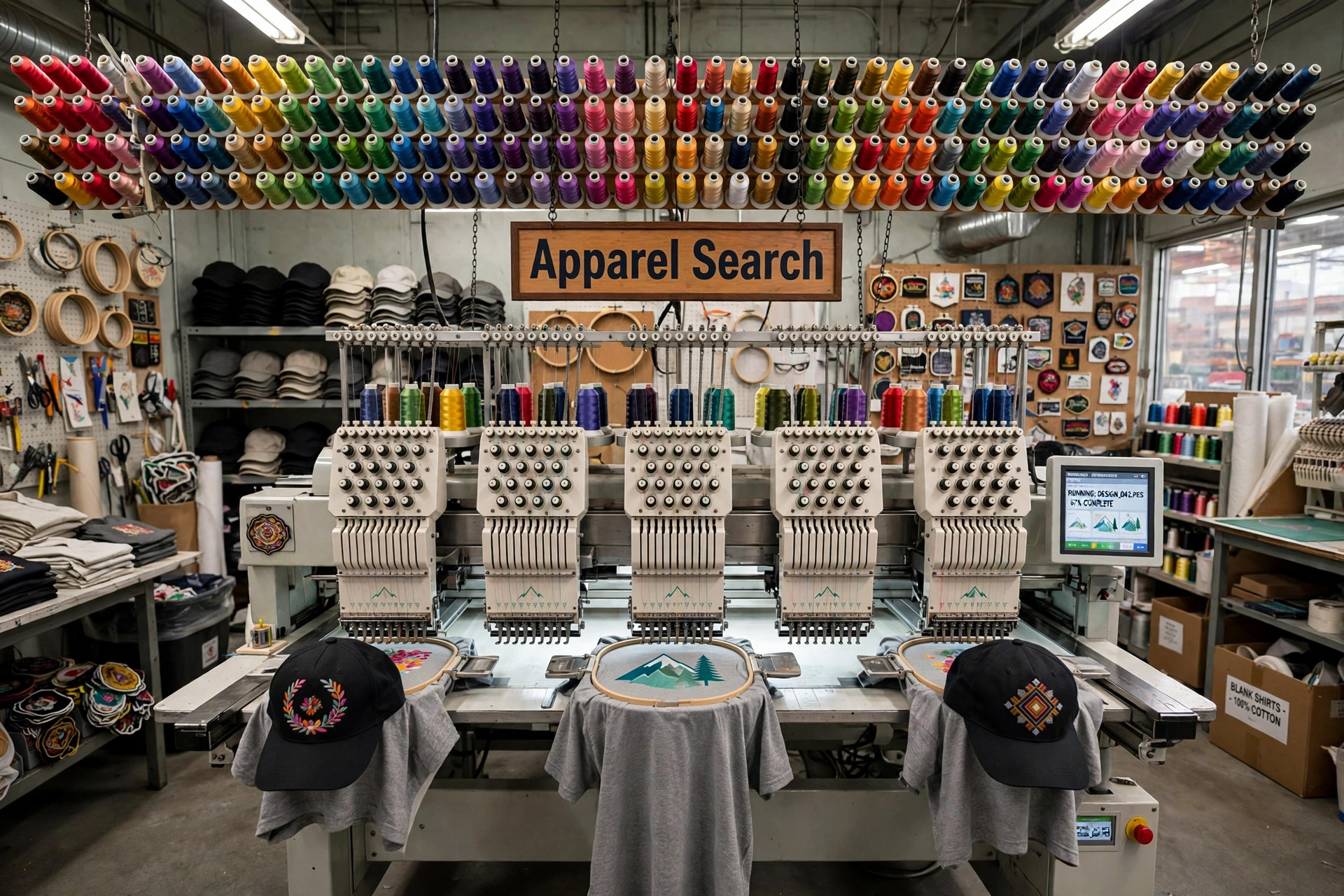
A production embroiderer’s day runs on a sequence of jobs, each arriving as a design file, a garment type and a placement instruction. The embroiderer loads the design, checks its size and stitch count, sets the thread colours in the order the machine will call for them, and programmes any stops for colour changes or appliqué placement. On a multi-head machine, one setup sews many garments at once, which multiplies both the output and the cost of a mistake — a wrong colour sequence repeated across twelve heads is twelve garments to unpick or discard.
While the machine runs, the embroiderer watches and listens. Thread breaks, bobbin run-outs, needle damage and fabric shifting in the hoop all announce themselves in the sound and look of the stitching, and a good operator catches them within a few stitches rather than at the end of the run. Finished pieces are checked against the sample: registration between colours, clean edges, no loops or gaps, and placement measured against the garment’s agreed position, because a perfect design sewn two centimetres off-centre is still a reject.
Hooping, Stabilizers and Materials
Hooping is the embroiderer’s foundational skill. The garment must sit in the hoop — or on the frame or cap driver — flat, square and at the right tension: too loose and the design puckers and drifts, too tight and hoop marks or distortion follow. Behind the fabric goes the stabilizer, chosen for the material: cut-away for knits that need lasting support, tear-away for stable wovens, water-soluble toppings to keep stitches from sinking into fleece and towelling. Choosing wrongly is the most common cause of poor results, and it is a choice the embroiderer, not the machine, makes.
Thread and needle knowledge completes the materials craft. Rayon and polyester threads behave differently in sheen and strength; metallics demand slower speeds and the right needle eye; bobbin tension decides whether the underside is tidy or a bird’s nest waiting to jam. The embroiderer keeps needles fresh, machines cleaned of lint and oiled on schedule, and thread stock organised so a repeat order next month matches this month’s colours exactly.
Hand Embroidery and Finishing Work
Hand embroidery survives wherever machines cannot go or the work itself is the luxury: couture embellishment, ecclesiastical and ceremonial pieces, restoration of antique textiles, and bespoke monogramming. The hand embroiderer works with frame, needle and a vocabulary of stitches — chain, satin, stem, French knots, couching — building surfaces that can take days. Production embroiderers borrow from the same tradition whenever a machine piece needs hand correction or a sample must be matched by eye.
Machine work ends with hand work regardless: trimming jump threads, removing stabilizer, steaming away marks, checking the reverse side and folding or bagging the finished garments. In many shops the embroiderer owns the piece from hoop to handover, so finishing standards — no stray tails, no scorch from the iron, no stabilizer corners poking out — are part of the job description, not an afterthought left to someone else.
Skills, Training and Career Path
Embroidery rewards patience, sharp eyesight and a feel for textiles. The embroiderer must judge tension by touch, colour by eye under workshop light, and placement with a ruler’s precision, while keeping a machine-paced rhythm across a shift. Basic computer confidence is now essential — loading files, using the machine’s controller, recording counts — and so is honest quality judgment: the willingness to stop a run that is going wrong rather than sew a whole batch badly.
Most embroiderers are trained in the shop, starting on hooping, trimming and single-head work before taking on multi-head production and difficult garments such as caps and jackets; textile and fashion courses can add design and materials grounding. Progress leads to senior embroiderer, sample and specialist work, digitizing — the file-making craft described on the Digitizer pages — or supervision of an embroidery department. Skilled embroiderers also build independent studios serving teams, businesses and brides from their own order books.
Common Questions
What does an embroiderer do day to day?
Sets up embroidery machines with the right design, threads and needles; hoops garments with suitable stabilizer; runs and monitors the stitching; then trims, removes stabilizer, checks quality and finishes each piece for delivery.
What is the difference between an embroiderer and a digitizer?
The digitizer creates the stitch file that tells the machine what to sew; the embroiderer operates the machine and produces the physical embroidery. Many small shops combine both roles in one person.
How do you become an embroiderer?
Usually by training in an embroidery shop or workroom, beginning with hooping and finishing and progressing to machine operation. Employers value careful hands, colour judgment and a portfolio of clean stitched work.
More to Explore
Embroidery Resources
- Embroidery Guide
- Embroidery Machines
- Embroidery Thread
- Embroidery Software
- Embroidery Terms
- Embroidery Design Services
- Embroidery Associations
- Interlining
- Embroidery Backcloth
- Embroidery Stabilizers
- Patches
- Heat Transfer
- Embroidery Hooping Equipment
- Embroidery Frames
- Embroidery Supply Holders
- Embroidery Magazines
References & Further Reading
More Job Description Categories
- Buying Job Descriptions
- Design Job Descriptions
- Marketing & PR Job Descriptions
- Miscellaneous Job Descriptions
- Planning & Allocation Job Descriptions
- Production & Sourcing Job Descriptions (current)
- Sales & Selling Job Descriptions
- Transportation & Warehouse Job Descriptions