Export Production Manager Job Description
Coordinating garment production for export — factories, critical paths, documentation and delivery
An export production manager makes clothing in one country arrive, correct and on time, in another. Working for a brand, importer or sourcing company, they place production orders with overseas factories, then steer each order through its critical path — samples approved, fabric and trims booked, production started, quality inspected, goods packed, shipped and documented — across time zones, languages and public holidays. The role exists because distance multiplies every small problem: a misunderstood comment or a missed vessel sailing costs weeks, so the export production manager’s craft is anticipation, communication and a calendar that never lies.
More Production Job Descriptions by Letter:
Placing Orders and Managing the Critical Path
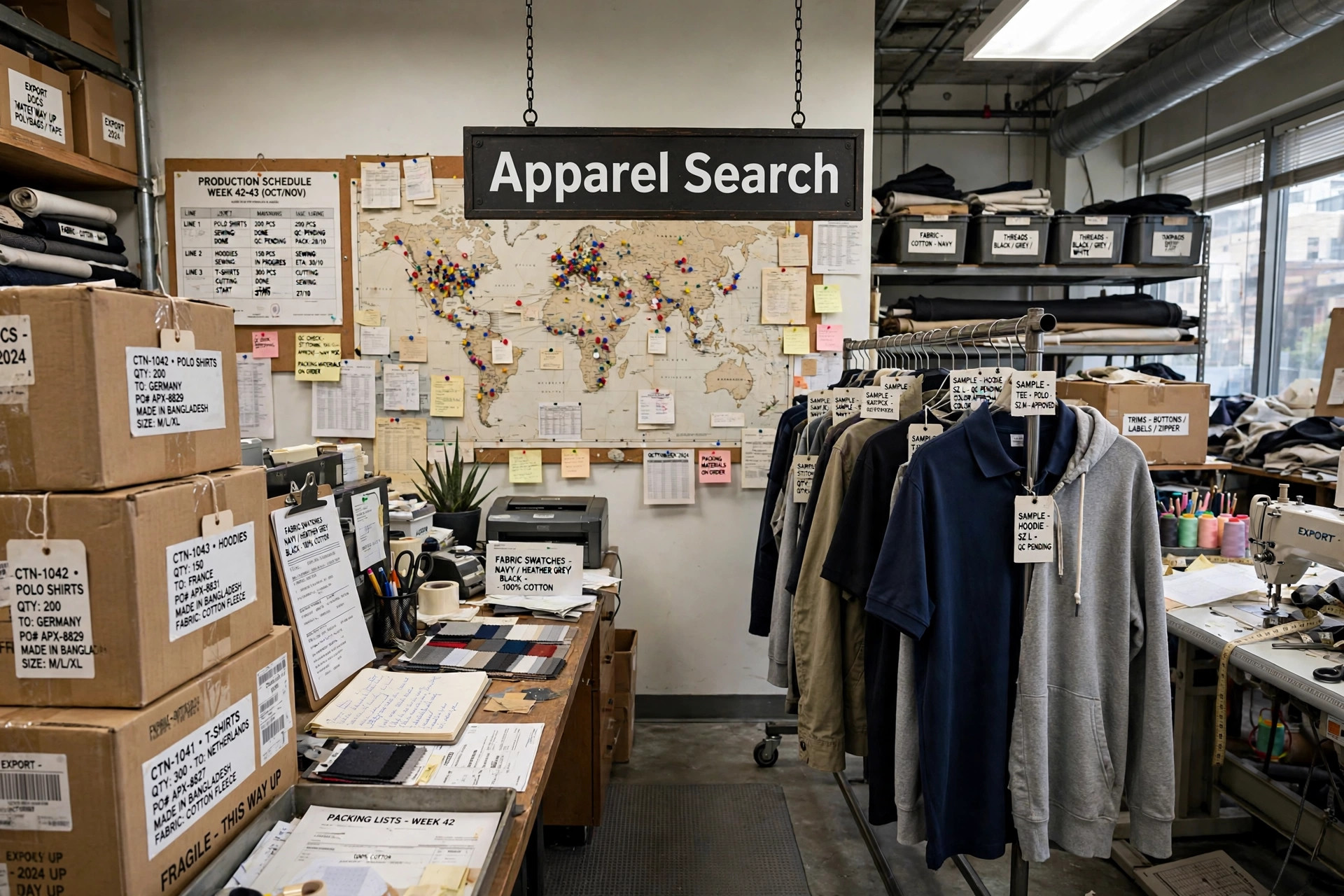
The work begins with the order itself: styles, quantities, size ratios, prices and delivery dates agreed with the factory, recorded in a purchase order and a critical path — the dated chain of milestones from proto sample to ex-factory date. The manager issues tech packs and approved samples as the factory’s instructions, confirms fabric and trim bookings so materials are on the floor before the cut date, and tracks every milestone against the plan, chasing early and in writing, because a slippage found at week two can be recovered and one found at week eight usually cannot.
Samples punctuate the path: pre-production samples confirm the factory has understood the garment, size sets check grading, and production samples prove the bulk matches the approval. The export production manager evaluates them with the technical team, sends clear, consolidated comments — never a drip of contradictions from five inboxes — and holds the line that bulk production does not start until the pre-production sample is approved, since factories that cut early own the risk of every change that follows.
Quality, Compliance and the Factory Relationship
Quality is managed before it is inspected. The manager agrees the inspection standard with the factory, arranges in-line and final inspections — by the company’s own quality controllers or a third-party agency — and reads reports with an eye for patterns: the same measurement drifting across styles points to a pattern or training problem at the factory, not a string of accidents. Defects found at final inspection are weighed against the shipment date honestly; air-freighting a corrected order is expensive, but receiving unsellable goods is worse.
Compliance sits alongside quality: factory audits and social and safety standards, product safety and labelling rules for the destination market, and restricted-substance requirements for fabrics and trims. The export production manager keeps certificates and test reports on file per order, because goods can be stopped at the border for paperwork as surely as for faults. All of this works best as a relationship rather than a raid — factories that are planned with, paid on time and given honest forecasts save their best capacity for the customers who treat production as a partnership.
Documentation, Shipping and Delivery
Export production ends in paper and freight. The manager confirms packing lists and carton markings, books freight with the forwarder, and checks the export documents — commercial invoice, packing list, bill of lading, certificates of origin and any preference or quota paperwork the destination requires — line by line against the order. A wrong carton count or a misspelled consignee is not a trivial error at a port; it is days of delay and charges while goods sit on a quay.
The shipping decision itself is a managed trade-off: sea freight for cost, air freight for recovery, or a split shipment that puts part of the order on shelves for a launch date. The manager tracks vessels and flights, warns the warehouse and sales teams of changes before they ask, and closes the order with a review — what the factory did well, what slipped, and what the next order’s critical path should change. That record is how sourcing improves season over season instead of repeating its surprises.
Skills, Training and Career Path
The role combines garment knowledge with project management and negotiation. The manager must read a tech pack and a measurement chart as confidently as a spreadsheet, understand fabric lead times, minimums and costing well enough to argue a price or a schedule credibly, and write instructions that survive translation — plain, numbered, illustrated. Cultural fluency and patience across time zones are working tools: much of the job is early-morning and late-evening calls handled with good humour and exact notes.
Most export production managers grow from production coordination, garment technology, merchandising or import roles, learning factories style by style; business, textiles or supply-chain study supports the climb, and languages are a genuine asset. Senior paths lead to head of production or sourcing roles, country management, or specialisation in a product category or region. It is one of fashion’s most internationally mobile careers — the skills travel wherever clothing is made for export.
Common Questions
What does an export production manager do?
Manages garment orders placed with overseas factories from purchase order to shipment: critical-path tracking, sample approvals, fabric and trim bookings, quality inspections, compliance files, export documentation and freight, so goods arrive correct and on time.
What is a critical path in export production?
The dated sequence of milestones an order must hit — samples, material bookings, cutting, sewing, inspection, packing and the ex-factory date. The export production manager tracks every date and acts on slippage while it can still be recovered.
How do you become an export production manager?
Usually by progressing from production coordinator, garment technologist or merchandiser roles in an importing or sourcing business. Employers look for garment construction knowledge, costing and lead-time fluency, and meticulous written communication.
More to Explore
References & Further Reading
More Job Description Categories
- Buying Job Descriptions
- Design Job Descriptions
- Marketing & PR Job Descriptions
- Miscellaneous Job Descriptions
- Planning & Allocation Job Descriptions
- Production & Sourcing Job Descriptions (current)
- Sales & Selling Job Descriptions
- Transportation & Warehouse Job Descriptions