Marker Making Job Description
Planning how pattern pieces nest on the cloth — the marker maker’s work decides how much fabric every garment consumes
Marker making is the planning step between pattern and cutting. A marker is the full-scale plan that shows exactly how every pattern piece of a garment — every size in the cutting order — fits onto the fabric at its actual width. The marker maker’s skill is measured in centimetres: a tight, correct marker can save several percent of the fabric on an order, and fabric is the most expensive part of a garment, so this quiet desk-and-table job carries an outsized share of the factory’s profit.
More Production Job Descriptions by Letter:
What a Marker Is and How It Is Made
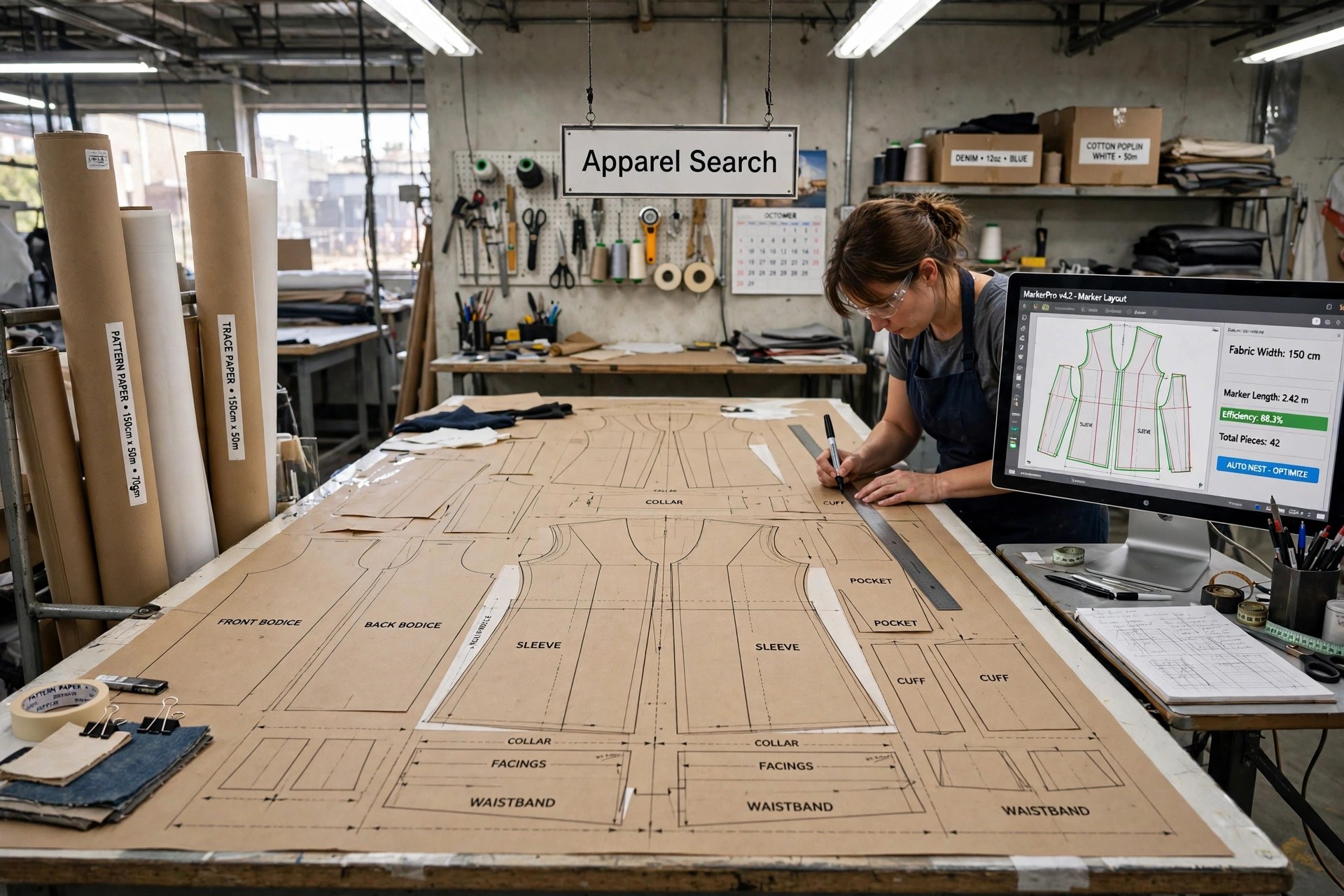
The marker maker starts from the cutting order: the style, the sizes and the ratio of pieces to be cut, the fabric and its usable width. Every pattern piece must appear the right number of times, on the correct grain, with matched pairs where the garment needs them. Pieces are nested like a jigsaw — a sleeve tucked into the curve of a body panel, small parts filling the gaps between large ones — while respecting the rules that keep garments hanging correctly: grain lines parallel to the marker edge, one-way nap or print direction where the cloth demands it, and matching points aligned for checks and stripes.
Traditionally markers were planned by hand, moving miniature or full-size pattern templates on paper at the fabric’s width and tracing the best arrangement. Most production markers today are made in CAD marker software, where pieces are placed on screen, efficiency is calculated instantly, and the finished marker is plotted full-size on paper or sent directly to an automatic cutter. The judgement is the same in both methods: the software can measure a marker, but the maker decides the compromises between efficiency, grain discipline and matching that a machine cannot weigh.
Efficiency, Fabric Behaviour and Costing
Marker efficiency — the share of the marker’s area covered by pattern pieces rather than waste — is the number the whole factory watches. The maker pursues it honestly: squeezing pieces closer is worthless if grain slips, if a notched piece is mirrored wrongly, or if the cutting room cannot separate the parts cleanly. Fabric behaviour shapes every decision. Shrinkage allowances must be built in for cloth that relaxes or contracts, pile fabrics force one-way layouts that cost length, and border prints or engineered placements fix pieces to exact positions regardless of waste.
The marker also sets the garment’s official fabric consumption — the length of cloth each garment is charged with — which flows straight into costing and fabric purchasing. A maker who re-plans a marker when the delivered fabric arrives narrower than ordered, or who finds a better size ratio split across two markers, saves real money on bulk orders. Makers therefore work closely with pattern makers on piece shapes that nest well, with the cutting room on what can actually be cut, and with merchandisers who cost styles from the marker before an order is confirmed.
Accuracy, Checking and the Cutting Room
A marker error multiplies: it is cut into every ply of the lay and sewn into every garment. Before release, the maker checks piece counts against the order, size labelling, drill and notch marks, seam allowances, and that no piece overlaps, hangs off the cloth edge or breaks a matching line. Plotted markers are measured for length and spot-checked against the screen version, because a plotting scale error ruins a lay as surely as a planning error.
The cutting room is the maker’s customer. Makers learn how spreaders and cutters actually work — how a lay is squared, where knife access matters, why pieces grouped by size and bundle help the sewing room — and adjust markers to the factory’s tables, lay lengths and cutting equipment. When a style is re-cut, shortened or re-ratioed mid-order, the maker turns the revision around quickly and versions it clearly, so no department ever cuts from a superseded marker.
Skills, Training and Career Path
Marker makers need strong spatial sense, patience, numeracy and an unusually careful eye; the work suits people who enjoy exact, absorbing planning. Most train inside cutting rooms and pattern departments, learning pattern construction first — a maker who understands why pieces are shaped as they are nests them better — and then the factory’s CAD marker system, usually through employer training and software courses. Qualifications in apparel production, pattern technology or clothing manufacture support entry, and a portfolio of efficient, trouble-free production markers is the real credential.
The role is based in the cutting room or a CAD office beside it, working to cutting schedules with peaks when orders land together. Experienced makers become senior marker makers owning the difficult fabrics and key accounts, cutting room managers, or pattern and CAD specialists; others move into costing and merchandising, where first-hand knowledge of consumption is prized, or into technical roles with the software and cutting-equipment companies that serve the industry.
Common Questions
What is a marker in garment production?
The full-scale plan for cutting: every pattern piece for the sizes in the cutting order, arranged on the fabric at its real width so the lay can be cut in one pass. The marker fixes how much fabric each garment consumes.
How is marker efficiency measured?
As the percentage of the marker’s area covered by pattern pieces rather than waste between them. Higher is better only when grain, nap, matching and cutting practicality stay correct — a tight marker that breaks those rules costs more than it saves.
Is marker making done by hand or computer?
Both. Production markers are now usually planned in CAD marker software and plotted or sent to automatic cutters, while hand planning on paper is still used for samples, small runs and training. The nesting judgement is identical; only the tools differ.
More to Explore
Marker Making and Pattern Resources
Definitions for Marker Makers
References & Further Reading
More Job Description Categories
- Buying Job Descriptions
- Design Job Descriptions
- Marketing & PR Job Descriptions
- Miscellaneous Job Descriptions
- Planning & Allocation Job Descriptions
- Production & Sourcing Job Descriptions (current)
- Sales & Selling Job Descriptions
- Transportation & Warehouse Job Descriptions