Assistant Product Developer Job Description
The entry-level engine room of product development — samples, data and deadlines
Product development is where a design becomes a product that can be costed, sampled, approved and manufactured, and the assistant product developer is the person who keeps that machinery moving day to day. Working under a product developer or development manager, the assistant tracks samples as they arrive from factories, updates the documents those samples are judged against, organises fabrics and trims, chases suppliers for information and makes sure nothing in the development calendar quietly stalls. It is one of the most common first jobs in the production side of fashion, and one of the best educations in how the industry really works.
More Production Job Descriptions by Letter:
Tracking Samples From Request to Approval
Sample management fills much of the assistant's week. They log every proto, fit sample, pre-production sample and salesman sample as it arrives, check it against its request, hang and label it for review meetings, record the comments made about it, and send corrections and updated requests back to the factory. Between rounds they measure samples against specification sheets, note where a garment misses its measurements or its approved fabric and trim, and flag discrepancies for the developer rather than letting them pass silently into the next round.
Because several styles, colours and sample rounds are always moving at once, the assistant's real product is order: a sample room and a tracking system where any garment, comment or approval can be found in moments. Developers and designers depend on that order in fittings and range reviews, and factories depend on receiving one clear, complete set of instructions after each review instead of a stream of fragments.
Tech Packs, Data and Supplier Communication
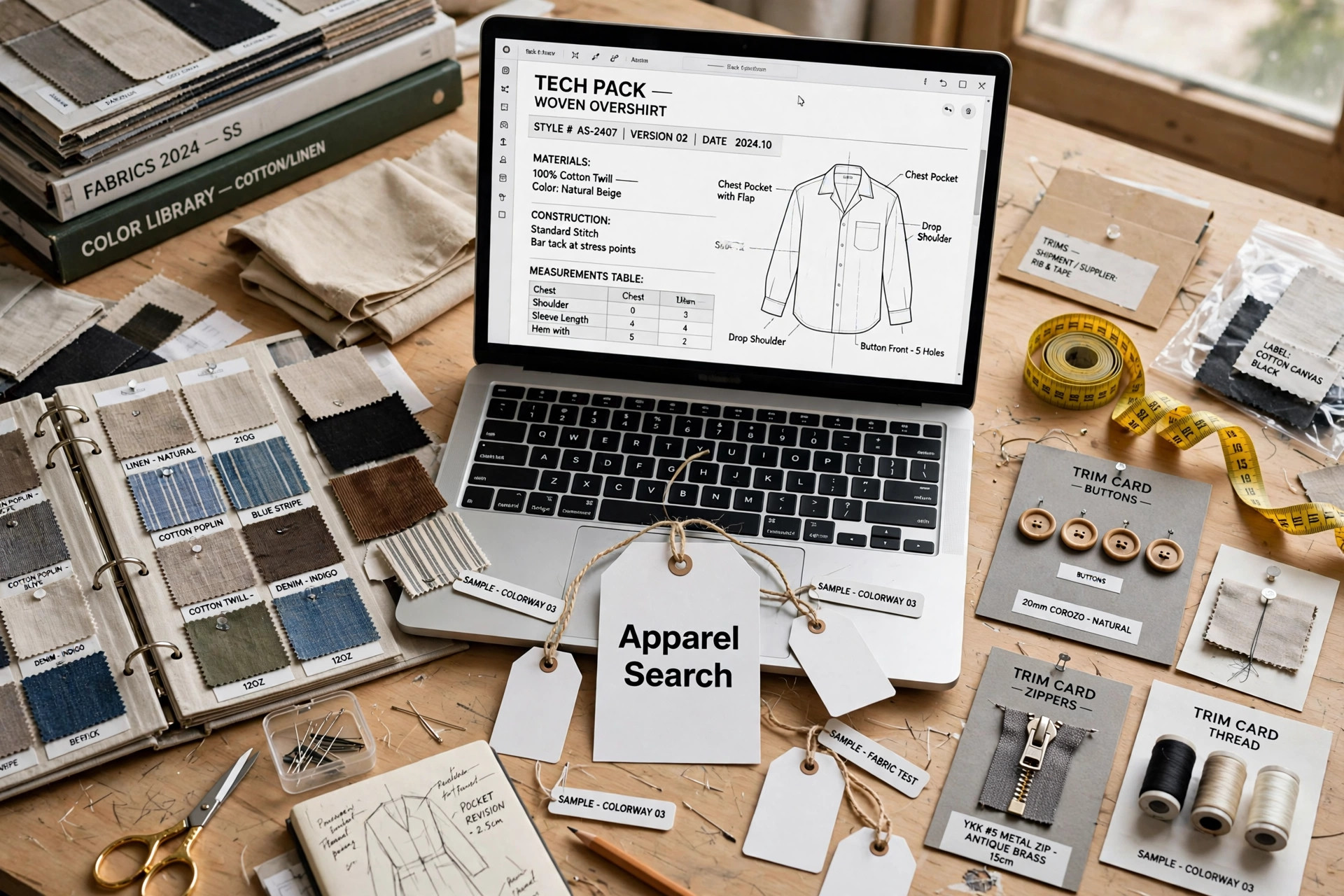
The assistant maintains the documents production runs on. Tech packs and bills of materials are updated after every fitting and approval — measurements amended, fabric and trim codes corrected, colourways added or dropped — in the company's product lifecycle system and spreadsheets. Costings are entered and re-checked as quotations arrive, fabric and trim libraries are kept current, and swatches, lab dips and strike-offs are filed against the styles they belong to so approvals can be traced later.
Communication is the other half of the desk. The assistant emails factories and mills daily — chasing a missing lab dip, confirming a sample ship date, asking for a revised consumption figure — politely, precisely and in writing, often across time zones. They learn early that a vague question earns a vague answer days later, so specifications, dates and quantities are stated plainly, and every promise received is logged against the development calendar and followed up when it slips.
Skills and Qualities Employers Look For
Accuracy with data is the headline skill: style numbers, measurements, colour codes and costs must be entered right, every time, because errors made at assistant level reappear expensively in bulk production. Close behind come organisation, spreadsheet and systems confidence, and a working knowledge of garments — fabrics, construction, components and how a sample differs from a sketch — that lets the assistant spot a wrong trim or an impossible measurement instead of merely recording it.
The role suits people who enjoy the making side of fashion more than the spotlight side. Assistants sit in fittings, handle real garments all day and see exactly how design decisions affect cost and manufacturability. Employers usually ask for a fashion, textiles or garment technology qualification, or equivalent experience from retail, sample rooms or administration in a supplier business, plus evidence of methodical work — the interview often includes a practical exercise in organising information or checking a document.
Career Path From the Assistant Desk
The assistant product developer role is deliberately a training ground. With a few seasons of ranges behind them, assistants are promoted to product developer, owning styles through development themselves, and from there to senior developer or development manager roles carrying whole categories. The same grounding also feeds neighbouring careers: production management, where the tracking and factory skills transfer directly, technical and garment technology roles for those drawn to fit and construction, or merchandising for those who prefer the commercial numbers.
Work settings include brand and retailer head offices, importers and suppliers developing product for several retail customers at once. Supplier-side roles develop range after range for different buyers and can build experience unusually fast. Whichever the setting, the assistants who progress fastest are those who treat every sample and spreadsheet as the business education it is, learning why decisions are made rather than only recording that they were.
Common Questions
What does an assistant product developer do?
Supports the product development team by tracking garment samples through every round, updating tech packs, bills of materials and costings, organising fabrics and trims, and communicating daily with factories and mills so the development calendar keeps moving.
Is assistant product developer an entry-level job?
Yes — it is one of the standard first jobs on the production side of fashion. Employers typically look for a fashion or textiles qualification or relevant experience, strong spreadsheet accuracy and genuine interest in how garments are made.
What can an assistant product developer progress to?
Most commonly to product developer and then senior developer or development manager. The factory, costing and tracking skills also transfer into production management, garment technology and merchandising roles.
More to Explore
References & Further Reading
More Job Description Categories
- Buying Job Descriptions
- Design Job Descriptions
- Marketing & PR Job Descriptions
- Miscellaneous Job Descriptions
- Planning & Allocation Job Descriptions
- Production & Sourcing Job Descriptions (current)
- Sales & Selling Job Descriptions
- Transportation & Warehouse Job Descriptions