Global Sourcing Job Description
Finding and managing the factories and mills worldwide that make a brand's products — cost, quality, capacity and responsibility
Global sourcing is the discipline of deciding where in the world a fashion product should be made — and then making that decision work. A sourcing manager or specialist matches each product to a country, a factory and a supply chain: this knitwear to one region's spinners and knitters, that tailored jacket to another's workshops, basic jersey to a high-volume producer near the fabric source. The calculations behind each placement blend unit cost with duty, freight, lead time, quality capability, capacity, political and climate risk, and the labour and environmental standards a brand must be able to stand behind. It is one of the most commercially exposed roles in production, because a sourcing decision is a promise the rest of the business must keep.
More Production Job Descriptions by Letter:
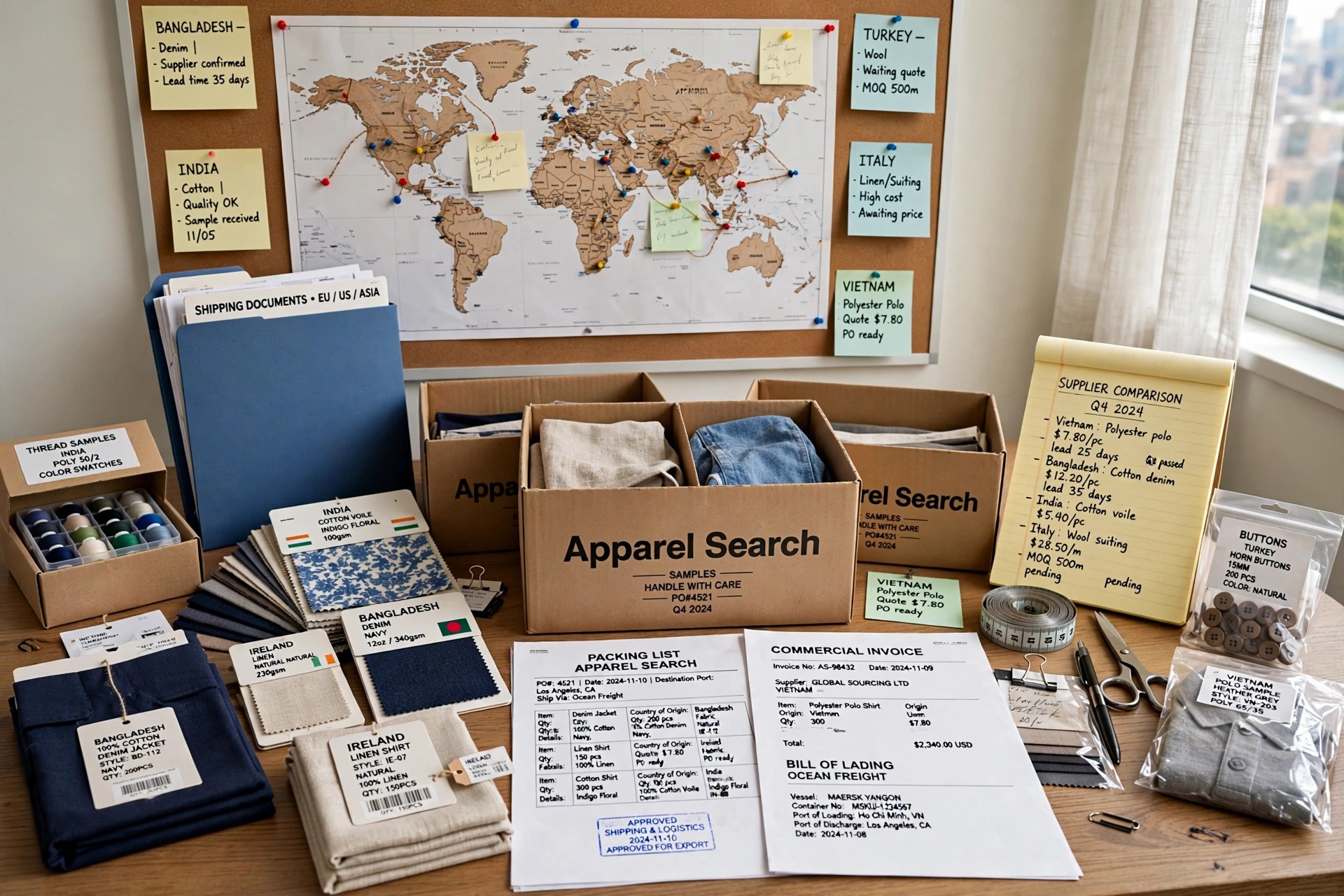
Finding and Choosing Suppliers Worldwide
Sourcing begins with market knowledge: which countries and regions specialise in which products, where the fabric and trims for a garment are made, how wages, energy costs and trade agreements are moving, and what each origin does to landed cost and delivery time. The sourcing specialist researches and visits candidate factories and mills, assesses their machinery, workforce, quality systems and export experience, and arranges the audits — technical, social and environmental — that a new supplier must pass before receiving an order.
Selection is a portfolio decision, not a single bet. Sourcing teams qualify more than one factory for important product types, balance nearshore speed against offshore cost, and keep capacity reserved ahead of the season with the suppliers they trust. Trial orders test a new factory on real product before volume follows, and performance scorecards — on-time delivery, quality results, responsiveness — decide how the portfolio evolves season by season.
Costing, Negotiation and Orders
With suppliers chosen, sourcing owns the numbers. Specialists build and challenge costings garment by garment — fabric, trims, making, finishing, packing, freight and duty — negotiating from knowledge of what a product should cost in that origin rather than from the first price offered. They place production against capacity plans, confirm lead times that design and buying calendars can actually meet, and agree the commercial terms: payment, inspection, claims and the consequences of late delivery.
Once orders are placed, sourcing monitors the critical path across countries and time zones: fabric approvals, production starts, inline quality, shipment bookings. When something slips — a port congests, a mill fails, a currency swings — the sourcing team finds the recovery: moving production, splitting shipments, air-freighting the styles that matter. The role works daily with design, buying, technical and logistics colleagues, translating between a range plan drawn in a head office and the realities of factories on other continents.
Trade rules quietly steer sourcing maps. Preferential agreements can remove duty entirely for garments made in one country from regional fabric, while a few percentage points of duty erase a making-price advantage in another. Sourcing specialists therefore track rules of origin alongside prices, and sometimes place a garment in the origin whose fabric ecosystem — local mills, trims and laundries — shortens the chain as well as the bill. The cheapest factory for a product is not always in the cheapest country for that product.
Skills and Knowledge the Role Requires
Commercial numeracy is the entry requirement: landed-cost modelling, exchange-rate effects, duty structures and the true cost differences between origins. Product knowledge must be real enough to judge whether a factory can make a garment to standard and whether its price is credible — sourcing specialists who have handled production spot an impossible quote. Negotiation skill, exercised across cultures and languages, decides how much of the theoretical saving survives contact with a contract.
Risk and responsibility now sit at the centre of the role. Sourcing professionals maintain supplier compliance with labour, safety and environmental standards, understand traceability requirements for fibres and materials, and plan resilience — dual sourcing, fabric stock strategies, alternative routings — against disruption. Clear written communication, meticulous records and the stamina for long-haul travel and inconvenient time zones complete a demanding profile.
Training, Qualifications and Career Path
Sourcing specialists typically grow from production, buying, merchandising or factory-side roles, often with business, supply-chain or textiles education behind them; what employers screen for is evidence of cost, supplier or production responsibility handled well. Language skills and time lived or worked in production countries are genuine advantages, as is experience inside a factory — many senior sourcing leaders began as merchandisers in the factories they now buy from.
The path runs to senior sourcing manager and head of sourcing or supply chain, owning origin strategy for a whole brand, or toward country-office leadership in a production region. Others move into consultancy, helping smaller brands build supply bases they could never research alone. Because sourcing sits at the junction of product, money and ethics, its senior holders increasingly shape company policy — on where things are made, from what, and under what conditions — not merely its prices.
Common Questions
What is the difference between sourcing and buying?
Buying decides what to sell and in what quantities, and owns the range and its sales performance. Sourcing decides where and by whom products are made, and owns supplier selection, costing, capacity and delivery. In smaller companies the roles merge; in large ones they are separate teams that negotiate with each other as much as with factories.
What is landed cost?
The full cost of a product by the time it reaches the warehouse: factory price plus fabric and trim extras, packing, freight, insurance and import duty. Global sourcing compares origins on landed cost — never on factory price alone — because a cheap making price can be undone by duty and freight.
How much travel does global sourcing involve?
Typically a significant amount: factory visits for selection, auditing, development and production checks are core to the role, often several trips a year to production regions, plus daily communication across time zones between trips. Office-based sourcing support roles travel less but still benefit from factory exposure.
More to Explore
Sourcing Resources
References & Further Reading
More Job Description Categories
- Buying Job Descriptions
- Design Job Descriptions
- Marketing & PR Job Descriptions
- Miscellaneous Job Descriptions
- Planning & Allocation Job Descriptions
- Production & Sourcing Job Descriptions (current)
- Sales & Selling Job Descriptions
- Transportation & Warehouse Job Descriptions