Fabric Technician Job Description
Testing cloth, guarding quality and solving fabric problems — the technical conscience of the fabric supply chain
A fabric technician makes sure cloth is what it claims to be — and proves it with numbers. Working in mill laboratories, brand and retailer technical departments and independent test houses, the technician samples fabric and puts it through the standard tests that predict how it will behave: Will it shrink in the wash? Fade in sunlight? Pill after a month of wear? Tear at the seam? The results decide whether thousands of metres are approved, rejected or sent back for correction, which makes the technician the quiet gatekeeper between a fabric order and a garment range. The role is part scientist, part inspector, part troubleshooter for everyone who designs, buys or sews the cloth.
More Production Job Descriptions by Letter:
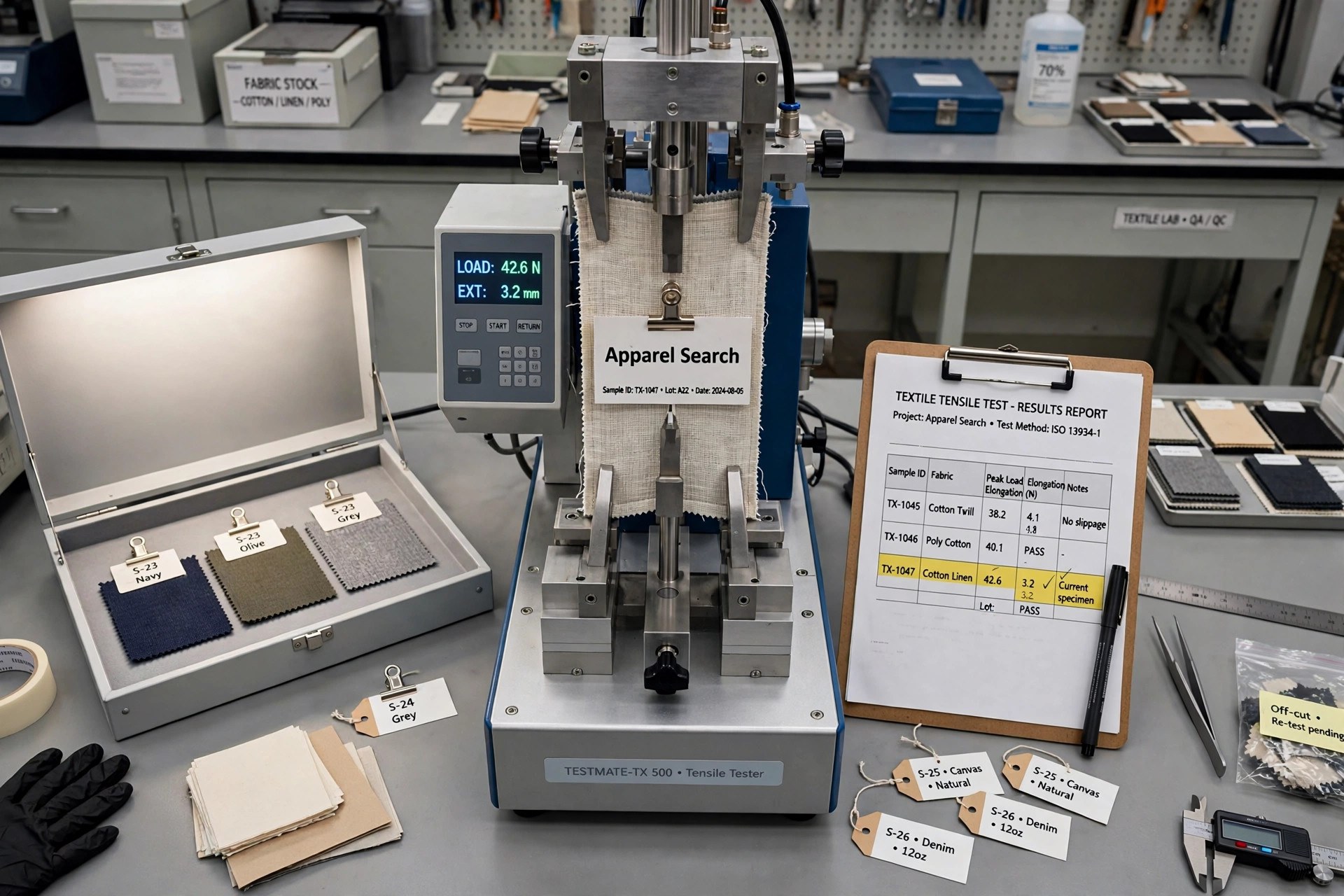
Testing Fabric in the Laboratory
The laboratory routine covers the physical and colour tests of a fabric specification. Dimensional stability — shrinkage and growth after washing or steaming — decides whether garments will still fit after their first wash. Colourfastness testing covers washing, rubbing (dry and wet), perspiration and light, graded against grey scales under standard lighting. Strength tests measure tensile and tear resistance and seam slippage; surface tests measure pilling and abrasion; and composition analysis verifies that the fibre content on the label is the fibre content in the cloth.
Technicians also run the checks that happen before fabric ever reaches a lab bench: measuring weight per square metre and usable width, counting construction, inspecting rolls over a light frame for weaving faults, holes, stains and shade variation from selvedge to selvedge and roll to roll. Every result is recorded against the standard and the batch, building the evidence file behind an approval — or the rejection report a supplier receives, with test data a mill cannot argue with.
Quality, Faults and Technical Support
When fabric goes wrong in production or in customers' hands, the technician investigates. A garment factory reports seams puckering; stores report a knit twisting after washing; a dye lot arrives two shades apart. The technician designs the test that isolates the cause — fabric, garment construction, dyehouse process or care-label error — and writes the finding in language a buyer, a mill and a factory can each act on. That translation work, from laboratory result to commercial decision, is where experienced technicians earn their standing.
Technicians also support fabric development and sourcing upstream: advising which tests a new fabric needs, setting realistic tolerance levels with developers, assessing new suppliers' sample yardage and auditing mills' own laboratories for calibration and method. In brand technical departments they maintain the fabric testing manual, train suppliers on it, and manage the flow of submissions so that approvals land before production deadlines rather than after them.
Approval is rarely a single test event. Production fabric is sampled across rolls and dye lots, because a fabric that passes from the first roll may drift by the tenth; technicians design sampling plans that catch drift without testing a business into paralysis. Shade continuity between lots gets the same treatment, assessed instrumentally and by eye, since garments cut from two lots are sewn into single orders. The technician's sampling discipline is what makes an approval mean something for the whole delivery rather than for one fortunate roll.
Skills and Knowledge the Role Requires
Methodical laboratory technique is the base skill: conditioning samples, following test methods exactly, calibrating equipment and recording results that another technician could reproduce. The knowledge layer covers fibres and fabric construction well enough to predict which tests matter for a given cloth, the national and international test standards the industry works to, and the pass levels major retailers set. Colour assessment in a light box, by trained eye, is a common requirement alongside the instruments.
Judgment sits on top of technique. Real fabric fails marginally, late, and under commercial pressure; the technician must hold the line on failures that will hurt customers while finding legitimate routes — a revised care label, a construction change, a narrowed tolerance with the mill's agreement — around failures that will not. Clear report writing and calm explanation under pressure from buyers who want a yes complete the profile.
Training, Qualifications and Career Path
Fabric technicians usually enter with a textiles, garment technology or applied science qualification, or from quality-inspection and laboratory-assistant roles with in-house training on test methods. Employers value recognised textile institute qualifications and hands-on familiarity with the standard test apparatus; colour-vision screening is routine. Independent test houses and large brands run structured technician training that can lead toward accredited laboratory status.
Progression leads to senior technician and laboratory or technical manager roles, into fabric development and fabric specialist positions where test knowledge shapes fabric choices earlier, and into quality assurance management across a supply base. Technicians are also recruited by dye and chemical suppliers, machinery makers and certification bodies — anywhere that fabric performance has to be measured, explained or guaranteed.
Common Questions
What tests does a fabric technician run most often?
Shrinkage (dimensional stability), colourfastness to washing, rubbing and light, tensile and tear strength, seam slippage, pilling and abrasion resistance, plus weight, width and fibre composition checks. The exact panel depends on the fabric and its end use — a swim fabric and a suiting cloth are tested very differently.
What happens when a fabric fails a test?
The batch is held and the failure is investigated. Depending on the cause and severity, the fabric may be re-finished or re-dyed and retested, downgraded to a less demanding use, accepted under a revised care label or construction, or rejected to the supplier. The technician documents the result and the decision so the outcome is traceable.
Is a fabric technician the same as a garment technologist?
They are close relatives with different subjects. The fabric technician's subject is the cloth — its properties and performance. The garment technologist's subject is the made garment — fit, construction, sealing and final quality. The two work together constantly, and careers cross between them.
More to Explore
Fabric Resources
References & Further Reading
More Job Description Categories
- Buying Job Descriptions
- Design Job Descriptions
- Marketing & PR Job Descriptions
- Miscellaneous Job Descriptions
- Planning & Allocation Job Descriptions
- Production & Sourcing Job Descriptions (current)
- Sales & Selling Job Descriptions
- Transportation & Warehouse Job Descriptions