Lace Weaving Manager Job Description
Managing the looms that interlace warp and weft into lace — warps, harnesses, woven motifs and a weaving team
A lace weaving manager runs the weaving operation that produces lace on looms, where the fabric is built by interlacing two sets of yarn: the warp, held under tension lengthwise, and the weft, inserted across it pick by pick. Woven lace — from traditional Leavers-type production to modern jacquard looms weaving openwork grounds and motifs — is a distinct product from knitted lace: firmer, more dimensional, often heavier, and woven more slowly. The manager owns the looms, the warps, the patterns and the weavers, and answers for cloth in which a single broken warp end or a mis-lifted harness repeats as a defect through every motif it touches.
More Production Job Descriptions by Letter:
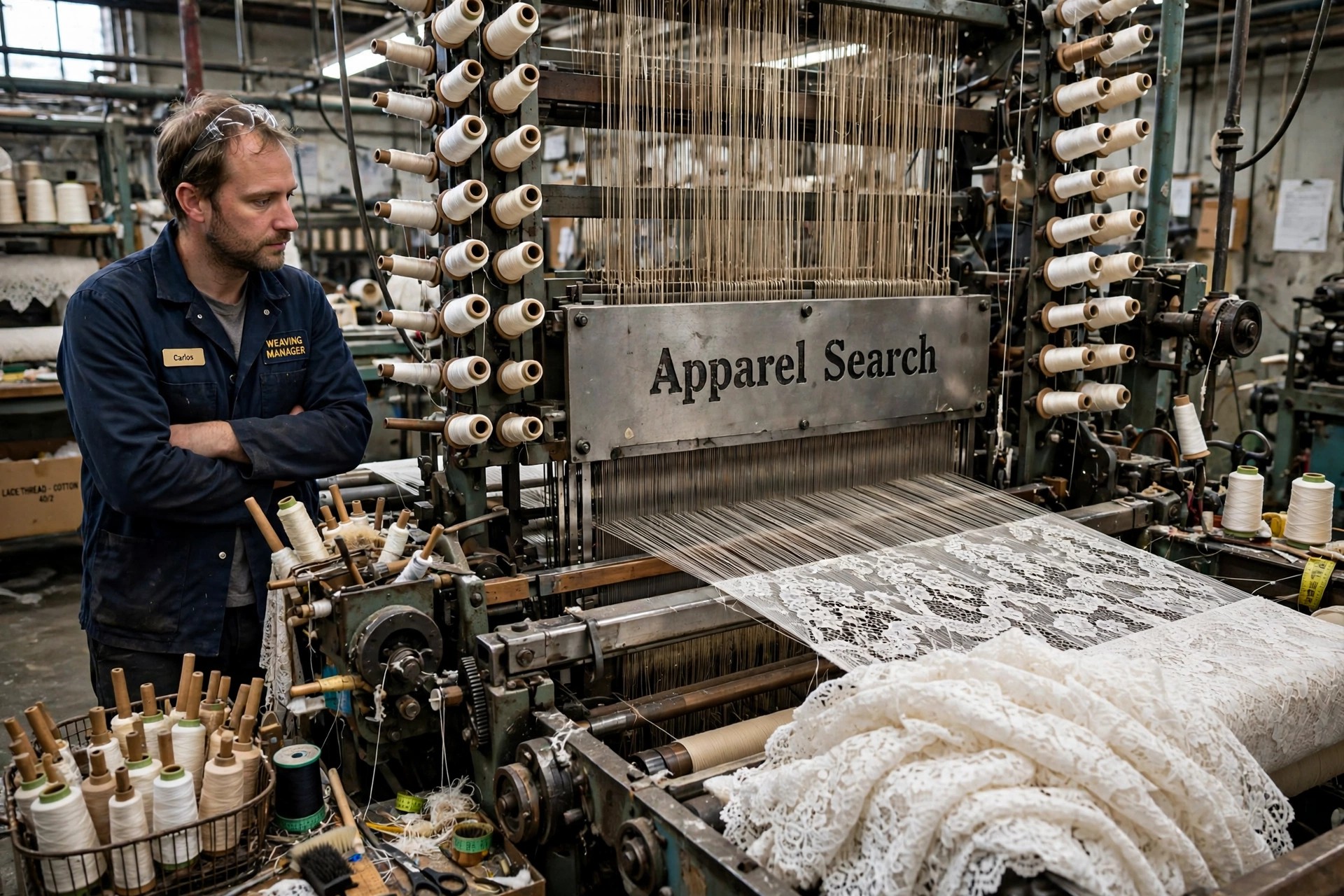
The Weaving Shed: Warps, Looms and Pattern Control
Weaving begins long before the loom. Warps for lace are prepared yarn by yarn — hundreds or thousands of ends wound onto the loom beam in exact order, drawn through heddles and reed — because the warp is the skeleton of the design: the ground mesh, the motif outlines and the scalloped edge are all predetermined by which warp threads lift, twist or cross at each pick. In traditional lace weaving, extra warp threads are worked around the ground to build the pattern; on jacquard-equipped looms, an electronic harness control lifts individual warp ends according to a pattern file prepared from the designer's artwork. The manager schedules this preparation, which is slow, skilled and impossible to hurry safely.
Once weaving, the manager's room runs on rhythm and attention: loom speeds set to what fine yarns tolerate rather than what the machine allows, weavers patrolling their looms for broken ends and weft faults, and production planned around the reality that a warp, once beamed, commits the loom to that design for its whole length. Changeovers in weaving are measured in warps, not hours of reprogramming, so the manager sequences orders to share warps where designs permit and keeps loom allocation honest against delivery promises made to garment and lingerie customers.
Quality in Woven Lace
The woven lace fault list is its own: missing picks where the weft failed to insert, floats where a warp end lifted wrongly, reed marks, tension bars across the width, and motifs that drift out of register so the pattern no longer matches when panels are cut. The lace weaving manager builds inspection into the process — cloth checked on the loom under raking light, again at cloth inspection after doffing, and again after dyeing, stentering and finishing, which woven lace needs to set its dimensions and hand. Fine woven lace is also mended: skilled menders repair small faults invisibly, and the manager decides what is worth their expensive time.
Repeatability is recorded as carefully as in any textile craft: warp plans, yarn lots, loom settings, pattern files and finishing routes are kept per design, because a woven lace reordered for a bridal or lingerie collection must drape, shine and dye exactly as the first delivery did. Bridal and occasion lace is unforgiving work — white and ivory shades show every inconsistency — and a weaving manager's reputation is made on cloth that photographs perfectly at a wedding, not merely passes at the inspection table.
Skills and Abilities the Role Requires
Weaving knowledge is the craft core: warp preparation, shedding and harness patterning, weft insertion, and the behaviour of fine natural and synthetic yarns under loom tension, learned at looms over years rather than from documentation. Pattern understanding follows — how a lace design is translated into warp plans and jacquard data, and how to trace a motif fault back to a heddle, a harness cord or a pattern error. Woven lace rewards managers who think in structures: the fabric is architecture, built thread by thread, and its faults are structural before they are visible.
The production layer adds warp and loom scheduling against orders, yarn stock control, realistic costing per metre — woven lace is slow, and its price must carry that honestly — and leadership of weavers, tuners and menders, trades with strong craft identities of their own. Patience is structural here too: a weaving manager cannot accelerate a warp, only protect it, and the discipline to inspect early and stop a loom for one repeated fault is what keeps a room's output saleable.
Training, Qualifications and Career Path
Lace weaving managers rise from the weaving shed: weaver or loom technician first, then tuner, shift leader or weaving supervisor, gathering loom types, warp work and pattern experience on the way. Textile technology education in weaving and fabric structure supports the route, and the traditional lace-weaving regions sustain the deepest training, but employers at manager level hire demonstrated records: warps run clean, quality held, deliveries met on lace specifically, since woven lace tolerates generalists poorly.
Progression leads to weaving or mill management over preparation, weaving and finishing together, and to technical development roles working with designers on new woven lace collections — a valued specialism in bridal, lingerie and occasionwear supply. As with its knitting counterpart, the trade is concentrated and experienced lace weaving managers are few; those with both traditional loom knowledge and modern jacquard pattern experience are particularly sought after when mills invest in new capacity.
Common Questions
How does woven lace differ from knitted lace?
Structure and making. Woven lace is interlaced on a loom — warp threads lengthwise, weft inserted across — giving a firmer, more dimensional fabric woven relatively slowly. Knitted lace is looped on warp-knitting machines at full width and speed. They handle differently, cost differently, and are managed as separate crafts.
What does a lace weaving manager oversee day to day?
Warp preparation and beaming, loom allocation and speeds, jacquard or harness pattern control, weaver patrols and fault response, inspection and mending decisions, and the records that let a design be rewoven identically on repeat orders.
What background leads to lace weaving manager roles?
Weaving itself: weaver or loom technician posts, then tuner or supervisor roles, building warp, pattern and quality experience, often with textile technology study behind it. Employers hire lace-specific production records at manager level.
More to Explore
Lace Resources
Production Directory Pages by Letter
References & Further Reading
More Job Description Categories
- Buying Job Descriptions
- Design Job Descriptions
- Marketing & PR Job Descriptions
- Miscellaneous Job Descriptions
- Planning & Allocation Job Descriptions
- Production & Sourcing Job Descriptions (current)
- Sales & Selling Job Descriptions
- Transportation & Warehouse Job Descriptions