Lace Knitting Manager Job Description
Running the warp-knitting machines that loop yarn into lace — patterns, yarns, quality and a knitting room team
A lace knitting manager runs the department where lace is knitted — not woven, not embroidered, but formed directly on warp-knitting machines, most famously the Raschel machine, where dozens of guide bars lay patterned yarns over a ground of loops at high speed. The output is the lace that edges lingerie, trims dresses and forms whole garments: elastic and rigid laces, galloon edgings, allovers and motifs. The manager owns the machines, the patterns, the yarn and the knitters, and answers for lace that must be beautiful, repeatable and free of the faults — broken ends, barré, distorted motifs — that fine yarns produce so easily.
More Production Job Descriptions by Letter:
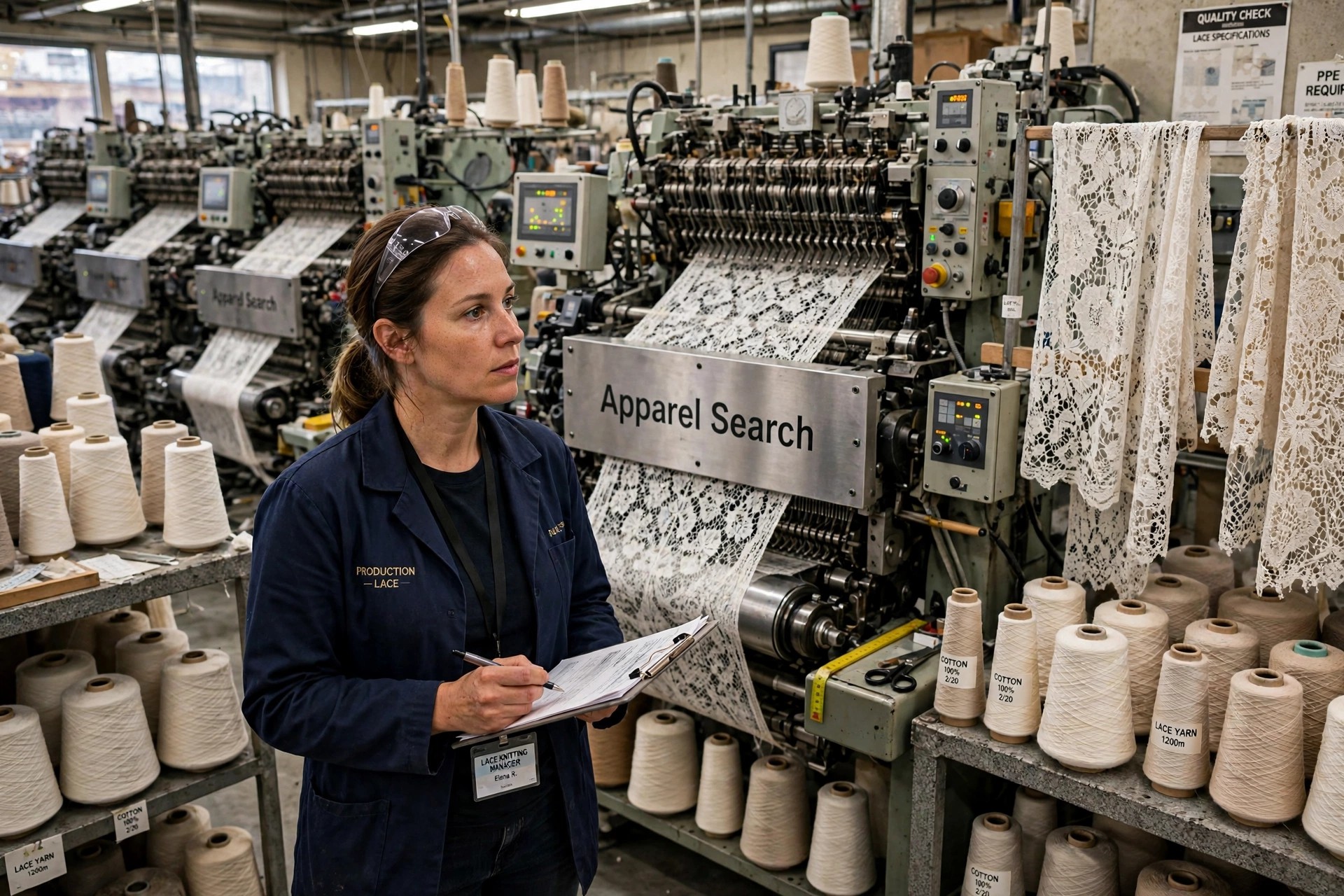
The Knitting Room: Machines, Bars and Patterns
Warp knitting builds fabric from many yarns at once. Warps are prepared on beams, threaded through guide bars, and knitted into a ground structure while pattern bars lay in the decorative yarns that draw the lace design — scallops, floral motifs, picot edges. Modern Raschel lace machines carry electronic pattern control: a design prepared in CAD is loaded to the machine, bar movements are programmed stitch by stitch, and the manager's team proves the pattern on the machine, adjusting tension, feed and timing until the motif repeats cleanly across the full width and down the roll.
The manager plans which designs run on which machines, sequences changeovers — a full pattern and yarn change can occupy a machine and its crew for many hours — and keeps the room's output matched to orders from garment makers and the company's own finishing department. Yarn preparation is managed with the same care: fine filament and spun yarns, elastane for stretch lace, each warped, conditioned and checked, because a knitting room can only knit as well as the beams it is given. Machine condition is a managed asset too: needles, guides and sinkers wear invisibly until quality falls, and the preventive maintenance calendar is the manager's defence.
Quality in Knitted Lace
Lace faults are small, numerous and fatal to value. A single broken end can repeat as a line of missing stitches down metres of fabric; uneven yarn tension shows as barré shading across the width; a mistimed pattern bar shifts the motif so scallops no longer match at a garment's edge. The lace knitting manager sets the inspection regime — fabric examined on the machine, again at doffing, and again after dyeing and finishing, when faults hidden in the greige state become visible — and decides what is first quality, what can be mended, and what is downgraded or scrapped.
Consistency between repeat orders is the quieter quality battle. A lingerie brand reordering the same lace a year later expects the same hand, the same stretch and recovery, the same shade after dyeing. The manager keeps the records that make that possible: yarn lots, machine settings, pattern files and finishing routes for every design, so a repeat is a reconstruction from evidence, not a fresh act of memory. Where lace is dyed and finished in-house, the manager works daily with the dyehouse, because knitting and finishing faults blame each other readily and only records settle the argument.
Skills and Abilities the Role Requires
The craft core is warp-knitting knowledge: stitch formation, guide-bar patterning, yarn behaviour under tension, and the mechanics of Raschel and related machines, learned on the machines themselves over years. Pattern literacy follows — reading and correcting lace designs, understanding how a motif is constructed from bar movements, and working with the CAD systems that programme electronic machines. A manager who cannot follow a pattern fault back to its bar, beam or needle is managing blind.
Around the craft sit the production skills: scheduling a room of machines with long changeovers against delivery dates, controlling yarn stock worth real money, costing output per metre honestly, and leading knitters and technicians whose expertise the manager must respect and organise. Eyesight and patience are genuine occupational requirements — the faults this role exists to catch are measured in single stitches — joined to the calm to stop a machine and lose an hour rather than run a fault through a full roll.
Training, Qualifications and Career Path
Lace knitting managers are made in knitting rooms. The usual route is knitter or machine technician, then senior knitter or shift leader, accumulating machine types, yarn types and pattern experience; textile technology study — knitting machinery, yarn and fabric science — strengthens the route and is offered by textile colleges in the traditional lace regions. Employers hiring a manager look for a production record on lace specifically: Raschel experience, pattern changeovers run, quality results held over seasons, not general textile claims.
Career paths lead to mill or production management over knitting plus dyeing and finishing, to technical and product-development roles designing lace collections with garment brands, and, in a trade concentrated in a small number of specialist mills, to considerable standing: experienced lace knitting managers are scarce, known by name across the industry, and recruited accordingly. Some move to the machine builders, commissioning and teaching new lace machines in mills worldwide.
Common Questions
What is the difference between knitted lace and woven lace?
Knitted lace is formed on warp-knitting machines such as the Raschel: yarns are looped into a ground while pattern bars lay in the design, quickly and at full fabric width. Woven lace is interlaced on a loom from warp and weft threads. The two laces differ in structure, stretch, handle and cost, and the manager roles are separate crafts.
What machines does a lace knitting manager run?
Primarily Raschel warp-knitting machines with multiple guide bars and electronic pattern control, alongside yarn warping and preparation equipment. The manager schedules the machines, programmes and proves patterns, and owns their maintenance calendar.
How do lace knitting managers usually start?
On the machines: as a knitter or technician, progressing through senior knitter and shift-leader roles while building pattern and yarn experience, often supported by textile technology study. Lace-specific production records are what employers hire at manager level.
More to Explore
Lace Resources
Production Directory Pages by Letter
References & Further Reading
More Job Description Categories
- Buying Job Descriptions
- Design Job Descriptions
- Marketing & PR Job Descriptions
- Miscellaneous Job Descriptions
- Planning & Allocation Job Descriptions
- Production & Sourcing Job Descriptions (current)
- Sales & Selling Job Descriptions
- Transportation & Warehouse Job Descriptions