Embroidery Digitizer Job Description
Preparing production-ready stitch files — machine formats, sew-out approval and working with embroiderers and clients
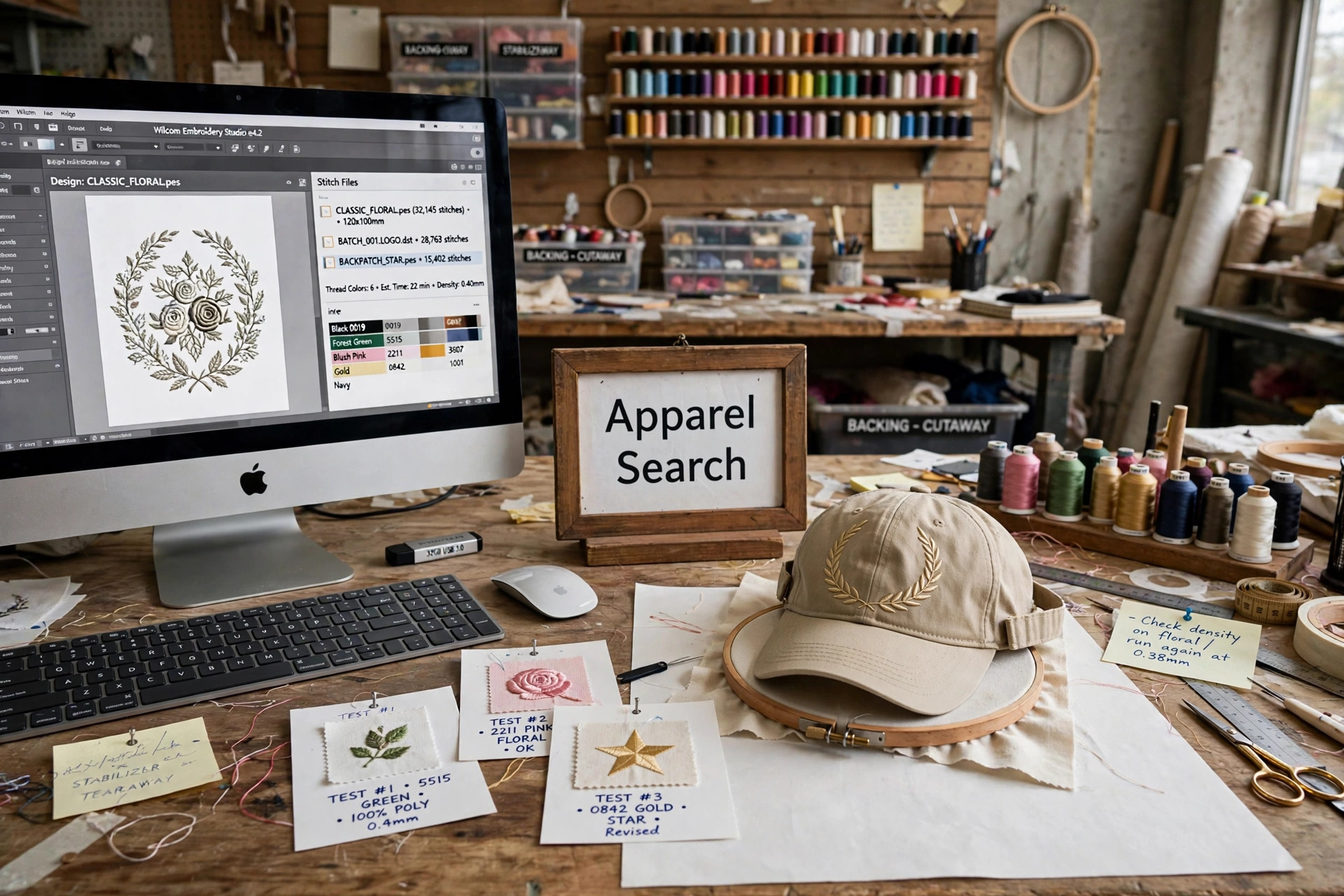
In a working embroidery business, the embroidery digitizer is the link between the customer’s artwork and the machines on the shop floor. Orders arrive as logos in email attachments, brand guidelines, deadlines and garment lists; the digitizer turns that bundle into a production-ready stitch file, in the format the shop’s machines read, at the size the garment allows, approved on a sew-out before the run begins. Where the craft-focused side of digitizing is about stitch behaviour, this page follows the production workflow: intake, formats, revisions, and the daily partnership between the digitizer’s desk and the embroiderers who must make the file earn its keep.
More Production Job Descriptions by Letter:
From Client Artwork to a Production Order
The workflow starts before any stitch is plotted. The digitizer reviews the client’s artwork for sewability at the ordered size — lettering height, fine detail, gradients that thread cannot reproduce — and agrees any simplifications with the client or sales contact up front, ideally with a proof the customer signs off. The order’s other facts shape the file too: garment type and fabric, placement, thread brand and colour references, and quantity, because a design for twelve caps is set up differently from one for five hundred polo shirts.
Good digitizers build the file for the run, not just the design. That means choosing a sewing sequence that suits the machines in house, placing colour changes where the shop’s thread stock makes them cheap, adding the stops an operator needs for appliqué or foam, and recording the thread chart and run sheet with the file so the embroiderer is never guessing. A stitch count estimate goes back to the office, since machine time is how embroidery is priced.
Machine Formats and File Discipline
Embroidery machines speak in formats — DST files that almost every machine accepts, and proprietary formats tied to particular machine brands and software. The digitizer exports the correct format for each machine the design will run on, keeps the editable master file alongside, and names and files everything so that a repeat order in eight months’ time finds version three, not a near-duplicate from someone’s desktop. In a busy shop, that file discipline is worth as much as artistic skill: the costliest digitizing errors are usually the wrong version sewn beautifully.
Formats carry practical consequences the digitizer manages daily. Some formats store thread colours and stops; others carry only stitch coordinates, so the run sheet must travel with the file. Designs are transferred by network, USB or the shop’s library system, and the digitizer checks that what loaded on the machine matches what left the desk — size, orientation and colour order — before the first garment is hooped.
Sew-Outs, Revisions and the Shop Floor
The sew-out is where desk and floor meet. The embroiderer stitches the new file on the production fabric, and together they read the result: gaps between colours, lettering that closes up, a border that pulls the garment out of shape. The digitizer takes the marked-up sample back, adjusts the file — a compensation widened, a density eased, an element re-sequenced — and issues a new version with the change logged. Clients join this loop for their approval sew-out, and the approved sample becomes the standard the production run is judged against.
That feedback loop runs all day in a production shop. Embroiderers report which files run clean and which break thread at the same corner every time; the digitizer fixes the pattern, not just the instance, updating the master so the fault never ships again. Over months, this builds the shop’s real asset: a library of proven files, tuned to its machines and garments, that new staff can run with confidence.
Skills, Training and Career Path
Production digitizing calls for software fluency plus service skills: interpreting client artwork and brand rules, explaining limits without jargon, estimating stitch counts and turnaround honestly, and staying organised across dozens of live orders. An understanding of how embroiderers work — hooping, machine speeds, thread behaviour — keeps files practical, which is why many production digitizers have spent time on the machines themselves and keep doing a sew-out shift when the shop is busy.
Entry routes include junior digitizer roles under a senior, embroidery-company training schemes and software certification courses, with advancement judged on a portfolio of sewn, approved production work. Senior digitizers take on key accounts, train operators and juniors, and may lead the whole decoration department; others specialise — caps and 3D puff, appliqué, large-format or high-fashion embroidery — or build freelance practices supplying production files to many shops, where reliability and turnaround are the brand.
Common Questions
What does an embroidery digitizer do in a production shop?
Turns client artwork into production-ready stitch files: checking sewability, plotting the design, exporting the right machine format, preparing thread charts and run sheets, and revising the file from sew-outs until it is approved for the run.
Which file formats do embroidery digitizers supply?
Most commonly DST, which nearly all commercial machines read, plus brand-specific formats where a shop’s machines require them. The editable master file is always kept so future revisions start from the true design.
How does a digitizer work with embroiderers?
Through the sew-out loop: the embroiderer stitches the file on the real garment, they review faults together, and the digitizer corrects and re-versions the master file. Operators’ feedback continually improves the shop’s library of proven designs.
More to Explore
Embroidery Resources
- Embroidery Guide
- Embroidery Machines
- Embroidery Thread
- Embroidery Software
- Embroidery Terms
- Embroidery Design Services
- Embroidery Associations
- Interlining
- Embroidery Backcloth
- Embroidery Stabilizers
- Patches
- Heat Transfer
- Embroidery Hooping Equipment
- Embroidery Frames
- Embroidery Supply Holders
- Embroidery Magazines
References & Further Reading
More Job Description Categories
- Buying Job Descriptions
- Design Job Descriptions
- Marketing & PR Job Descriptions
- Miscellaneous Job Descriptions
- Planning & Allocation Job Descriptions
- Production & Sourcing Job Descriptions (current)
- Sales & Selling Job Descriptions
- Transportation & Warehouse Job Descriptions