Dyehouse Manager Job Description
Managing fabric dyeing — colour matching, dye machines, chemical safety and the team that colours cloth
A dyehouse manager runs the part of textile production where grey fabric becomes coloured cloth. Dyehouses sit inside mills, serve garment factories as commission dyers, or specialise in yarn and garment dyeing, and their manager is accountable for everything that decides whether colour comes right: the recipes and lab dips approved before bulk dyeing, the machines and the people who run them, the water, energy and chemicals consumed, and the shade that finally reaches the customer. Colour is unforgiving — a shade that is slightly wrong under one light may be unusable — so the dyehouse manager’s job blends chemistry, production planning and quality judgment in equal measure.
More Production Job Descriptions by Letter:
Planning and Running Dye Production
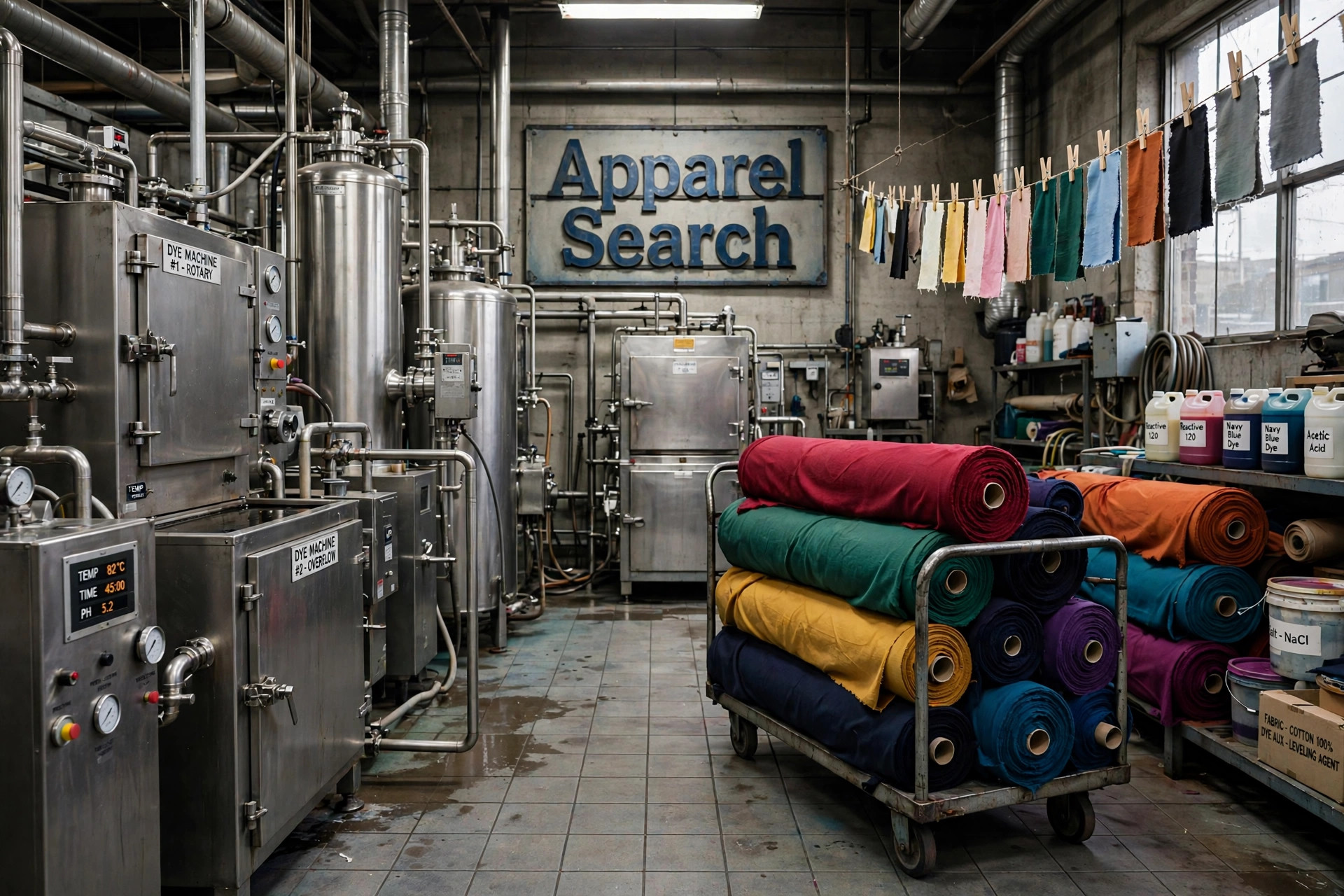
The manager plans the dyehouse day around orders, machine capacity and colour sequence. Dye machines — jets, jiggers, winches and package dyeing lines among them — are loaded by fabric type and weight, and the schedule runs light shades before dark ones where possible to reduce cleaning between batches. Each lot is dyed to a recipe: dyestuffs weighed to fractions of a gram per litre, temperature and time profiles controlled, and samples cut during the run so the shade can be checked and corrected before the batch is drained and finished.
Bulk dyeing is a chain of linked stages — preparation, scouring and bleaching before dyeing; washing off, fixing and finishing after — and the manager keeps that chain moving so fabric neither waits wet in machines nor piles up between processes. When a shade misses, the manager decides whether it can be corrected with an addition, stripped and re-dyed, or downgraded, weighing the cost of each route against the delivery date. Those judgment calls, made calmly with the lab and the customer in the conversation, are the core of the role.
Colour Matching, the Laboratory and Quality
Every bulk shade begins as a lab dip: small dyeings made in the laboratory to match a standard — a customer’s swatch or a spectrophotometer reading — under controlled conditions. The dyehouse manager oversees the lab’s recipe library, approves lab dips before they go to the customer, and makes sure the recipe that matched in a beaker is scaled faithfully to a machine holding hundreds of kilos, where water ratios and heating rates behave differently. Colourists and lab technicians are the manager’s closest colleagues, and the best dyehouses run lab and bulk as one team.
Quality in dyeing means shade consistency within and between lots, levelness without streaks or listing, and fastness — the colour must survive washing, rubbing and light to the standard the garment’s end use demands. The manager owns the testing regime, the shade-band tolerances agreed with customers, and the records that trace every lot back to its recipe and machine, so that a repeat order months later can be matched to the original delivery rather than to a memory.
Machines, Chemicals, Safety and Water
A dyehouse is a wet, hot, chemical workplace, and its manager carries clear safety and environmental responsibilities. Dyestuffs and auxiliaries are stored, weighed and handled under proper controls; steam, hot liquors and moving machinery are guarded; and the effluent — dyehouse wastewater is heavily regulated — is treated to the required standard before discharge. Water and energy dominate dyeing costs, so the manager also drives efficiency: right-first-time dyeing is the biggest saving of all, because every re-dyed lot doubles the water, chemicals and hours spent on that fabric.
Maintenance is planned rather than suffered. The manager schedules machine servicing, keeps spares for pumps, valves and sensors whose failure mid-batch would ruin a load, and trains operators to report drift in temperature or flow before it shows in the shade. Working closely with the wider mill — weaving or knitting before, finishing after — the dyehouse manager makes the colour stage a reliable link in textile production instead of its most frequent bottleneck.
Skills, Training and Career Path
The role demands a working command of dye chemistry — fibre and dyestuff classes, and why cotton, wool, polyester and blends each need their own approach — together with production management: scheduling, costing, team leadership and customer communication. A trained eye for colour, ideally supported by instrument readings rather than eyesight alone, and the discipline of meticulous records complete the profile. Managers typically employ and develop shift supervisors, machine operators, weigh-up staff and lab colourists, so coaching and rota planning are daily work.
Most dyehouse managers arrive through the laboratory or the machine floor: colourist or dye technician roles, textile technology or chemistry qualifications, then supervisory responsibility before the whole house. Formal study in textile dyeing and finishing strengthens the chemistry behind the craft. From dyehouse manager, paths lead to mill and finishing management, technical management across a manufacturing group, or specialist consultancy in colour and wet processing — expertise that stays in demand wherever fabric is coloured.
Common Questions
What does a dyehouse manager do?
Runs a textile dyehouse: planning dye production across machines, approving lab dips and recipes, controlling shade quality and colour fastness, managing chemicals, water, effluent and safety, and leading the operators, weigh-up staff and laboratory colourists.
What qualifications help a dyehouse manager?
A background in textile dyeing — as a colourist, lab technician or dye machine operator — supported by textile technology or chemistry study. Employers look for proven shade judgment, recipe discipline and production management experience.
Why is right-first-time dyeing so important?
A failed shade usually means correcting, stripping or re-dyeing the lot, which doubles water, chemical and energy use and delays delivery. Right-first-time results are the main driver of dyehouse cost, quality and environmental performance.
More to Explore
Dyeing Resources
References & Further Reading
More Job Description Categories
- Buying Job Descriptions
- Design Job Descriptions
- Marketing & PR Job Descriptions
- Miscellaneous Job Descriptions
- Planning & Allocation Job Descriptions
- Production & Sourcing Job Descriptions (current)
- Sales & Selling Job Descriptions
- Transportation & Warehouse Job Descriptions