Pigment
Fabric Definitions — dye and colour definitions from Apparel Search
Search Apparel Search
At a Glance
Definition: A pigment is a dry colorant, usually an insoluble powder, that colours paint, ink, plastic, fabric and other materials by selectively absorbing some parts of the visible spectrum and reflecting others.
Category: Fabric Definitions
In the colouring of paint, ink, plastic, fabric and other material, a pigment is a dry colorant, usually an insoluble powder. There are natural and synthetic pigments, and both organic and inorganic ones, and all of them work the same way: by selectively absorbing some parts of the visible spectrum while reflecting others. In biology the word is wider — pigment is any material producing colour in plant or animal cells through selective absorption, and nearly all types of cells, in skin, eyes, fur and hair, contain pigment.
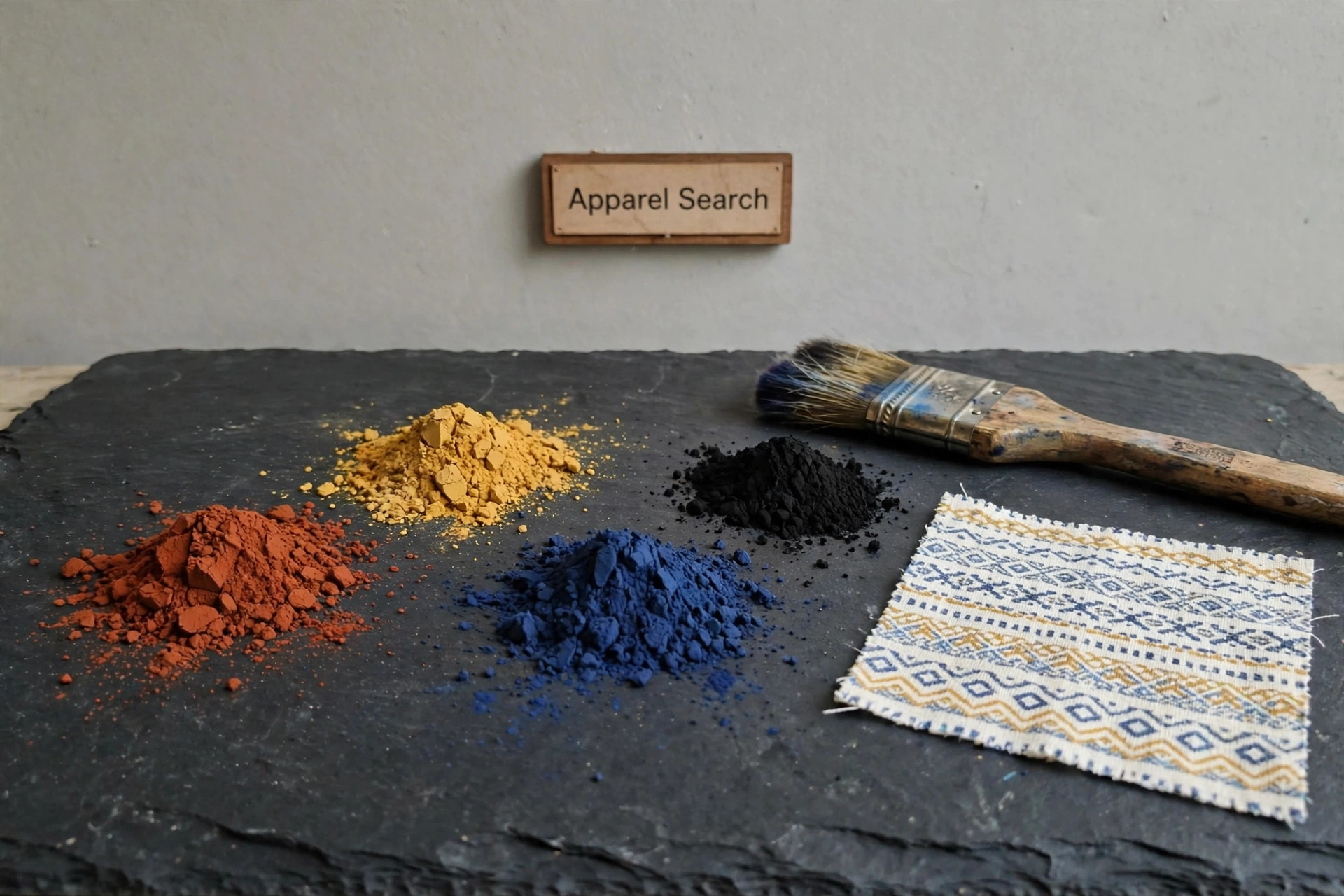
Pigment Colour and Structural Colour
Because pigment colour is the result of selective absorption, pigment colour is the same for all viewing angles. Some biological material instead shows structural colour, the result of selective reflection or iridescence, usually produced by multilayer structures — and structural colour changes with the angle of view. Butterfly wings typically contain structural colour, although many of them contain pigment as well. Creatures deficient in pigmentation are called albinos. The absorption definition has one famous consequence: strictly, there is no such thing as a white pigment, because a white object is simply a diffuse reflecting object that does not contain pigment — in practice, white pigments such as titanium dioxide work by scattering and reflecting nearly all the light that reaches them.
The biological pigment families include the heme and porphyrin group (chlorophyll, bilirubin, hemocyanin, hemoglobin and myoglobin), the light-emitting luciferin, and the lipochromes — carotenoids such as alpha and beta carotene, the cyanins and anthocyanins, lycopene, rhodopsin and the xanthophylls — together with melanin, the brown-black pigment of skin and hair. The painter's and manufacturer's palette overlaps it at points — alizarin, indigo, Prussian blue and ultramarine appear in both worlds — and runs on through bone black and ivory black, carbon black, cadmium, chromium and cobalt pigments, red and yellow ochres, sienna, Naples yellow, Venetian red and zinc white.
Pigments on Fabric: Printing, Not Dyeing
On textiles, pigment is the colorant of printing rather than dyeing. A pigment paste — insoluble colour, a resin binder and a thickener — is printed onto the fabric surface and cured with heat, and the binder film holds the colour in place; most printed T-shirts are pigment prints. The process works on any fibre and any blend, needs no washing-off afterwards, and gives exact placement of multi-colour designs, which dyeing cannot do. The trade-offs are the mirror image of dyeing's strengths: the colour sits on the surface, so the hand is stiffer, heavy deposits can crack, and rubbing fastness depends entirely on the binder. A garment dyer and a pigment printer can work on the same shirt, but the specification must name which one it wants — compare the dye definition and the role of the mordant in fixing dyes that do bond with the fibre.
Two Families of Pigment
Inorganic pigments — metal oxides and mineral colours such as the iron oxide reds and yellows, and titanium dioxide white — are the older family, exceptionally lightfast and heat-stable, with a generally earthy range. Organic pigments are carbon-based, mostly synthetic, and supply the bright, clean reds, blues and greens of modern inks and plastics. Biology runs on its own set: melanin browns and blacks in skin and hair, carotenoid yellows and oranges, and heme red in blood — all working by selective absorption, and all distinct from the structural blues and iridescence that physical microstructure produces in feathers and wings. Whatever the family, the pigment itself is only half the system: on any fiber-based material it is the binder, not the powder, that decides how long the colour survives. For the industry applying these colorants, see the printing and dyeing industry directory.
Not to Be Confused With
A pigment is not a dye. A pigment is insoluble — a dry powder with no affinity for the material it colours, which must be dispersed in a binder to hold it on the surface. A dye dissolves, or is applied in solution, and is taken up by the substrate itself. The dividing line is not perfectly sharp — some colorants serve as both, and a lake is made by precipitating a soluble dye with a metallic salt — but in textile specification the distinction decides whether a colour is dyed in or printed on.
Common Questions
How does a pigment differ from a dye?
A pigment is insoluble — a dry powder that must be dispersed in a binder to colour a material — while a dye dissolves and is taken up by the material it colours. A distinction is usually made between a pigment, which is insoluble, and a dye, which is either a liquid or is soluble.
Is there such a thing as a white pigment?
Because pigment colour results from selective absorption, the traditional definition holds that there is no such thing as a white pigment in that sense: a white object is simply a diffuse reflecting object. In practice, white pigments such as titanium dioxide colour by scattering and reflecting nearly all light rather than absorbing it.
What is structural colour?
Structural colour is colour produced by selective reflection or iridescence, usually from multilayer structures, rather than by absorption. Pigment colour is the same for all viewing angles; structural colour changes with angle. Butterfly wings typically contain structural colour, although many contain pigment as well.