Cutting Fabric Job Description
Cutting fabric as a stage of garment manufacturing — markers, spreading, and cutting the lays that sewing rooms depend on
In garment manufacturing, cutting fabric is the stage that turns cloth into clothing. Before a single seam is sewn, the cutting room receives the production marker — the plan that nests every pattern piece for every size — spreads the fabric into a lay of many layers, and cuts through the stack so that dozens or hundreds of garments are shaped in one pass. It is the point in the factory where fabric, the most expensive input, is committed for good: a well-run cutting room protects the material budget and feeds the sewing lines with accurate, complete bundles, while a careless one wastes cloth and starves machinists of work.
More Production Job Descriptions by Letter:
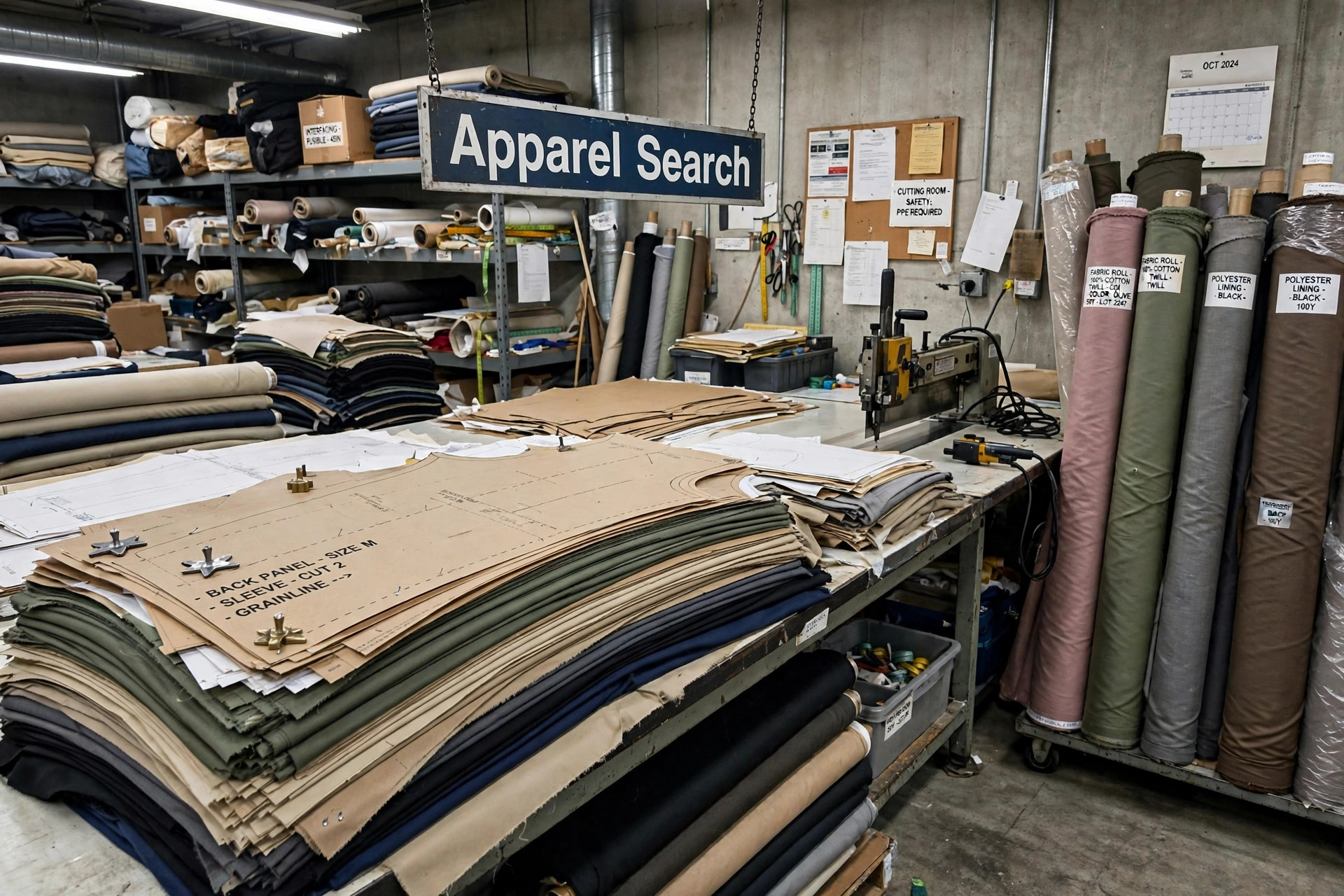
Cutting as a Stage of Garment Manufacturing
A production order arrives in the cutting room as paperwork and pattern: the sizes and quantities to be cut, the fabric and its width, and the marker, printed on paper or sent to a computerised cutter, showing how the pieces fit together with the least waste. The cutting fabric worker reads that paperwork first. Style numbers, size ratios and colourways must match the fabric actually delivered, because cutting the right pattern from the wrong cloth is the costliest mistake the room can make, and it is usually discovered only when the bundles reach the sewing floor.
Cutting sits between the warehouse and the sewing room, and its pace sets the pace of both. Sewing lines cannot start a style until its bundles arrive, and they cannot finish it if a part is missing or mis-cut. Experienced cutting staff therefore work a little ahead of the lines, keep the next style ready while the current one is being cut, and flag fabric faults, shade differences and shortages to production management while there is still time to order more cloth or re-plan the marker.
Spreading, Marking and Cutting the Lay
Spreading is the patient half of the job. Fabric is drawn from the roll along the cutting table, layer upon layer — a lay may run from a handful of plies for a sample to a hundred or more for a bulk order — with each layer aligned at the edges, smoothed free of wrinkles and tension, and checked for faults as it passes. Nap, pile and one-way prints must all run the same direction, and checked or striped fabrics may need matching across plies. A spreading machine helps on long lays, but the worker’s eye for a twisted layer or a shading band is what protects the cut.
With the marker laid on top and secured, the cutting itself begins. Straight-knife and band-knife machines cut the stack following the marker lines, round knives and shears handle small lays and samples, and computerised cutters follow the digital marker automatically on larger production. The worker guides the blade steadily through curves and notches, keeps hands clear under proper guarding, and works in sections so the stack never shifts. Accuracy here is measured in millimetres: pieces cut off-grain or undersize cannot be rescued at the sewing machine.
Bundling, Ticketing and Quality Checks
Cut pieces are not finished work until they are organised. The cutting room sorts the parts by size and colour, counts them against the order, and ties or bags them into bundles, each with a ticket recording the style, size, quantity and the operations the bundle must pass through. Fusing parts — collars, cuffs and waistbands matched with their interlining — are prepared in the same room. Clear ticketing is what allows a bundle to travel through a large sewing floor, and through payment systems that pay machinists by the bundle, without its identity being lost.
Quality checking runs through every stage rather than at the end. The worker compares cut parts against the pattern for size and shape, checks that notches and drill marks are present and legible, separates any parts cut from faulted fabric, and re-cuts replacements before the bundle leaves. Shade sorting matters too: parts cut from different dye lots may be kept apart so a finished garment never shows two tones of the same colour under shop lighting.
Skills, Training and Career Path
The work asks for steady hands, good eyesight and a practical feel for fabric — how a cloth drapes, stretches, frays or shines changes how it should be spread and cut. Numeracy matters for counts, ratios and marker lengths; stamina matters because spreading and cutting are standing, physical work; and safety discipline is non-negotiable around powered blades, with cut-resistant gloves and machine guards treated as part of the uniform. Knowledge of pattern shapes and garment construction grows with time and makes the worker faster at spotting a wrong piece before it is bundled.
Most cutting-room workers are trained in the factory, starting on spreading, sorting and bundling and progressing to the machines as their accuracy is proven; garment-technology courses can add marker planning and computerised cutting. The career path leads to senior cutter, cutting-room supervisor and production roles, or sideways into marker making and CAD pattern work. Because every garment factory, sample room and CMT unit needs cloth cut before it can be sewn, it is one of the trade’s most transferable skills.
Common Questions
What does cutting fabric involve in a garment factory?
Reading the production marker and order paperwork, spreading fabric into an even lay, cutting the stacked layers with a knife machine or computerised cutter, then sorting, bundling and ticketing the cut parts so sewing lines receive complete, accurate work.
What is a marker in garment cutting?
A marker is the cutting plan: a full-width layout, on paper or in a CAD file, that nests all the pattern pieces for the ordered sizes as tightly as possible, so the lay can be cut with minimum fabric waste.
How do you get a job cutting fabric?
Most workers start in a cutting room as spreaders or bundlers and are trained on the machines in-house. Employers look for accuracy, numeracy, stamina and strict safety habits around cutting equipment.
More to Explore
References & Further Reading
More Job Description Categories
- Buying Job Descriptions
- Design Job Descriptions
- Marketing & PR Job Descriptions
- Miscellaneous Job Descriptions
- Planning & Allocation Job Descriptions
- Production & Sourcing Job Descriptions (current)
- Sales & Selling Job Descriptions
- Transportation & Warehouse Job Descriptions