AI Tools for Fashion / Selling
AI Virtual Try-On Technology
AI virtual try-on lets a shopper see a garment on a body before buying — on their own photo, on a model who resembles them, or in a live mirror. This guide explains how the technology actually produces that image, what retailers use it for, where it still falls short on drape, fit and body diversity, and how to choose among provider types.
The Technology
How Virtual Try-On Works
Virtual try-on shows a shopper a garment on a body — their own photo, a model who resembles them, or a live camera view — before they buy. The promise is simple: online shopping removed the fitting room, and try-on technology tries to give some of it back. What the shopper sees, however, can be produced by very different machinery, and understanding which machinery is behind the button matters, because each approach answers a different question. A generated image answers “how might this look on me?” A size engine answers “which size should I order?” Confusing the two is the most common mistake retailers and shoppers make with this technology.
The best-known consumer example is Google’s try-on feature in Search and Shopping. Google has explained that its model uses a diffusion-based image generation process: one neural network processes an image of the garment, another processes an image of the person, and a process Google calls cross-attention lets the two exchange information so the system can generate a photorealistic image of the person wearing the garment. Google trained the model on pairs of images showing the same person wearing the same garment in different poses, so it learned how fabrics fold, stretch, cling and drape across different bodies. Shoppers can pick a model across a range of body types or, where the feature offers it, upload a full-length photo of themselves.
Walmart took a different route to the same shopper problem. In 2021 Walmart announced plans to acquire Zeekit, a virtual fitting room company whose technology used real-time image processing to map a shopper’s image into thousands of segments, process the clothing the same way, and match equivalent points to build the final simulation. Walmart later offered shoppers a choice of models representing different heights, shapes and skin tones, and then a “Be Your Own Model” option using the shopper’s own photo. The two examples show the same lesson: large retailers treat try-on as core shopping infrastructure, not a novelty widget.
For a directory of companies offering virtual try-on and fit technology, and the definitions behind the category, see the companion Apparel Search directory, Virtual Try-On and Fit Technology. This guide stays with the technology itself: how the image is made, what it can and cannot tell you, and how to judge it.
Three Approaches
The Three Main Approaches
Nearly every try-on product on the market is one of three types, or a blend of them. The differences decide what a retailer must supply, what the shopper must share, and how much the result can be trusted.
| Approach | What the shopper does | What the retailer supplies | What it shows well | Main weakness |
|---|---|---|---|---|
| Photo-based generative try-on | Uploads a photo, or picks a model | Ordinary product images | Overall look, color, proportion and styling on a body like the shopper’s | It renders appearance, not measurements; fine fit detail can be invented |
| 3D and avatar try-on | Enters measurements or completes a body scan | 3D garment patterns with fabric properties | Garment behavior in motion and across sizes, when the 3D assets are accurate | Building accurate 3D garments for a whole catalog is slow and costly |
| AR try-on and smart mirrors | Stands in front of a phone camera or an in-store mirror | Tracked garment or accessory assets, store hardware for mirrors | Immediate, playful preview; strong for eyewear, watches, makeup and simple overlays | Loose clothing is hard to track on a moving body; in-store hardware needs upkeep |
Photo-based generative try-on is the fastest-growing type because it works from the product photography a retailer already has. The model has learned, from very large numbers of garment-and-person image pairs, how clothing generally behaves on bodies, and it paints a new image rather than cutting and pasting the garment photo. That is why results can look strikingly real — and why they must be read as an informed rendering, not a photograph of a real fitting.
3D try-on starts from the other end: a digital garment built from the actual pattern, with simulated fabric behavior, placed on a digital avatar built from the shopper’s measurements. Where a brand already develops products in 3D, the same assets can serve design and selling. The approach connects naturally to the AI product imagery covered in AI Product Photography for Fashion, because both depend on trustworthy digital garments.
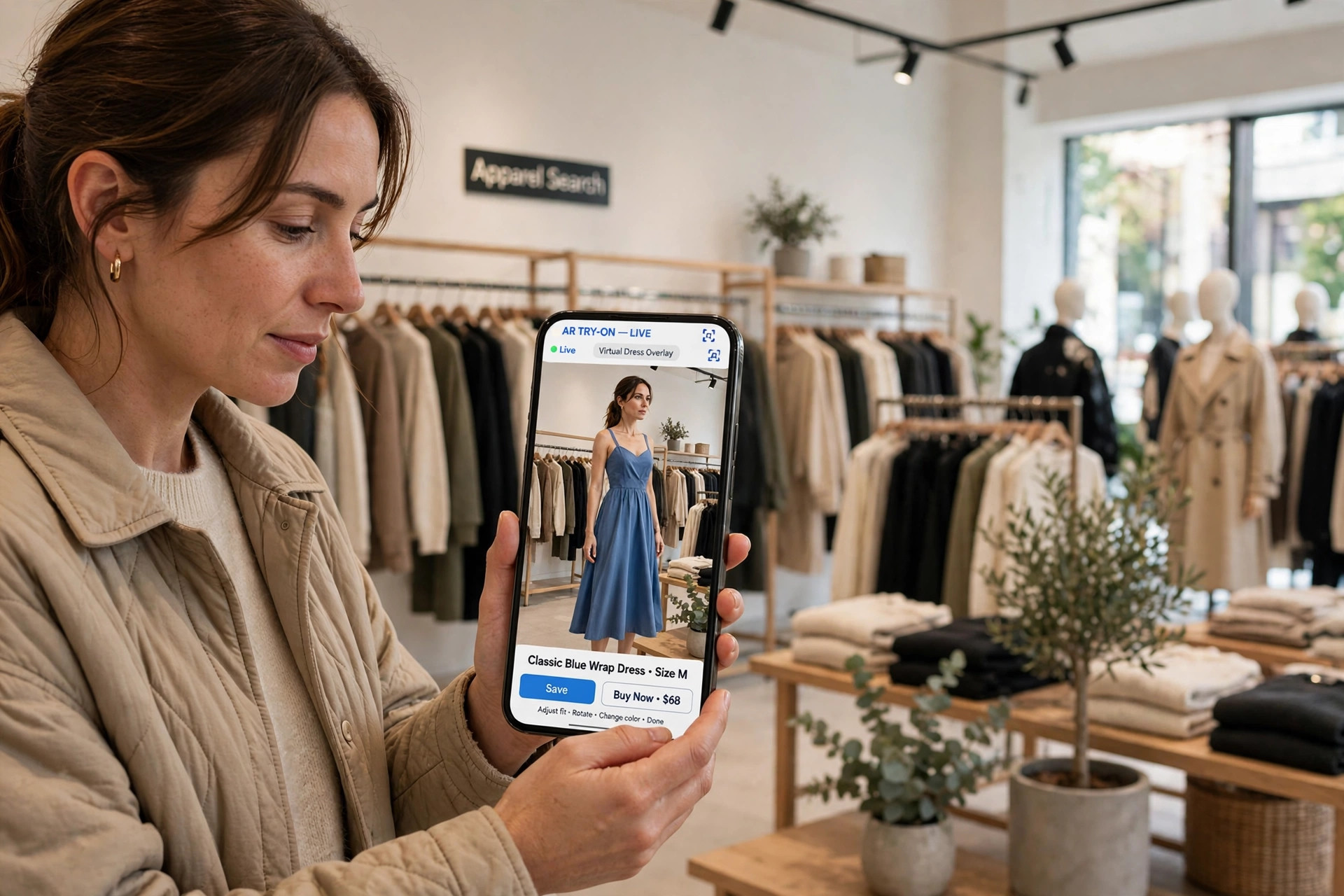
AR try-on and smart mirrors overlay a garment or accessory on a live camera image. In a store, a smart mirror can suggest sizes, colors and coordinating items without a trip to a fitting room, and staff can bring alternatives to the shopper. On a phone, AR is strongest where the item sits on a stable part of the body — a watch on a wrist, glasses on a face — and weakest for soft, loose garments that move with every step.
The Business Case
What Retailers Use It For
Retailers adopt try-on for practical reasons. The first is confidence at the moment of decision: a shopper who can picture a dress on a body like their own has one less reason to abandon the page or to order two sizes “just in case.” The second is discovery: try-on invites shoppers to experiment with colors and styles they would not risk untested, which suits outfit-building and occasion dressing. The third is returns reduction — with an important qualification. Try-on can reduce returns caused by “it looked different than I imagined,” but it does not, by itself, answer the size question. A rendering that flatters can even increase disappointment if the delivered garment fits differently than the picture suggested.
That is why try-on works best paired with genuine fit guidance. Apparel Search’s guide to AI Sizing and Fit Prediction covers the measurement side of the problem — the size recommendation engines that tell a shopper which size to order — and the two technologies are complements, not substitutes. Retailers evaluating the wider category, including inventory and personalization tools, will also find the listings in AI Tools for Fashion Retail useful context.
A useful test: before believing any try-on demo, run it on a garment with a distinctive check, stripe or print, in a size range the demo does not feature. Pattern placement, scale and alignment are where generated images most often improvise — and where a careful buyer can see the improvisation.
Honest Limits
Real Limits: Drape, Fit and Bodies
Fabric drape. A generative model predicts how a fabric probably folds; it does not know the actual fabric in the box. Weight, stiffness and surface texture change how a garment hangs, and two garments with identical product photos can behave very differently in person. Treat the rendered drape as a plausible preview, especially for fluid fabrics, structured tailoring and anything whose appeal is its movement.
Fit accuracy. A try-on image is not a fitting. It cannot reliably show whether a waistband will dig in, whether a shoulder seam sits correctly, or whether a shoe will pinch — and Google states plainly in its merchant guidance for the feature that the generated representation does not indicate fit or suggest a size. Retailers should never let a beautiful rendering carry a fit promise it cannot keep; the honest pairing is try-on for appearance, a sizing tool for size.
Diverse body types. Models learn from the images they are trained on. If training imagery under-represents larger bodies, shorter or taller shoppers, wheelchair users, pregnancy, or limb differences, renderings for those shoppers will be less accurate — sometimes subtly, sometimes obviously. Walmart’s model-choice approach and Google’s range of model body types are attempts to widen representation, but a retailer should test any system across the full range of bodies it actually serves, and invite correction when shoppers spot distortions of their own photo.
Garment detail. Logos, embroidery, lace, text on graphics and exact button placement can drift in generated images. For products where a detail is the reason to buy, the generated view should supplement — never replace — accurate product photography and written specifications.
Trust
Privacy and Body Data
Try-on asks for unusually personal inputs: a full-length photograph, sometimes measurements, sometimes a body scan. A shopper’s photo can reveal far more than a size — health clues, home surroundings, other people in the background. Responsible retailers state, in plain language, what happens to that image: whether it is processed on the device or uploaded, how long it is kept, whether it is used to train models, and how a shopper deletes it. Shoppers should prefer tools that work with the least data the task needs, and retailers should treat “we keep your photo to improve our models” as a consent question, not a footnote. Where body data is collected in a store, the same duties apply at the mirror as at the checkout.
Making the Choice
Choosing a Provider Type
A retailer choosing among provider types should start from the catalog, not the demo. Ask four questions. Coverage: can the system handle your whole catalog from assets you already have, or only a curated subset? Truthfulness: test it on patterned, textured and dark garments, and on bodies across your size range — and score it on errors, not on its best outputs. Fit honesty: does the provider separate appearance from sizing, and integrate with a real size recommendation tool rather than implying one? Data terms: who owns the shopper images and generated renders, how is consent captured, and what happens to the data if you leave?
Small retailers will usually start with photo-based generative try-on, because it needs no new photography and no 3D asset pipeline. Brands that already build garments in 3D can justify avatar-based systems that reuse those assets. Physical stores experimenting with smart mirrors should pilot in one department, measure fitting-room traffic and return reasons before and after, and keep a human fitting room experience fully available — the mirror is an addition, not a replacement. In every case, judge the pilot on your own shoppers and your own return reasons, not on a vendor’s headline figures.
Common Questions
Common Questions
What is AI virtual try-on?
AI virtual try-on is software that shows a garment on a body before purchase — on the shopper’s own uploaded photo, on a model with a similar body type, or as a live overlay in a camera or store mirror. Photo-based systems generate a new image of the person wearing the garment; 3D systems dress a digital avatar; AR systems overlay the item on a live view.
Does virtual try-on tell me my size?
No. A try-on image shows how a garment may look, not how it will fit, and it does not suggest a size. Google states this limit plainly in its merchant guidance for its try-on feature. Use a size recommendation tool for sizing, and treat try-on as help with appearance, color and proportion.
What is the difference between generative try-on and a smart mirror?
Generative try-on creates a still image from a shopper photo and a product photo, and works across a whole online catalog. A smart mirror is in-store hardware that overlays garments or suggestions on the shopper’s live reflection. Generative try-on scales online; mirrors add service and outfit suggestions inside a physical store.
What happens to my photo when I use virtual try-on?
It depends on the retailer and provider, which is why the privacy notice matters. A photo may be processed on the device or uploaded, kept briefly or stored, and in some cases used to improve models. Check how long the image is kept, whether it is used for training, and how to delete it before you upload.
Keep Exploring
More to Explore
AI Guides
Virtual Try-On and Fit Technology Directory
The companion Apparel Search directory of virtual try-on and fit technology providers and definitions.
Read the guide ↗AI Personalization and Recommendations
How recommendation engines decide which garments each shopper sees.
Read the guide ↗AI Shopping Assistants and Chatbots
Conversational assistants that help shoppers find and compare clothing.
Read the guide ↗Related Guides
Search Apparel Search