AI Tools for Fashion / Selling
AI Shopping Assistants and Chatbots for Fashion
AI shopping assistants hold the conversation between a shopper and a store: answering product questions, styling outfits, tracking orders and, in the newest agentic systems, searching, comparing and even buying with the shopper’s approval. This guide maps the main forms, separates sales help from service automation, names the quality pitfalls — including hallucinated product information — and sets out the disclosure every shopper is owed.
The Landscape
The Main Forms of AI Shopping Assistance
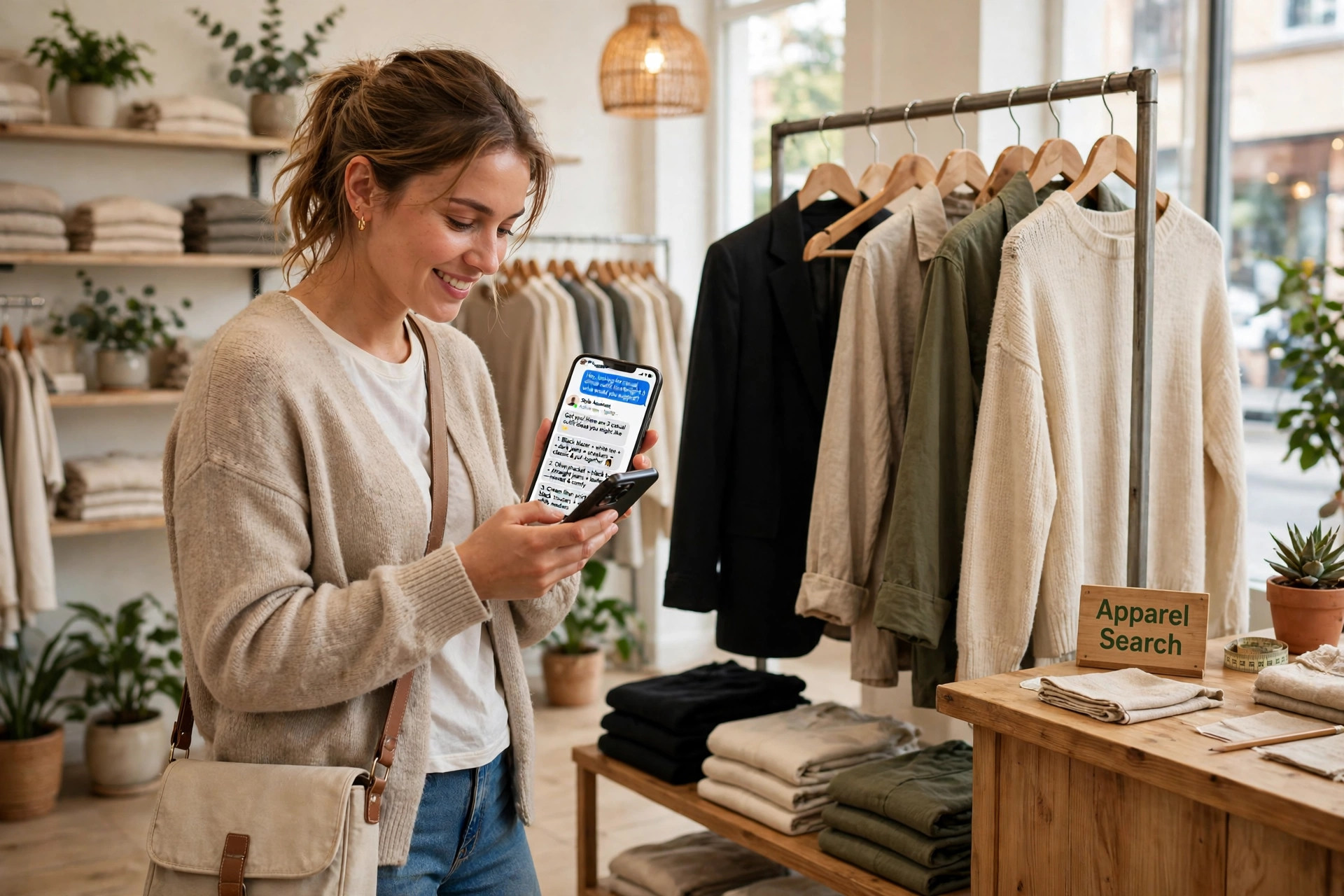
“Chatbot” now covers several different jobs, and a retailer choosing one should name the job first. On-site chatbots live on a store’s own pages and answer within that store’s catalog: where is my size, does this come in navy, what is the fabric, when will it ship. AI stylists go further into advice — building outfits, dressing for an occasion, working within a budget — and lean on the personalization methods covered in AI Personalization and Recommendations in Fashion Retail. Messaging assistants meet shoppers inside the chat apps they already use, handling product questions, order updates and reordering in a conversational thread. And platform assistants operate across many retailers at once: Amazon describes its assistant Rufus — renamed Alexa for Shopping in 2026, according to Amazon — as a generative AI shopping assistant trained on its product catalog, customer reviews and community questions, able to answer product questions, compare items and recommend by occasion or purpose.
What changed with generative AI is the conversation itself. Older bots matched keywords to scripted answers and failed the moment a question left the script. Current assistants understand phrasing, remember context within a conversation (“the same coat, but under $150, and not wool”), and compose answers from product data rather than reciting pages. That fluency is exactly why their failure modes deserve attention: a scripted bot that fails says “I don’t understand”; a generative assistant that fails may answer smoothly, confidently and wrongly.
| Type | Best at | Needs to work well | Typical failure |
|---|---|---|---|
| On-site product chatbot | Product facts, size and stock questions, guided finding | Accurate, current catalog and inventory data | Answering from stale data after a product changes |
| AI stylist | Outfit building, occasion dressing, gift suggestions | Good catalog attributes plus shopper preferences | Generic taste presented as personal advice |
| Messaging assistant | Order updates, quick reorders, questions inside chat apps | Order-system access and clear identity checks | Discussing an order with the wrong person |
| Customer-service automation | Delivery status, returns steps, common policy questions | Current policy text and a fast route to a human | Looping a frustrated shopper with no exit |
| Agentic shopping assistant | Searching, comparing and — with approval — buying across stores | Explicit user instructions, spending limits and confirmations | Buying the near-right item at the wrong size, price or seller |
Two Jobs, Two Standards
Sales Assistance Is Not Customer Service
An assistant that helps a shopper choose a dress and an assistant that resolves a failed delivery look identical in a chat window, but they should be judged by different standards. Sales assistance succeeds when the shopper finds a suitable item faster and with more confidence — measure it by completed purchases that are kept, not merely by conversations held. Service automation succeeds when the problem is actually resolved: the refund issued, the exchange arranged, the correct return label produced. A service bot that deflects a shopper from reaching a human without resolving anything has not saved a support cost; it has converted it into a lost customer and, often, a public complaint.
The boundary cases matter most. Returns handling is where fashion assistants most often disappoint: a shopper asking to return a final-sale item, exchange a size that is now out of stock, or report a defect needs the real policy, applied to their real order — not a cheerful summary of the returns page. Well-built systems check the order, state what is possible, do what they are permitted to do, and hand over to a person, with the conversation history attached, the moment the case leaves their authority. Retailers will find the commercial platforms for both jobs listed among the AI Tools for Fashion Retail, and the wider retail context in the Apparel Search Clothing Retail Guide.
The Newest Layer
Agentic Shopping: Assistants That Act
The newest assistants do not stop at advice. In agentic shopping, the shopper gives an instruction — find running shoes for a winter marathon under a stated budget, watch this coat and buy it if it drops to a stated price — and the assistant searches, compares and, with the shopper’s approval, completes steps of the purchase. Amazon has described its assistant gaining abilities of exactly this kind, including adding items to a cart and auto-buying at a price the customer sets. The convenience is real, and so are the new duties it creates. An agent spending a person’s money needs explicit instructions, clear spending limits, a confirmation step the shopper can actually review, an easy way to cancel standing instructions, and a complete record of what it did and why. “The assistant bought it” must never be the end of an inquiry; it is the beginning of one.
For fashion specifically, agentic buying raises the stakes on details agents are worst at: size, fit nuance, fabric hand, final-sale terms and seller legitimacy in marketplaces. A sensible rollout lets agents search and compare freely, shortlist with reasons, and stop for human approval before any purchase — widening their authority only for repeat, low-risk orders the shopper has explicitly defined.
Quality Control
Quality Pitfalls: Hallucinated Products and Confident Errors
Generative assistants can hallucinate: invent a fabric content, a care instruction, a size that does not exist, a delivery promise or even a product the store does not sell — stated in the same fluent tone as a correct answer. In fashion the costly versions are specific: “yes, that blazer is fully lined” when it is not; “this dye is colorfast in hot washes” when the care label says otherwise; “your return window is 60 days” when it closed last week. Each error creates a return, a chargeback risk or a consumer-protection problem, because shoppers reasonably treat the store’s own assistant as the store speaking.
The defenses are engineering and editorial discipline, not hope. Ground the assistant in the live catalog and policy data, and require it to answer product questions from those records or say it does not know. Test it with adversarial questions before launch — discontinued items, contradictory requests, policy edge cases — and keep testing after every catalog or policy change. Log conversations, review failures weekly, and treat every discovered hallucination as a defect with an owner, not an anecdote. And keep the human route visible: an assistant that hides its escalation path is telling shoppers their problem matters less than the deflection metric.
The one-sentence test
If the assistant’s answer would embarrass the store printed on a sign in its own window — wrong fabric, wrong price, wrong policy — the system is not ready, however impressive its demo conversation was.
Honesty by Design
Disclosure: The Shopper Should Know It Is AI
Shoppers should never have to guess whether they are talking to a person. Clear disclosure — the assistant identifies itself as AI at the start, in plain words — is both an ethical baseline and, in a growing number of jurisdictions, a legal one; rules on bot disclosure and deceptive AI practices continue to develop, and retailers should confirm the current requirements where their customers are. Disclosure also protects the brand: a shopper who knowingly chats with a capable assistant judges it as a tool; a shopper who discovers mid-conversation that the “associate” was software judges the store as dishonest, and prices every future interaction accordingly. The same honesty applies to recommendations: if placement is paid or an answer is sponsored, that connection should be visible in the conversation, not buried in terms no one opens.
Making the Choice
Choosing and Piloting an Assistant
Start with one job, not five. Pick the conversation your team already handles worst at scale — size questions at peak hours, delivery-status contacts, gift-finding in December — and pilot the assistant there, against a human-handled comparison group. Before launch, load it with your real catalog and policies, run the adversarial test set, and write down its authority limits: what it may answer, what it may do, and what it must hand over. After launch, review transcripts weekly, publish internally the errors found and fixed, and measure resolution and kept purchases rather than conversation counts. Expand to a second job only when the first is boringly reliable. An assistant that does one job flawlessly earns the trust — from shoppers and from your own staff — that a five-job demo never will.
Common Questions
Common Questions
What is the difference between a shopping chatbot and an AI stylist?
A shopping chatbot mainly answers questions within a store’s catalog — sizes, stock, fabric, shipping — while an AI stylist gives advice: building outfits, dressing for occasions and working to a budget using the shopper’s preferences. Many products blend both, but the jobs differ: facts first, taste second.
What is agentic shopping?
Agentic shopping means an AI assistant acts on instructions rather than only advising: it can search across products, compare options, monitor a price and, with the shopper’s approval and within limits the shopper sets, complete steps of a purchase. Well-designed agents confirm before buying, keep a record of what they did, and let the shopper cancel standing instructions easily.
Can an AI shopping assistant be wrong about a product?
Yes. Generative assistants can hallucinate — inventing a fabric, a size, a delivery promise or a return window in a confident tone. Retailers should ground assistants in live catalog and policy data, require them to say when they do not know, test them with difficult questions, and keep a visible route to a human.
Should a store tell shoppers they are talking to AI?
Yes. The assistant should identify itself as AI at the start of the conversation, in plain words. Disclosure is an ethical baseline, is legally required in a growing number of places, and protects trust: shoppers judge a known tool as a tool, but judge a store that disguised software as a person as dishonest.
Keep Exploring
More to Explore
AI Guides
AI Virtual Try-On Technology
How photo-based, 3D and AR try-on produce the image of a garment on a body.
Read the guide ↗AI Sizing and Fit Prediction
How fit prediction recommends the size a shopper is most likely to keep.
Read the guide ↗AI Marketing Tools for Fashion
AI tools for product descriptions, ad creative and lifecycle marketing.
Read the guide ↗Related Guides
Search Apparel Search