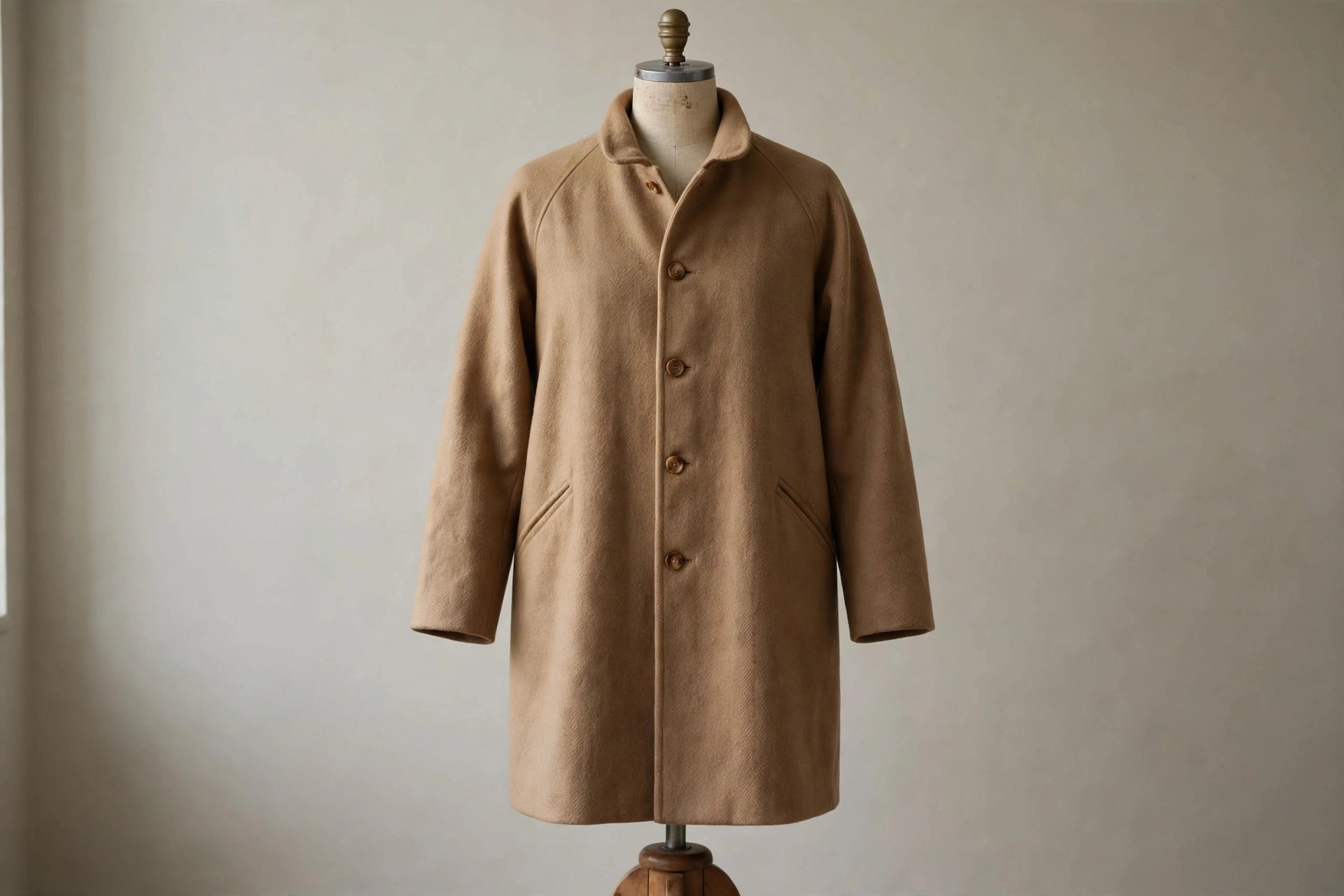
A Balmacaan coat is a single-breasted raincoat or overcoat defined by three features: raglan sleeves, a small neat Prussian collar, and a hidden fly front that conceals its buttons. The silhouette is loose and straight rather than belted or shaped, falling cleanly from the shoulders with nothing to interrupt the line. It takes its name from the Balmacaan estate near Inverness in Scotland, and it began as a country coat in tweeds and Lovat-toned wools before becoming a town staple in smoother cloth such as gabardine.
How It Differs From a Trench Coat and a Chesterfield
The Balmacaan is most often confused with the trench coat, but the two are easy to separate once you look at the details. A trench is belted, usually double-breasted, and carries military hardware: epaulettes, a storm flap, and buckled cuffs, with set-in sleeves. A Balmacaan has none of that: no belt, no epaulettes, no storm flap, a single row of hidden buttons, and raglan sleeves whose diagonal seams run from collar to underarm, giving the shoulder a soft, sloping line.
Against a Chesterfield, the difference is formality and sleeve. The Chesterfield is a dressier tailored overcoat with set-in sleeves, a velvet collar in its classic form, and a shaped, closer fit meant for suits and occasions. The Balmacaan is the relaxed relative: roomier, plainer, and designed to be thrown over whatever you are wearing. Traditional cloths were rough tweeds and muted Lovat greens and browns; modern versions also come in cotton gabardine and showerproof fabrics that return the coat to its raincoat roots.
Fit, Styling, and Care
That roominess is deliberate. The coat was made for layering, so it should slip easily over a jacket or a thick sweater without pulling, and the raglan shoulder accommodates layers better than a structured set-in sleeve. Length usually falls around the knee. If the coat feels neat and close in your usual size over a jumper, that is about right; it is not meant to be tailored to the body, and sizing down for a fashionably slim look defeats the design.
Styling follows from its easy character. It is one of the few overcoats that flatters both tailoring and knitwear: wear it over a suit for a softened, modern line, or over a sweater and jeans with boots for weekends. The small collar sits neatly open or buttoned to the top in bad weather. For care, brush wool versions down after wear, hang on a broad hanger to keep the raglan shoulder smooth, and follow the label for gabardine, which often tolerates gentle cleaning better than tweed.
The Balmacaan also travels well. Its soft raglan shoulder has no padding or structure to crush, the loose cut shrugs off creasing better than a tailored coat, and the hidden front looks presentable straight off a train or out of a car. It is the coat many people end up reaching for daily precisely because it asks so little: no belt to tie, no double row of buttons to align, nothing to adjust. Understated, forgiving of layers, and hard to wear wrong, it earns its place quietly.
Common Questions
- Why is it called a Balmacaan coat?
- The name comes from Balmacaan, an estate near Inverness in the Scottish Highlands, where this style of loose, single-breasted country coat was associated with outdoor wear in tweed and Lovat-toned wool. The name stuck as the coat moved from country use into town wardrobes, and it now refers to the cut, raglan sleeves, small collar, and hidden front, rather than to any particular fabric.
- Is a Balmacaan a raincoat or an overcoat?
- It can be either, depending on the cloth. In showerproof cotton gabardine it works as a raincoat; in wool tweed or melton it is a full overcoat for cold weather. The cut stays the same in both cases: single-breasted, fly front, raglan sleeves. Check the fabric and any water-resistant finish when buying, and choose the version that matches the job you need it to do.
- What is a fly front on a coat?
- A fly front is a flap of fabric that covers the button closure, so the buttons are hidden when the coat is fastened. It gives the Balmacaan its clean, uninterrupted front and also keeps wind and rain from reaching the buttonholes directly. Many raincoats and minimalist coats use the same device; on the Balmacaan it is one of the defining features, along with the raglan sleeve.
- Should a Balmacaan coat fit loose or tailored?
- Loose, by design. The coat was made to go over layers, including jackets and heavy knitwear, so it should feel roomy through the body and easy across the shoulders. A raglan sleeve has no fixed shoulder seam to judge fit by; instead check that the collar sits comfortably, the coat closes without strain over your bulkiest layer, and the length suits your height.
Classic Wardrobe Staples
Four enduring wardrobe classics that bring structure, polish, and character to everyday dressing.