Perfume Storage & Shelf Life
Light, heat and air are quietly ageing every bottle you own — how perfume degrades, how long it honestly lasts, and the simple rules that keep it fresh.
A bottle of perfume feels permanent — glass, alcohol, a satisfying weight in the hand. Yet every collector eventually meets the sad moment: a favourite sprayed after a year in a sunny bathroom smells sharp, thin and wrong. Perfume does not last forever, but it lasts far longer than most people fear when it is stored with even basic care. This guide explains what actually happens to perfume over time, how long you can honestly expect a bottle to stay good, how to recognise one that has turned, and the simple storage rules that protect the bottles you own.
Two neighbours complete the picture: our How Perfume Is Made guide ends with the bottling and quality-control steps that give a fresh bottle its best start, and our Sillage, Projection & Longevity guide explains why a degraded perfume performs weakly — the two pages together cover a bottle's whole life, from filling line to final spray.
The Short Version
- Perfume degrades rather than spoils: it rarely becomes unsafe, but oxidation slowly dulls it — top notes first.
- The three enemies are light, heat and air, with bathroom humidity and temperature swings close behind.
- Typical life: many perfumes keep well for years unopened; once opened, commonly cited around 3–5 years with good storage — citrus fades fastest, heavy orientals last longest.
- Store it dark, cool, stable, upright and in its box — a drawer or closet, never the bathroom shelf.
- Turned signs: darkened colour, a vinegar-sharp opening, and noticeably weaker projection.
Fragrance Guides
Does Perfume Expire?
Yes — but in its own way. Perfume does not spoil like food, grow mould or usually become dangerous; the alcohol base that carries the fragrance is itself a hostile environment for microbes, which is why perfume keeps far better than creams or lotions. What happens instead is slow chemical change, above all oxidation: oxygen reacts with the aromatic materials and gradually alters them. The change follows a predictable order. The light, volatile top notes — the bright citrus and fresh notes that open the scent — are the most fragile and fade or turn first. The heart follows over a longer period. The heavy base materials are the most durable, which is why a very old perfume often smells like a shadow of itself: the deep notes remain, recognisably related to the original, while the brightness that balanced them has gone.
This is also why age alone is a poor judge. A well-stored amber perfume can smell true after many years, while a fresh citrus cologne kept on a sunny windowsill can smell tired within a year. Storage matters more than the calendar, and composition matters almost as much — the next sections take each in turn.
The Three Enemies: Light, Heat and Air
- Light
- Ultraviolet light breaks down fragrance molecules directly, and it attacks colour as well as scent. It is why so many houses use tinted or opaque glass and sell bottles in boxes — that packaging is protection, not decoration. A bottle displayed on a bright dresser or windowsill is ageing every sunny day, however pretty the arrangement looks.
- Heat
- Warmth speeds up every chemical reaction involved in ageing, oxidation included, and pushes the delicate top notes out fastest. Radiators, hot cars, sun-warmed shelves and rooms that overheat in summer all shorten a bottle's life. Just as damaging are swings: a bottle that warms each afternoon and cools each night repeatedly expands, contracts and breathes, stressing the formula far more than a steady, slightly warm room would.
- Air
- Every spray admits air to replace the liquid that left, and the oxygen in that growing air pocket — the headspace — works on what remains. A nearly full bottle ages slowly; a bottle sprayed down to its last quarter, with far more air pressing on far less liquid, ages fastest of all. This is the unavoidable cost of use, and the reason finishing a beloved bottle is better stewardship than rationing it for a decade.
- Humidity and the bathroom problem
- The bathroom, where most bottles live, combines nearly every risk: heat and steam from showers spike the temperature and humidity daily, and the swings repeat morning and night. Humidity does not seep through sealed glass, but it stresses caps, sprayers, labels and boxes, and the temperature cycling does the real damage to the liquid. If you take one rule from this page, take this one: apply perfume in the bathroom if you like, then store it somewhere else.
How Long Does Perfume Actually Last?
Honest answer first: there is no universal expiry date, and any single figure is a generalisation across very different formulas and homes. With that said, the ranges commonly cited by houses and fragrance editors are a useful planning basis. An unopened bottle, sealed and stored cool and dark, commonly stays good for years — often well beyond the opened figures below, and sturdy formulas can remain enjoyable for a very long time. Once opened, the commonly cited working life is around 3 to 5 years with decent storage, and many bottles exceed it. Treat those numbers as a quality curve rather than a cliff edge: a perfume does not turn on a birthday; it gradually loses its top, then its balance.
Composition moves a bottle within — and beyond — those ranges:
- Citrus and fresh scents fade fastest
- Their character lives in exactly the volatile materials that oxidation takes first. A light cologne or fresh floral is the bottle to use and enjoy promptly rather than save, and the first to check if it has been stored badly.
- Florals and everyday eau de toilette styles sit in the middle
- Commonly good through the middle of the 3-to-5-year window and often beyond, especially with a meaningful base of musk or woods underneath the flowers.
- Heavy orientals, ambers, woods and parfums last longest
- Built on the most durable materials, these commonly outlast the standard range, and well-kept examples are the ones collectors report enjoying after many years. Some even seem to deepen pleasantly for a time as the blend settles — the same settling, at production scale, that maceration achieves before bottling, as described in How Perfume Is Made.
Many bottles carry a small "period after opening" symbol — an open jar marked, for example, 36M — suggesting use within that many months of opening. Read it as the maker's conservative promise under ordinary conditions, not a laboratory verdict on your carefully stored bottle.
Signs a Perfume Has Turned
- The colour has darkened
- Oxidation commonly deepens a pale liquid toward amber or brown. Darkening alone is a warning rather than a verdict — some ingredients deepen naturally — so confirm with your nose before mourning the bottle.
- The opening smells sharp, sour or like vinegar
- The classic sign. Because top notes go first, a turned perfume announces itself in the first minutes: a vinegary, metallic or harshly sharp edge where the fresh opening used to be. Spray a blotter and judge the first five minutes carefully.
- The projection has weakened
- A degraded perfume commonly sits closer and fades faster than it used to — its sillage and longevity shrink together, because the materials that lifted it off the skin are the ones that have gone. If a once-generous scent now needs your nose at your wrist within the hour, suspect the bottle, not your skin.
- The drydown smells flat or simply different
- Late-stage change: the base remains but the balance is gone, leaving a scent that is recognisably related to the original yet dull, thin or oddly sweet. At this point the perfume is a keepsake, not a fragrance.
A practical check combines all four: look at the colour against a fresh memory or photo, spray a blotter, judge the opening, then wear a small amount on one wrist and compare its strength at midday with what you remember. If the opening is sour, retire the bottle from skin — oxidised perfume can irritate sensitive skin and is more likely to mark fabric — though it may still serve to scent a drawer or a room spray experiment where its flaws matter less.
The Storage Rules
Good storage is five habits, all easy:
- Dark
- A drawer, a closet shelf or a closed cabinet. Darkness is the cheapest protection there is, and it costs the bottle nothing in convenience.
- Cool and stable
- Ordinary room temperature in a room that does not overheat — commonly suggested around 55 to 72 degrees Fahrenheit (roughly 12 to 22 degrees Celsius) — with stability valued over chasing the coldest spot. Away from radiators, sunny walls and exterior windows.
- Upright and capped
- Standing upright keeps liquid away from the sprayer mechanism and minimises contact with the air pocket; the cap keeps dust out and evaporation down. Keep caps on between uses rather than leaving bottles open on the dresser.
- In the box, if you have it
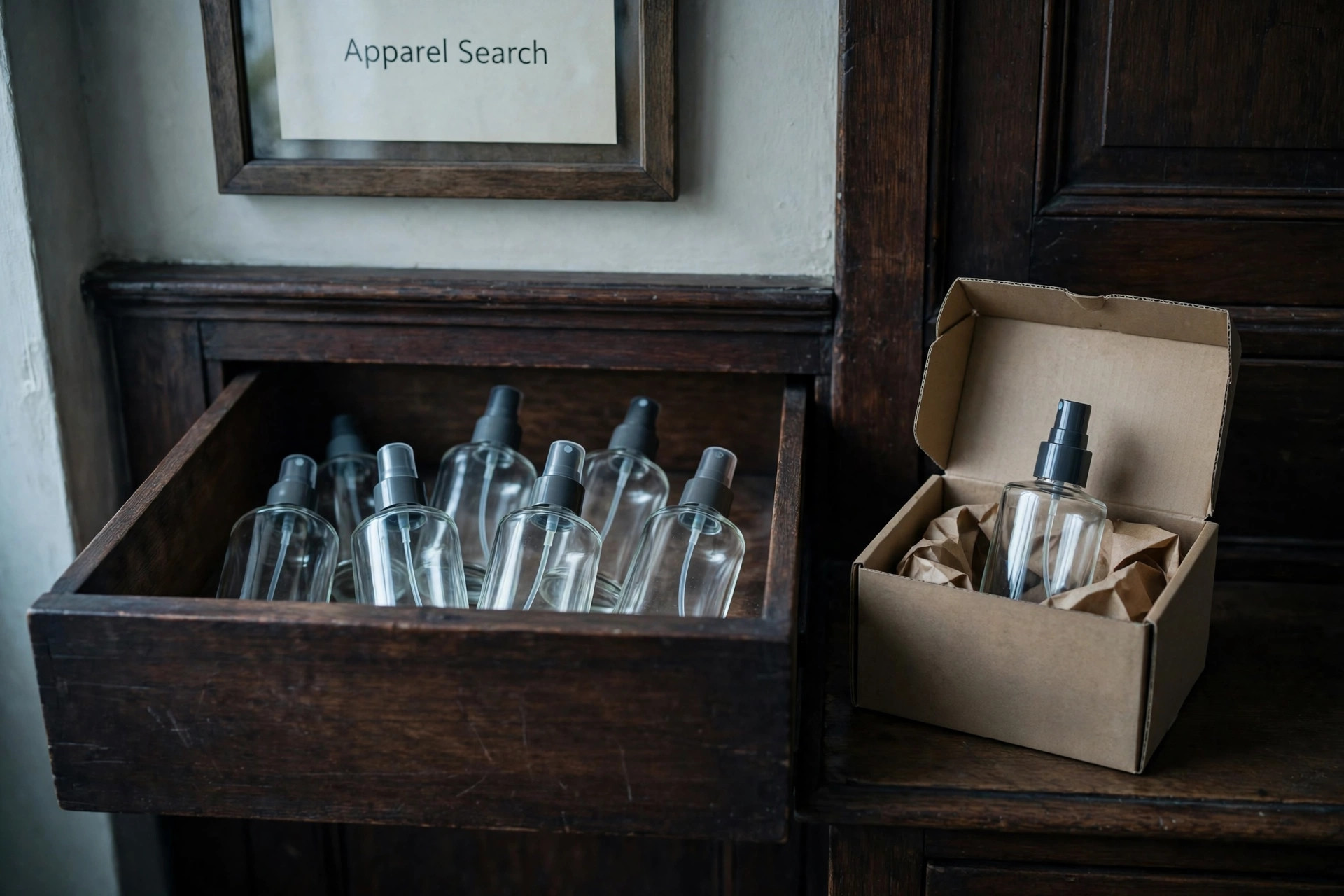
- The original box blocks light and cushions small temperature changes. Bottles you wear daily can live unboxed in a dark drawer; bottles in reserve genuinely benefit from their boxes.
- Out of the bathroom
- For the heat-and-humidity reasons above, the bathroom cabinet is the one popular storage place to avoid. A bedroom drawer or closet is almost always the better home.
Decants and Travel Sprays: The Air Trade-Off
Decanting — transferring perfume into a small travel sprayer or sample vial — is genuinely useful: it makes a favourite portable, protects the main bottle from being carried and dropped, and lets you share or test small amounts. But every transfer exposes the liquid to air and light, and the small container then holds a high proportion of air to liquid, so a decant ages faster than the bottle it came from. The sensible practice follows from that: decant small amounts you will use within weeks or a few months, fill the travel sprayer reasonably full rather than leaving it mostly air, label it with the name and date, store it with the same dark-and-cool care, and keep the main bottle sealed at home as your reserve. A decant is a working copy, not an archive.
What Not to Do — Including the Fridge Question
A few popular ideas deserve careful handling. Refrigeration is debated, and the honest summary is that experts genuinely disagree: cold and darkness do slow oxidation in principle, and some perfumers and houses endorse the fridge, particularly for colognes, for fragile citrus scents, for sealed backup bottles, or in homes that run hot for long stretches. Others advise against it for everyday bottles, pointing to the temperature cycling each time a kitchen fridge is opened, condensation on cold glass brought into warm air, and the risk of a daily bottle being chilled and warmed repeatedly — swings being worse than a steady cool room. The safe advice for most people is the boring one: a cool, dark, stable drawer or closet keeps perfume well for years, and the fridge is an optional tool for hot homes and long-term reserves rather than a requirement. If you do refrigerate a bottle, keep it boxed, at the back, and let it stay there rather than moving it in and out daily.
Beyond the fridge: do not store bottles on windowsills or in cars, do not leave caps off, do not shake bottles in the belief it refreshes them, and do not decant your whole collection "for organisation" — you would be trading the main bottles' sealed protection for many small, airy containers ageing in parallel. Finally, do not ration a beloved opened bottle for a special decade that may never come. Perfume is at its best in its first years; wearing it generously is the preservation strategy, because a finished bottle never has the chance to turn.
Store a bottle with these simple courtesies — dark, cool, steady, upright, boxed — and it will repay you by smelling, years from now, the way its perfumer intended.
Common Questions
Does perfume expire?
Perfume degrades rather than spoils. It rarely becomes unsafe — the alcohol base resists microbes — but oxygen slowly oxidises its aromatic materials, dulling the scent. The fragile top notes go first, then the heart, while heavy base notes last longest. A well-stored bottle commonly stays enjoyable for years; a badly stored fresh scent can smell tired within a year.
How long does perfume last once opened?
With decent storage — dark, cool and stable — the commonly cited working life is around 3 to 5 years after opening, and many bottles exceed it. Composition matters: citrus and fresh scents fade fastest, florals sit in the middle, and heavy oriental, amber and woody perfumes and parfums last longest. Unopened bottles stored cool and dark commonly keep well for years longer.
What are the signs that a perfume has turned?
Look for a colour that has darkened toward amber or brown, an opening that smells sharp, sour or vinegar-like instead of fresh, noticeably weaker projection and longevity than you remember, and a drydown that smells flat or simply different. Confirm colour changes with your nose — the sour opening is the most reliable sign.
Should I keep perfume in the fridge?
It is debated, and for most bottles unnecessary. Cold and darkness slow oxidation, so refrigeration can help in homes that run hot, for fragile citrus colognes or for sealed backup bottles kept for years. But repeated moves between cold and warm, and condensation on the glass, can do harm of their own. The safe default is a cool, dark, stable drawer or closet at room temperature.
Why is the bathroom a bad place to store perfume?
Because it combines heat, humidity and daily temperature swings: every hot shower spikes the room's temperature and fills it with steam, and that repeated cycling stresses the formula and ages it faster than a steady room would. Humidity also attacks caps, sprayers, labels and boxes. Apply perfume in the bathroom if you wish, but store the bottle in a bedroom drawer or closet.