How Perfume Is Made
Petals, peels, resins and laboratory molecules — how raw ingredients are captured, blended by a perfumer, aged, diluted and bottled into the fragrance you wear.
A finished bottle of perfume looks simple: scented liquid, a sprayer, a box. Behind it sits one of the longest production chains in all of beauty — part agriculture, part chemistry, part craft. A single fragrance may begin as jasmine picked at dawn in the south of France, bergamot peel from Calabria, resin tapped from trees in Oman and molecules built in a laboratory, and it passes through the hands of farmers, distillers, chemists and a perfumer before a factory ever fills a bottle. This guide walks that chain in order: where the raw materials come from, how their scent is extracted, how a perfumer composes them into a formula, and what happens between the approved blend and the bottle on your dresser.
Two companion guides complete the picture. Our Fragrances & Perfumes Guide covers the finished product — the concentration ladder from parfum to eau fraîche, and how to apply it — while Fragrance Notes & Scent Families explains the top, heart and base structure of the scent itself. This page is about everything that happens before you spray.
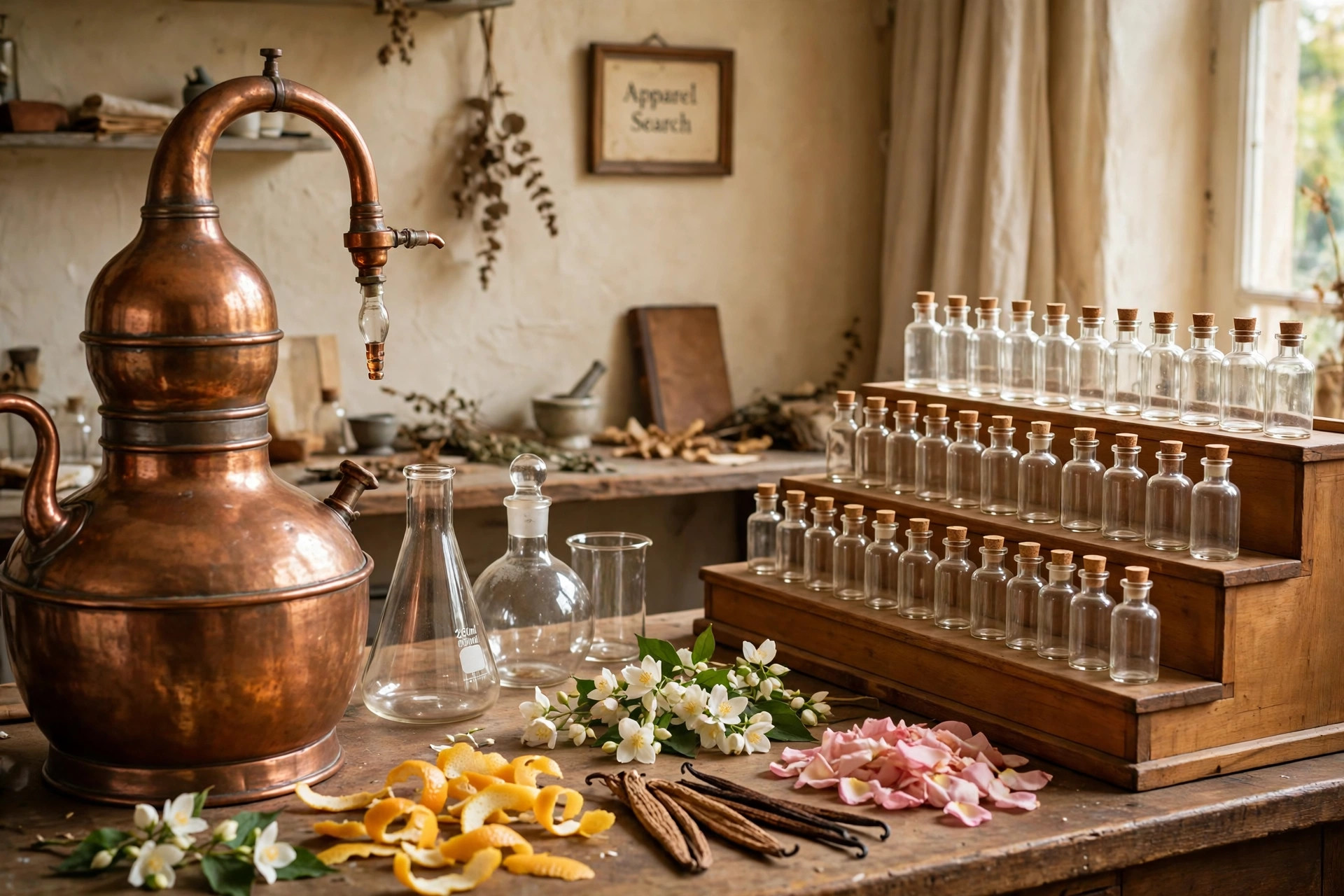
The Short Version
- Gather: raw materials are harvested (flowers, peels, woods, resins, spices) or synthesized in a laboratory.
- Extract: the scent is captured by distillation, cold-pressing, solvents, CO2 — or, historically, enfleurage.
- Compose: a perfumer blends dozens of materials into a formula, through trial after trial at the perfumer's organ.
- Age and dilute: the concentrate is macerated for weeks, then diluted in alcohol to its final strength.
- Finish: the blend is chilled, filtered, quality-checked and bottled.
Fragrance Guides
Step 1 — Gathering the Raw Materials
Every perfume starts as a palette of raw materials, and a working perfumer's palette runs to thousands of ingredients drawn from two sources: nature and the laboratory.
The natural materials are the romantic end of the trade, and the most labour-intensive. Flowers dominate: jasmine is picked in the early morning, when its scent is strongest and before the sun can fade it; the rose de mai of Provence has a flowering window of only a few weeks in May and June; tuberose, orange blossom, lavender, iris and violet leaf all have their own seasons and regions. Citrus peels — bergamot, lemon, bitter orange — are squeezed rather than picked for scent. Woods and roots bring depth: sandalwood, cedarwood, vetiver, orris (the aged root of the iris, one of the most expensive materials in perfumery). Resins and balsams such as frankincense, myrrh and labdanum are tapped or gathered from trees and shrubs, and spices — cardamom, pink pepper, vanilla pods — arrive through the same trade routes as the kitchen kind.
Some materials in the classical palette came from animals: musk from the musk deer, ambergris from sperm whales, civet and castoreum. Modern perfumery has almost entirely replaced them with synthetic equivalents — for reasons of conservation, law, cost and consistency — so a contemporary perfume that lists musk is describing a family of laboratory molecules, not an animal product.
The laboratory half of the palette is just as important, and older than most people expect. The first synthetic aroma chemicals arrived in the late nineteenth century — coumarin, synthesized in 1868, and vanillin, in 1874 — and they changed perfumery permanently. Synthetics let a perfumer use smells that nature will not surrender at all (lily of the valley and most soft fruits cannot be extracted and exist only as laboratory reconstructions), they smooth out the variation between one harvest and the next, and they keep a formula affordable and stable at production scale. Nearly every modern fragrance, at every price, uses both halves of the palette.
Step 2 — Extracting the Scent
A petal does not smell like a perfume ingredient until its aromatic molecules have been captured in a usable form — an oil, an absolute or a tincture that can be measured, stored and blended. Perfumery has developed a handful of extraction methods, each suited to different materials:
- Steam distillation
- The workhorse method. Steam is passed through the plant material — lavender, rose petals, woods, leaves — and carries the volatile scent molecules with it; when the steam condenses, the essential oil floats on top of the floral water and is separated off. It is simple and ancient, but the heat can damage delicate flowers, and the yields can be startlingly small: several tonnes of rose petals may be needed to produce a single kilogram of rose oil, which is why the genuine article is so expensive.
- Expression (cold pressing)
- Used for citrus. The peel of bergamot, lemon, orange or grapefruit is mechanically pressed or grated so that the tiny oil glands in the rind burst and release their oil, which is then separated from the juice and pulp. No heat is involved, which keeps the bright, fresh character that makes citrus the classic opening of a fragrance.
- Solvent extraction
- For flowers too delicate for steam — jasmine above all, and tuberose. The material is washed in a volatile solvent that draws out the aromatic compounds along with natural waxes, producing a waxy solid called a concrete. Washing the concrete with alcohol and chilling away the waxes leaves a concentrated liquid, the absolute, which is the form the perfumer uses. Absolutes smell exceptionally true to the living flower.
- CO2 extraction
- The modern method. Carbon dioxide under high pressure behaves partly like a liquid and partly like a gas, and can be used as a gentle solvent at low temperatures. It leaves no solvent residue, protects delicate notes that heat would spoil, and can be tuned to capture different fractions of a material's scent. Many houses prize CO2 extracts for their freshness and fidelity.
- Enfleurage
- The historical method of Grasse. Fresh petals were pressed daily into purified, odourless fat spread on glass plates; the fat slowly absorbed the scent, and the resulting pomade was washed with alcohol to release it. Beautiful and effective, it was also ruinously slow and labour-intensive, and solvent extraction replaced it commercially. It survives as a heritage craft — and as the reason Grasse's jasmine became legendary.
- Headspace capture
- Not an extraction but an analysis: a glass dome is placed over a living flower, the scented air around it is drawn off and analysed in a laboratory, and the molecule-by-molecule report lets chemists rebuild the scent synthetically. Headspace is how perfumers obtain convincing versions of flowers that yield no extract at all.
Step 3 — The Perfumer and the Organ
The person who turns ingredients into a fragrance is the perfumer — informally, the "nose." It is a small profession with a long apprenticeship. A perfumer must first memorize the smell of hundreds of raw materials, in their pure form and in dilution, the way a musician learns scales; formal training runs through perfumery schools such as those in Grasse and ISIPCA in Versailles, or through the internal schools of the large fragrance houses, and mastery takes years of daily smelling and blending.
The perfumer's traditional workstation gives the craft one of its best images: the organ, a tiered, semicircular desk with raw-material bottles arranged in stepped rows, like the pipes of a church organ. The name is apt — the perfumer is said to compose with odours as a musician composes with notes, choosing materials the way a composer chooses instruments and arranging them into chords, called accords: small blends of a few ingredients that together smell like something new.
Most perfumers work for fragrance houses — the specialist companies that develop scents on commission — or in-house for the largest luxury brands. A project usually begins with a brief: a written description from the brand of the scent it wants, its audience, its price point and the feeling it should carry. The perfumer answers the brief with a formula.
Step 4 — Composing the Formula
A formula is a recipe written in weights: so many parts of each material, adding up to a perfume concentrate. Composing one is an exercise in controlled trial and error. The perfumer builds the accord structure around the architecture described in our notes and families guide — volatile materials for the opening, the characterful heart, and the heavy base materials that will still be on the skin in the evening — then makes a trial blend, smells it on a paper strip (a mouillette), adjusts, and blends again. A single project can run through dozens or even hundreds of these modifications, called mods, before the brand approves one.
The judging is not only about beauty. The perfumer is simultaneously balancing how far the scent projects from the skin (its sillage), how long it lasts, how it behaves at the target concentration, what the formula costs per kilo — some natural materials cost more than gold by weight — and whether it complies with the safety standards set by the International Fragrance Association (IFRA), which restrict or limit certain ingredients. A formula that smells wonderful but fails any of those tests goes back to the organ.
Step 5 — Maceration, Dilution and Filtration
Once a formula is approved, production begins by blending the concentrate at scale, exactly following the recipe. The fresh concentrate is then macerated: left to rest in tanks, typically for several weeks and sometimes for months. During maceration the ingredients react gently with one another and the blend settles into its final character — harsh edges soften, and the scent becomes rounder and more unified than the day it was mixed. Rushing this step is one of the easiest ways to make a perfume smell unfinished.
The matured concentrate is next diluted with perfumer's alcohol (usually with a small proportion of water) to the strength the product will be sold at — the concentration ladder of parfum, eau de parfum, eau de toilette and the rest, which our Fragrances & Perfumes Guide sets out in full. The diluted perfume is then chilled and filtered to remove any waxes or particles that would cloud it, and rested again briefly before bottling.
Step 6 — Bottling and Quality Control
Before any batch is filled, it is checked against the reference standard for that fragrance — smelled by trained evaluators and analysed in the laboratory to confirm that this batch matches the approved formula, since natural materials vary slightly from harvest to harvest and the blend may need a final, minute adjustment. The approved perfume then goes to the filling line: bottles are filled, fitted with their spray pumps and caps, labelled, batch-coded and boxed. If you want to see this end of the process rather than read about it, our Perfume Videos page collects films of perfume being made, blended and bottled, including the BBC's three-part Perfume documentary.
Grasse: The Town That Taught the World Perfumery
No account of how perfume is made is complete without Grasse, the small town in the hills above the French Riviera that became the industry's capital. Grasse began in leather: its tanneries and glove-makers were famous, and when scented gloves became fashionable the town's craftsmen found that perfuming leather was more profitable than tanning it. By the eighteenth century Grasse had largely exchanged hides for flowers, and its surrounding fields — the pays de Grasse — filled with jasmine, rose de mai, tuberose, orange blossom and lavender grown expressly for perfumery.
The town's historic houses still anchor its identity: Galimard, founded in 1747 and supplier of scented products to the court of Louis XV, is among the oldest perfume houses in the world, and Fragonard and Molinard followed in later centuries. In 2018 UNESCO added "the skills related to perfume in the Pays de Grasse" — growing the plants, processing the raw materials and composing the perfumes — to its list of the Intangible Cultural Heritage of Humanity. Much of the world's fine-fragrance expertise, and many of its perfumers, still train or work in and around Grasse.
Natural and Synthetic: Partners, Not Rivals
Marketing sometimes presents natural and synthetic ingredients as opponents, with "natural" as the virtue. Perfumers themselves do not work that way. Natural materials bring complexity and a living, shifting quality that synthetics imitate imperfectly; a fine jasmine absolute or a real sandalwood has depths no single molecule reproduces. Synthetics bring what nature cannot: scents that cannot be extracted at all, batch-to-batch consistency, supply that does not depend on a harvest, freedom from over-harvesting pressure on vulnerable plants such as Indian sandalwood, and price points that let more people wear good fragrance. The craft lies in the blend of the two — and if you enjoy experimenting with how scents combine on your own skin, our guide to perfume layering is the practical next step.
Common Questions
How long does it take to make a perfume?
The hands-on steps are quick compared with the creative ones. Developing a formula can take a perfumer weeks to many months of trials, and a full launch from the first brief to a filled bottle commonly runs a year or more. After that, each production batch is blended, macerated for several weeks, diluted, chilled, filtered and bottled — a matter of weeks per batch once the formula exists.
What is a perfumer's organ?
The perfumer's traditional workstation: a tiered, semicircular desk holding rows of bottles of raw materials in stepped ranks, arranged so the perfumer can reach hundreds of ingredients while composing. It is named after the musical organ because the tiers of bottles resemble organ pipes and stops — and because the perfumer is said to compose with scent the way a musician composes with notes.
What is the difference between a concrete and an absolute?
Both come from solvent extraction. When a solvent draws the aromatic material out of flowers or other plant matter, the first product is a waxy, semi-solid mass called a concrete. Washing the concrete with alcohol and removing the waxes leaves a concentrated liquid called an absolute — the form perfumers actually use, prized for delicate flowers such as jasmine whose scent heat would damage.
Is enfleurage still used to make perfume?
Almost never at commercial scale. Enfleurage — pressing fresh petals into purified fat so the fat absorbs their scent, then washing the scent out with alcohol — is slow and extremely labour-intensive, and solvent and CO2 extraction do the same job faster and more consistently. It survives mainly as a heritage craft demonstrated in Grasse, where it was once the town's signature method for jasmine and tuberose.
Why is there alcohol in perfume?
Alcohol is the carrier. Undiluted perfume oils are far too strong to wear and can irritate skin, so the finished concentrate is diluted in perfumer's alcohol (usually with a little water). The alcohol dissolves the oils evenly, helps the scent lift off the skin and project, and evaporates cleanly within moments of spraying, leaving the fragrance itself behind.