Apparel Search Consumer Guides
Blazer vs. Sport Coat
Two jackets, two different jobs: the honest comparison of cloth, buttons and formality — and how each should fit.
Shops use 'blazer' for any odd jacket on the rail, and men reasonably repeat them — but a blazer and a sport coat are different garments with different jobs, and the difference is not pedantry. It decides what the jacket is made of, what it can be worn with, and how formal it reads across a room. Confusing them is how a man ends up wearing an orphaned suit jacket with jeans, wondering why the outfit looks off (it is the jacket: its cloth was woven to match a pair of trousers, not to stand alone). This page makes the honest comparison, and then covers how each should fit — which is mostly the suit jacket's rules, applied from our how a suit should fit guide.
The Blazer: A Solo Jacket in a Uniform's Cloth
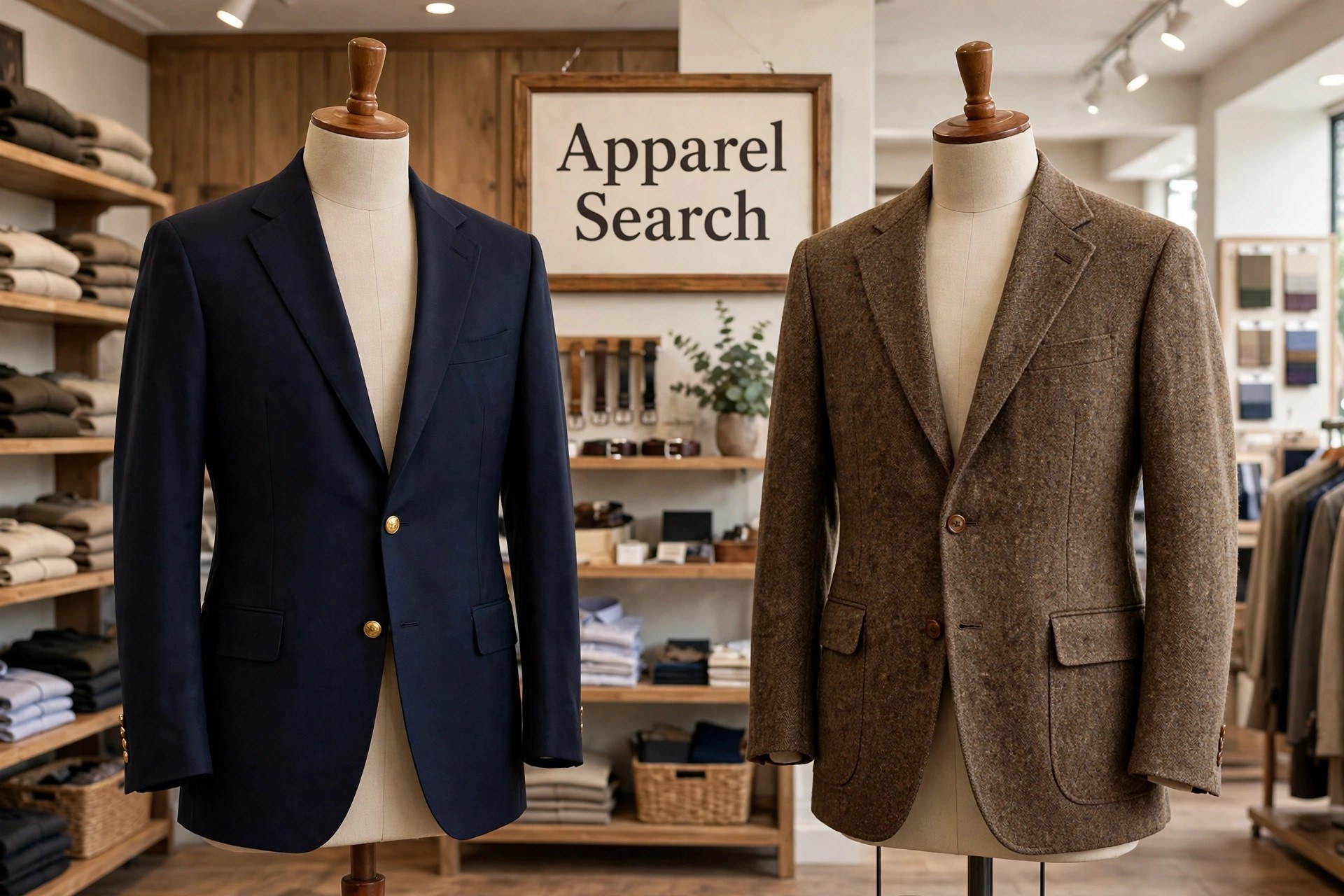
A blazer is the tailored jacket defined by what it does not have: no matching trousers. Its classic form is navy — dark, smooth and solid — in a worsted wool or an open hopsack weave, with buttons that declare themselves: brass or gold metal traditionally, horn on quieter versions. The cut is a suit jacket's cut, the pockets flap or patch, and the whole garment carries a faint naval and club heritage — it began as the jacket of rowing clubs and ships' officers, which is why it still reads as the most formal of the odd jackets. Because its cloth is smooth and solid, a blazer pairs the way a frame does: it sets off grey flannel trousers, khakis, even dark jeans, without ever competing with them. What it never does is pretend to be half of a suit — navy blazer and navy trousers in mismatched cloth is the one combination to avoid, since the eye reads it as a suit that failed.
The Sport Coat: Texture Is the Point
The sport coat (sport jacket in American shops, and close cousin to the British hacking jacket) was born outdoors — shooting, riding, country weekends — and it still wears that origin in its cloth. Where the blazer is smooth, the sport coat is textured or patterned: tweed, herringbone, houndstooth, birdseye, flannel checks, corduroy, linen for summer. Buttons are horn, leather or nut rather than metal; patch pockets are common, and older country versions add leather elbow patches. A sport coat is designed to sit over knitwear and open collars, with odd trousers — cords, moleskins, chinos, jeans — rather than fine dress trousers. It is the more personal garment: two men's sport coats can be wildly different from each other in a way two navy blazers never are.
Side by Side
The Blazer
- Color & pattern: solid, classically navy; black and dark green exist but navy is the standard.
- Cloth: smooth — worsted wool, hopsack, flannel at the softest.
- Buttons: metal (brass/gold) or horn; the buttons are a feature, not a detail.
- Formality: the top of the odd-jacket scale — a step below a suit, above everything else without matching trousers.
- Wears with: grey flannels, dress trousers, chinos, dark jeans; a tie is welcome.
The Sport Coat
- Color & pattern: patterned or visibly textured — checks, tweeds, herringbone; rarely solid, never plain navy by convention.
- Cloth: textured — tweed, flannel, corduroy, linen, hopsack blends.
- Buttons: horn, leather or matte nut; patch pockets are a signature.
- Formality: the relaxed end of tailoring — above a sweater alone, below a blazer.
- Wears with: odd trousers, cords, chinos, jeans; knitwear underneath, tie optional.
The shortest honest test in the shop: if the jacket is solid navy with bright buttons, it is a blazer whatever the label says; if it has pattern or texture you can feel, it is a sport coat. Everything else is a variation on those two ideas.
How Each Should Fit
Fit for both follows the suit jacket's law, because both are built on the same frame. The shoulder seam belongs at the shoulder bone, the collar against the neck, the button closing without an X of pulled cloth, the hem covering the seat, and the sleeve showing a sliver of shirt cuff — the full sequence is in our suit fit guide, and our men's blazers guide covers the garment styles in depth. Two differences are worth knowing. First, the sport coat is often worn over a sweater, so try it with the layer you intend: a touch more ease through the body is legitimate here, provided the shoulders do not grow with it. Second, the blazer frequently substitutes for a suit jacket in dressed-up settings, so it should be fitted like one — clean through the waist, nothing relaxed that would look slack next to dress trousers. Neither jacket forgives a wrong shoulder, and neither is saved by correct buttons: fit first, identity second.
Which Should You Buy First?
For most men, the blazer — because it covers more of the map. One navy blazer handles every 'smart' occasion that is not a suit occasion: dinners, ceremonies, client days, funerals at the edge of its range, and it flatters both dress trousers and jeans. Buy the sport coat first only if your life runs the other way — mostly casual, mostly country or creative settings, knitwear more common than ties — where the blazer's formality would sit unused. Own both eventually and the question the comparison began with answers itself each morning: the blazer when the day needs polish, the sport coat when it needs character. Readers dressing for an office will find the rotation these jackets belong to in our men's work wardrobe essentials page (linked below), and the formality ladder both jackets sit on in the dress codes hub.
Common Questions
Is a suit jacket the same thing as a blazer?
No. A suit jacket is cut from cloth matched to its trousers — smooth, usually solid or subtly patterned — and worn alone it reads as exactly what it is: half a suit. A blazer is designed to stand alone, classically solid navy with distinctive metal or horn buttons and no trousers made to match it. The orphaned suit jacket is the most common odd-jacket mistake precisely because the two look similar on the hanger and read differently on the body.
Which is more formal, a blazer or a sport coat?
The blazer, and clearly. A navy blazer with metal buttons sits one step below a suit and can carry dress trousers and a tie into most smart settings. A sport coat — textured, patterned, in tweeds and flannels — sits a step below the blazer, in company with knitwear, cords and open collars. When an occasion is ambiguous, the blazer is the safer reach; when it is plainly relaxed, the sport coat has more personality to offer.
Can a sport coat be worn with matching trousers as a suit?
It should not be assembled into one. A suit is jacket and trousers cut from the same bolt of cloth; a sport coat paired with near-matching trousers produces the worst of both — a suit that fails to match. Sport coats are meant to contrast with their trousers: tweed over grey flannel, herringbone over cords or chinos. If the combination makes a stranger look twice to decide whether it matches, change one of the pieces.
What trousers go best with a navy blazer?
Mid-grey flannel is the classic answer — the contrast is clean and the pairing works from office to ceremony. After that: charcoal trousers for a darker register, khaki chinos for the lighter and more casual one, and dark, clean jeans at the relaxed end. The one pairing to avoid is navy trousers in a different navy cloth, which reads as a mismatched suit rather than a deliberate outfit.
Back to the How a Suit Should Fit Guide
The full fit check — shoulders, button stance, sleeves, waist and seat — plus what a tailor can and cannot fix.