Apparel Search Consumer Guides
Camera Bags & Backpack Purses
The two organized carriers: camera bags with their protective compartments, and backpack purses with a full day's capacity on two straps — structure, security and day use.
Two types in this guide share a philosophy the rest of the family mostly ignores: organization first. The camera bag is a small armored box of compartments worn across the body; the backpack purse is a full day's capacity carried on two straps with both hands left empty. This guide covers both in depth, as part of our handbag types and styles guide — what each is built from, what belongs inside, and the days each one quietly outperforms every prettier bag you own.
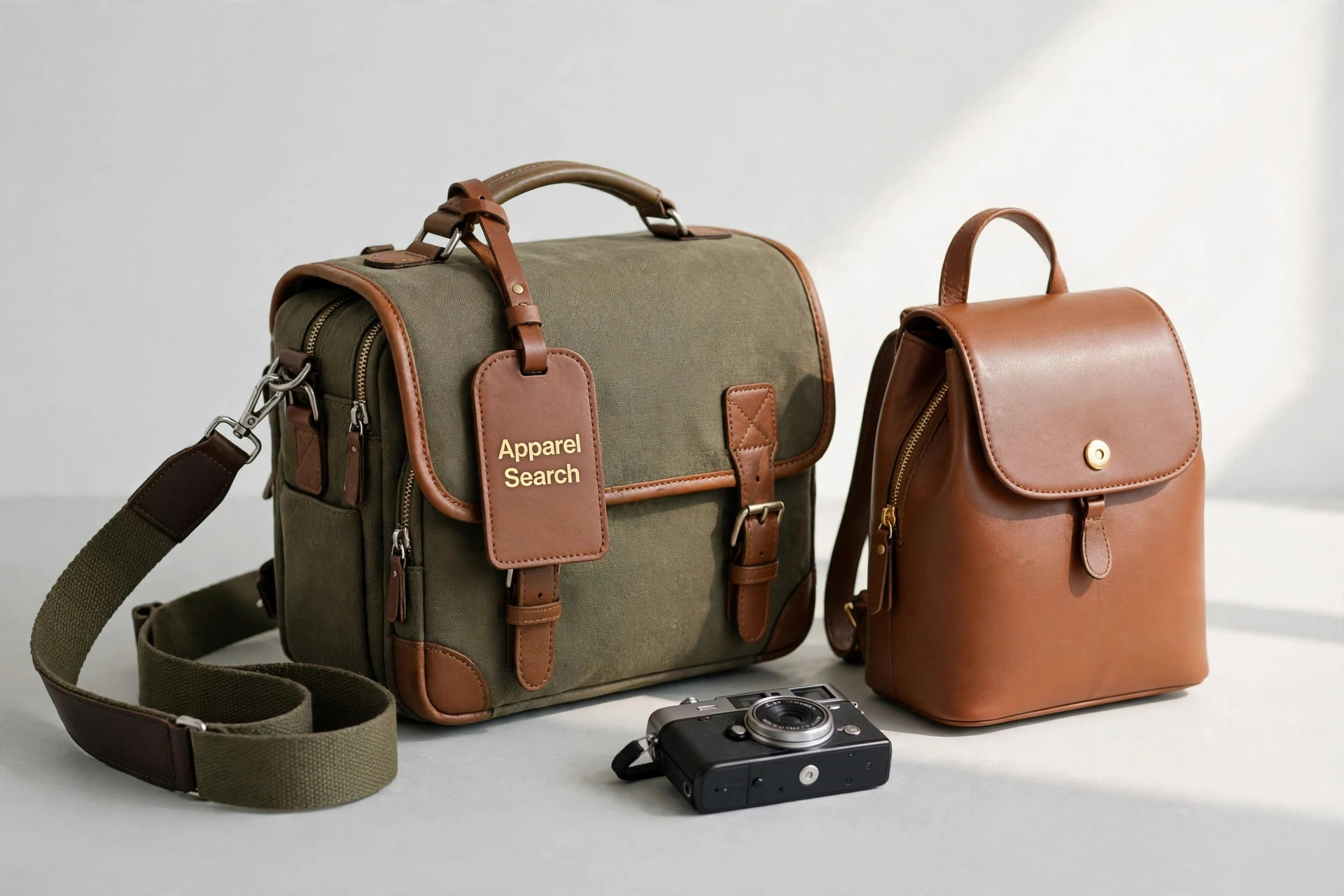
The Camera Bag
The camera bag descends from the cases photographers carried when cameras were expensive, fragile and heavy: a compact rectangular body, padded on all sides, with internal dividers that could be arranged around a camera body and its lenses, closed by a zip or flap and hung on a long, adjustable strap. Fashion adopted the type wholesale — keeping the box, the padding and the dividers, and usually dropping only the camera.
As a handbag, its virtues are precision and peace of mind. The rigid little box protects sunglasses and a phone the way it once protected a lens; the dividers stop the contents becoming a single sliding layer; worn crossbody it sits close and still, the most settled carry of any small bag. Its limits are the same box: capacity is small and fixed, and nothing soft or bulky negotiates with those padded walls. Judge one by the strap (long, adjustable, well-anchored), by dividers you can remove, and by an interior measured against your phone — the type's one generational trap.
The Backpack Purse
The backpack purse takes the handbag off the shoulder entirely: a compact bag with two straps worn on the back, a top handle for grabbing, and handbag materials and finishing — leather, polished hardware, lined interiors — in place of the schoolyard's nylon and logos. Convertible versions route a single strap to switch between backpack and shoulder carry. The capacity is a genuine day's worth: wallet, phone, water bottle, paperback, a light layer, arranged in a vertical space that rewards packing rather than stuffing.
The backpack purse's case is ergonomic and practical. Weight rides on both shoulders and against the back — the carry doctors recommend and shoulders forgive — and both hands stay free for commuting, cycling, markets, museums and children. Against that, the bag is behind you: access means swinging it around, and security depends on keeping the main zip against your back and your wits about you in crowds. It reads more casual than a structured shoulder bag of the same leather, which limits it at the formal end and makes it, for many owners, the most-used bag they have.
Choosing Between the Two
Pick the camera bag when your load is small, fixed and worth protecting, and you want it organized and in front of you — city days, galleries, travel days on foot. Pick the backpack purse when the load is a whole day and your hands and shoulders have claims on them — commuting, sightseeing, market days. The two are complements, not rivals: the camera bag is the smallest organized answer, the backpack the largest comfortable one. For the broad A–Z survey of bag types including backpack handbags, see the handbag types series linked below.
Shop Camera Bags & Backpack Purses
Ready to shop? Product links are kept in one place on the Apparel Search shopping guide:
Shop Camera Bags on AmazonThis link opens the Apparel Search shopping guide for Amazon, where the product links are kept in one place.
Common Questions
Is a camera bag only for photographers?
No — most fashion camera bags never carry a camera. The type began as a protective case: a boxy body, padded walls, movable dividers and a long crossbody strap. As a handbag it is simply the best-organized small crossbody in the family, and the dividers that once separated lenses now separate phone, wallet, keys and cosmetics into compartments that stay put. If you like a small bag but hate the single-pouch rummage, the camera bag is the type designed for you.
What is the difference between a backpack purse and a mini backpack?
Intention and finish. A backpack purse is a handbag worn on two straps: handbag materials and hardware, a handbag silhouette scaled for a day's carry, usually with a top handle as well, and sold alongside handbags. A mini backpack is a scaled-down school or sport backpack — casual fabrics, sporty zips, logo energy. The line blurs in the middle, but the test is the rest of your outfit: the backpack purse is built to finish a dressed outfit; the mini backpack is built to accompany a casual one.
Are backpack purses secure for travel?
They can be the most secure day bag you own, with one condition: the main opening must rest against your back. A zip that opens against the wearer's back cannot be dipped into in a crowd, and both hands stay free. In genuinely crowded places — packed transit, markets, festivals — swing the bag to your front, as you would a crossbody. Choose smooth zips that run freely, avoid dangling exterior pockets for valuables, and keep the passport layer in the compartment closest to your back.
What should I check before buying a camera bag as an everyday bag?
Three things. The strap: it must adjust long enough to wear crossbody comfortably, because shoulder-only carry defeats the type's purpose. The dividers: they should be removable or movable, unless you truly carry a camera — fixed lens-shaped compartments waste space. And the interior dimensions against your phone: camera bags predate today's large phones, and vintage or camera-first models can be surprisingly tight. Measure the phone, not the product photo.
Back to the Handbag Types & Styles Guide
The full type map — structured against soft, day against evening — with every named handbag type defined in brief.