Apparel Search Consumer Guides
Soft Handbag Styles
Drawstring bucket bags and crescent bags: the soft family's named types — how the drape works, how each is carried, what each honestly holds, and the habits that make soft bags work.
Soft bags are the relaxed family: no frames, no stiffened panels, nothing between the leather and the day. They drape, they slouch, they mold to what is inside them, and they ask to be judged by material and movement rather than architecture. This guide covers the two named soft types in depth — the drawstring bucket bag and the crescent — with the hobo alongside as context, as part of our handbag types and styles guide. If structured bags are furniture, these are clothing: chosen for how they hang, how they feel against the body, and how forgiving they are of an unplanned purchase stuffed in on the way home.
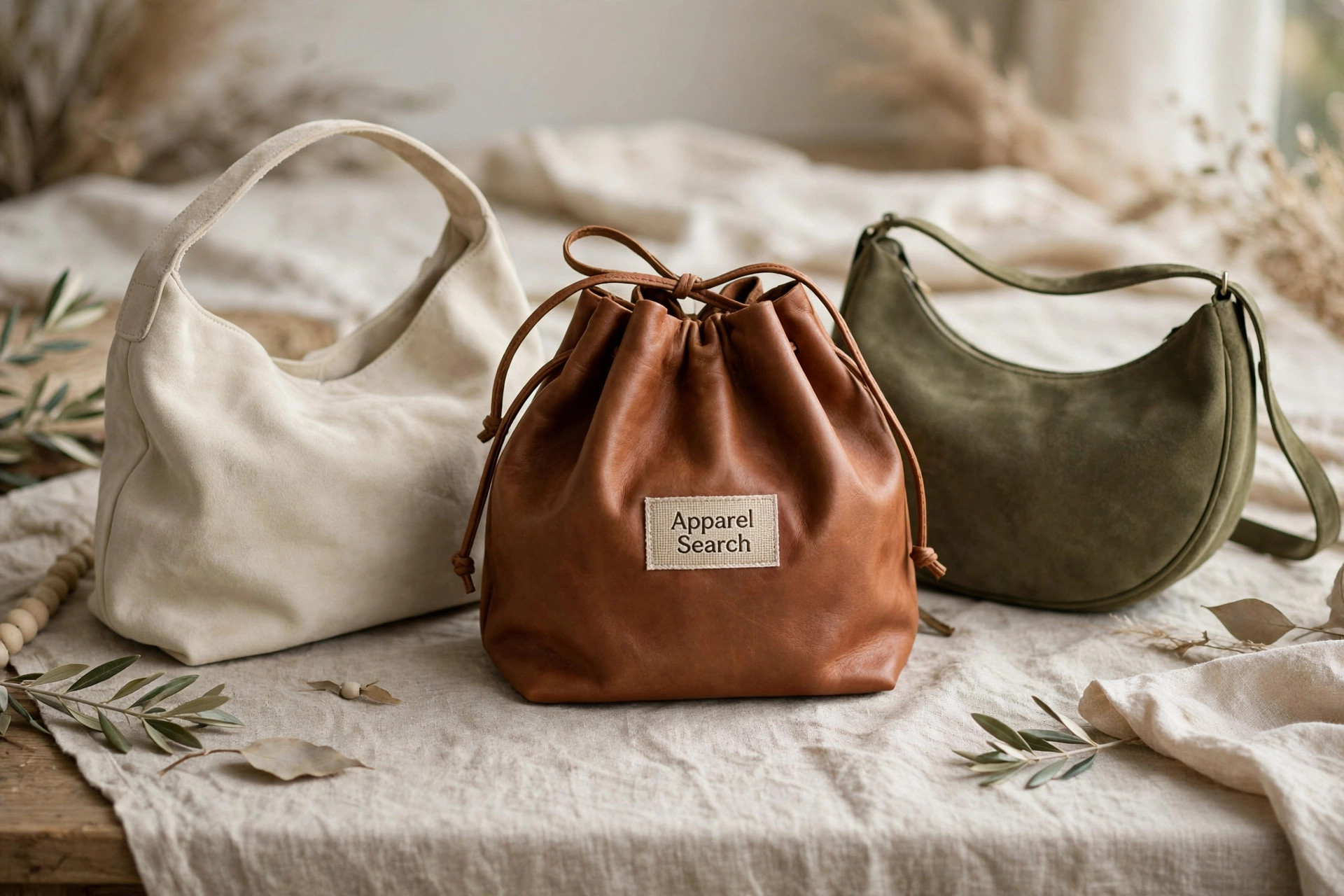
The Drawstring Bag (Bucket Bag)
The drawstring bag is a pouch that grew up: a soft body with a flat or reinforced base, gathered at the top by a drawstring that cinches the mouth closed, carried by a shoulder strap or crossbody strap. In its bucket form it stands roughly cylindrical, deeper than it is wide, with the drawstring often threaded through eyelets and finished with tassels or knots that have become the type's signature. The design is centuries old — the drawstring purse predates every other type in this guide — because it solves the simplest problem in carrying: put things in, pull it shut, go.
What the drawstring does well is volume with lightness. There is no frame, no hardware to speak of, and the bag weighs little more than its material; the depth swallows the day, including the odd shapes — a scarf, a sandwich box, a market purchase — that defeat rigid bags. What it does poorly is order and ceremony: one deep well, everything jumbled, and a silhouette that stays resolutely casual no matter the leather. Buy it in the best material you can, because on a drawstring bag the leather is not a detail — it is the entire structure, and thin or coated material shows its price within a season.
The Crescent Bag (Half-Moon Bag)
The crescent is the soft family's designed shape: a shoulder bag cut as a crescent or half-moon, the strap continuing the curve so the bag sits in a single arc against the body, tucked under the arm. Where the hobo slouches by accident of construction, the crescent's curve is deliberate pattern-making — top edge dipped, ends rising to the strap — and the best examples hold the silhouette empty or full.
Carried, the crescent is the closest-fitting of all shoulder bags: nothing swings, nothing juts, and the bag reads as part of the outfit rather than equipment. Capacity is modest and shaped — flat things thrive, bulky things fight the curve — so the crescent suits the edited load: phone, card wallet, keys, lipstick, sunglasses in a soft case. It is the soft bag for people who like soft bags' ease but want a line with intention, and it moves between day and early evening more gracefully than any other soft type.
The Hobo, in Context
The hobo is the crescent's bigger, looser relative: a large soft shoulder bag, traditionally crescent-topped with a single strap, made to be filled generously and to collapse into its famous slouch. Our clothes guide's hobo handbags guide covers the type in full. In this map it matters as the soft family's capacity answer — the bag for the unstructured day — and as the warning label: the hobo's charms (softness, room, ease) are the soft family's charms at maximum, and so are its costs in organization and polish.
Living With Soft Bags: The Three Habits
Pouch everything. Small items go in pouches or a wristlet wallet, never loose — a soft bag's interior is a single shared space. Mind the closure. Drawstrings get pulled fully shut; open-top soft bags get worn crossbody in crowds, where your arm is the closure. Store them stuffed. Soft leather stored empty and folded takes creases that never fully leave; tissue stuffing and a dust bag keep the drape where it belongs — in use, not in storage.
Shop Soft Handbags
Ready to shop? Product links are kept in one place on the Apparel Search shopping guide:
Shop Soft & Drawstring Handbags on AmazonThis link opens the Apparel Search shopping guide for Amazon, where the product links are kept in one place.
Common Questions
Is a drawstring bag secure?
Reasonably, with one honest caveat. A drawstring pulled fully closed and knotted or stoppered keeps contents in and casual hands out, and the gathered mouth is genuinely hard to dip into unnoticed. But it is not a seal: a partially closed drawstring gapes at the center, and small items can work their way out of a loosely cinched bag in a car or under a plane seat. Treat the drawstring as a closure for honest environments, keep valuables in an inside zip pocket or a zip pouch, and pull it fully closed — the type's one real discipline.
What is the difference between a crescent bag and a hobo?
Shape and intent. A hobo is a large, soft shoulder bag with a slouchy, unstructured body and a single strap, designed to carry a day's worth and collapse around it. A crescent bag is cut to a deliberate curve — the half-moon silhouette is the design — usually smaller, worn close under the arm, and holding its crescent outline whether full or nearly empty. If the curve is the point, it is a crescent; if the slouch is the point, it is a hobo.
What actually fits in a bucket bag?
More than its footprint suggests, because the depth is usable: a full-size wallet, phone, sunglasses case, cosmetics pouch, paperback and a small water bottle stand upright in a typical bucket bag with room to spare. The catch is retrieval — everything shares one deep well, so the bottom layer becomes archaeology. Bucket-bag veterans run a strict pouch system: wallet, pouch, phone, nothing loose.
How do I stop a soft bag from puddling when I set it down?
Partly, you do not — slouch is the type's nature, and a soft bag that stands like a box is a structured bag in disguise. You can manage it: choose leathers with some body over the thinnest lambskin, use a base shaper or felt organizer insert to give the bottom a floor, keep the bag moderately filled rather than nearly empty, and store it stuffed. On the day, set it against a chair leg or wall rather than mid-floor, where a puddled bag collects kicks.
Back to the Handbag Types & Styles Guide
The full type map — structured against soft, day against evening — with every named handbag type defined in brief.