Apparel Search Consumer Guides
Wallet Types Explained
Bifold, continental, zip-around, card case and wristlet wallet: the five wallet types — what each holds, how each carries, and choosing by the bag it has to fit.
The wallet is the accessory that must fit two lives at once: your hand, where it is handled a dozen times a day, and your bag, whose usable space it either respects or ruins. This guide defines the five main types — bifold, continental, zip-around, card case and wristlet wallet — and treats the choice as what it really is: a negotiation between capacity and bulk, settled by the bags you actually carry, as part of our handbag types and styles guide.
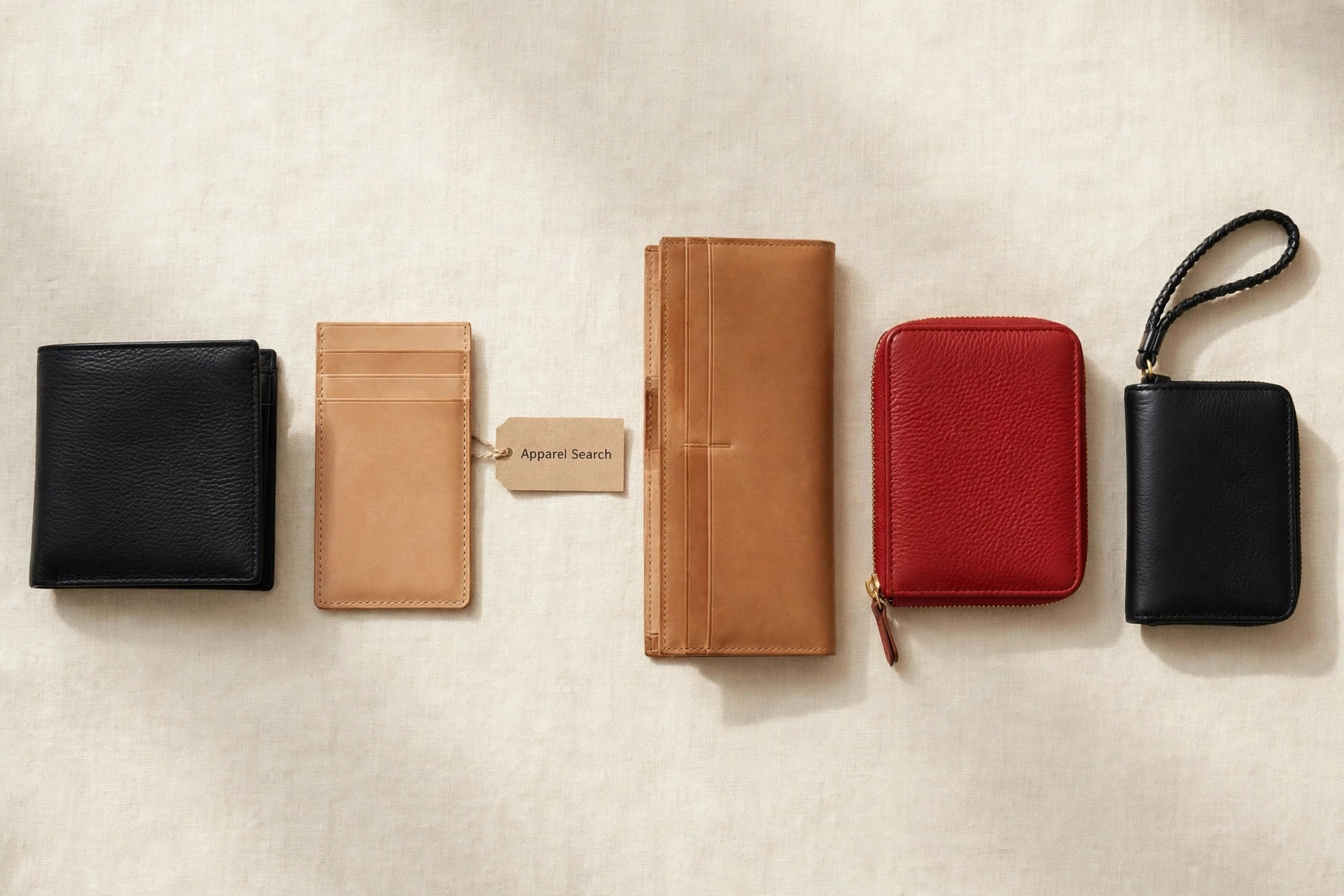
The Bifold
The bifold is the classic folding wallet: a rectangle that folds once, in half, with card slots on the inner faces and a full-length bill sleeve behind them. Notes fold with the wallet — that is the type's one compromise — and in exchange the bifold stays the slimmest full wallet there is, disappearing into a jacket pocket or the flat of a handbag. It is the wallet of cash-and-cards lives lived lightly: a handful of cards, notes, nothing else. Ask more of it — receipts, loyalty cards, coins — and the fold bulges, the leather stresses at the spine, and the type's one virtue evaporates.
The Continental Wallet
The continental is the long wallet: an elongated rectangle, usually opening like a book or unfolding in sections, in which banknotes lie flat and full-length and cards stand in visible rows. Nothing folds, nothing hides — a continental laid open is an audit of your money at a glance, which is why the type is the handbag wallet par excellence: it lives in bags, not pockets, and it is designed to be opened on a counter with a little ceremony. If your life is card-rich and note-flat, and your bags are medium or larger, the continental is the most satisfying wallet to use daily.
The Zip-Around Wallet
The zip-around takes the continental's long format and encloses it with a zipper that runs around three sides, turning the wallet into a sealed case. Coins, cards, notes, receipts, a passport at a pinch — everything is contained, and nothing has ever fallen out of a zip-around in a bag, a car or an airport tray. That security makes it the travel wallet and the big-bag wallet: toss it in a tote and it asks for nothing. The costs are a little bulk, a little ceremony of zipping and unzipping, and zips that must be good — a failed zip on this type is a failed wallet, so hardware quality is the whole purchase decision.
The Card Case
The card case is the wallet reduced to its modern essence: a flat slip of leather or metal with slots on both faces — four to six cards — and sometimes a center pocket for folded notes. It carries the payment-and-ID core of a life that has moved everything else to the phone, and its radical thinness is a feature with consequences: a card case fits the small bags — the camera bag, the envelope clutch — that defeat every other type. It is also the honest test of a cashless life: if a month of card-case carrying produces no moment of regret, you have found your wallet.
The Wristlet Wallet
The wristlet wallet is a wallet with a bag's ambitions: a long wallet's interior — slots, zip section, phone-sized pocket — in a zip or flap body fitted with a loop strap for the wrist. It works three jobs: as the wallet inside a large bag, as the organizer that moves between bags carrying your essentials intact, and as the smallest possible bag in its own right for errands, lunches and evenings. Of the five types it is the one that changes how the others get used — many wristlet owners find their full wallet retired to a drawer, because the wristlet covers both the wallet's job and the small bag's.
Shop Wallets
Ready to shop? Product links are kept in one place on the Apparel Search shopping guide:
Shop Wallets on AmazonThis link opens the Apparel Search shopping guide for Amazon, where the product links are kept in one place.
Choosing by Bag Size
Work backwards from the smallest bag you carry regularly. Evening bags and small crossbodies set the hardest limit: card case, or at most a slim wristlet wallet — measure the bag's interior before buying either. Small day bags take a bifold comfortably or a continental laid flat if the bag's shape allows. Totes, doctor bags and backpack purses impose no limit, which is exactly why their owners drift to zip-arounds and carry everything; the discipline has to come from you. And one rule over all of it: buy the wallet for the life you have this year, and evict relentlessly — a wallet's worst enemy is not wear but accumulation.
Common Questions
Which wallet type fits a small bag?
The card case first, the wristlet wallet second. A card case — flat, with slots on both sides and sometimes a center pocket — is the only type that fits an envelope clutch or a small camera bag without a fight. A wristlet wallet fits most small day bags and adds a zip compartment and a strap. The rule runs the other way too: if you have fallen for a small bag, let the wallet decision follow the bag, because the reverse negotiation — bag chosen around a bulky wallet — quietly rules out half the handbag family.
What is the difference between a continental wallet and a zip-around?
Layout philosophy. A continental wallet is a long, flat wallet that opens like a book: notes lie flat and unfolded, cards stand in rows of slots, and a flap or snap closes it — the most elegant and the easiest to audit at a glance. A zip-around keeps the same long format but encloses everything behind a zipper running around three sides: nothing falls out, ever, and the interior can be a little more crowded because security does the organizing. Choose the continental for order and ceremony, the zip-around for containment and travel.
Is a card case enough as an everyday wallet?
For a growing number of people, yes — the card case is the wallet the phone made possible. If your day runs on two payment cards, an ID, a transit card and phone-based everything else, a card case with four to six slots and a center pocket for folded notes is a complete wallet, and its thinness changes what bags you can carry. It fails honestly at cash-heavy lives: notes fold, coins have no home, and receipts accumulate nowhere. Judge by your last month's actual wallet contents, not by the wallet you inherited.
How many cards does each wallet type hold?
As working figures: a card case takes 4 to 8 cards and a few folded notes. A bifold takes 6 to 10 cards plus notes in its bill sleeve, and stays slim only if receipts are evicted weekly. A continental or zip-around takes 10 to 16 cards in slots, plus notes flat, coins in a zip section and often a phone. A wristlet wallet matches the zip-around's count in a slightly softer package. Every type holds double its comfortable count exactly once — the day it is overstuffed, stretched, and never quite slim again.
Back to the Handbag Types & Styles Guide
The full accessories map — every named handbag type defined, with belt types alongside the wallets.