Apparel Search Consumer Guides
Belt Types & Styles
Obi, chain, corset and braided belts defined — where each sits, what each does to an outfit, and how to style them — with the classic leather and rope belts for context.
A belt is the smallest garment with the largest job description: it can hold trousers up, draw a waist where a dress forgot one, or serve purely as jewelry that happens to circle the body. This guide defines the named types — obi, chain, corset and braided — with the classic leather and rope belts alongside for context, as part of our handbag types and styles guide. For each: what it is, where it sits, and how it is styled — because with belts, placement is not a detail; placement is the styling.
The Obi Belt
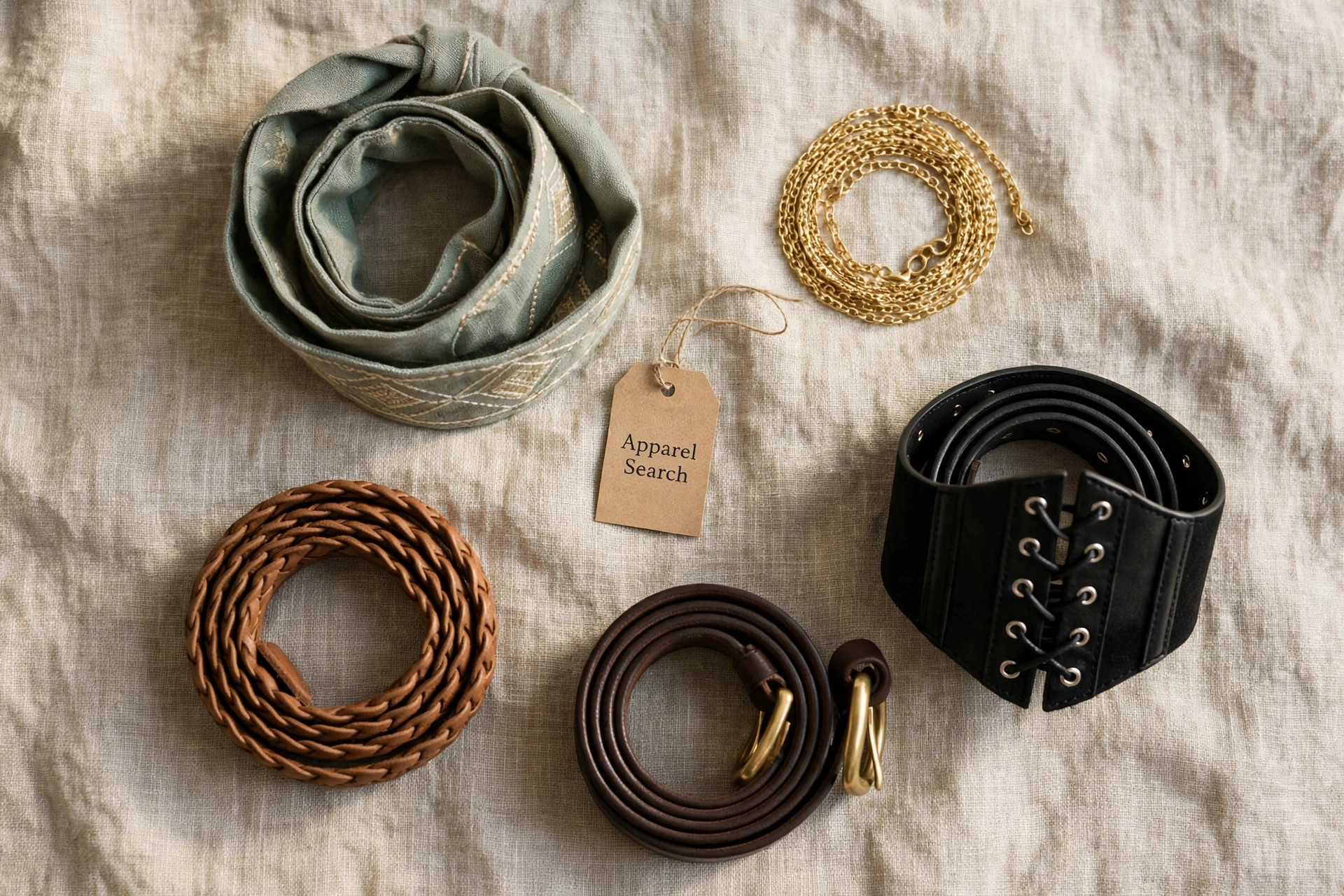
The obi is a wide, soft wrap belt borrowed from the sash of the Japanese kimono: a broad band of leather or fabric, widest at the center front, that wraps around the natural waist — often twice — and ties in a knot or soft bow. It fastens with nothing: no buckle, no holes, just wrap and tie, which makes it infinitely adjustable and completely unforgiving of being worn in the wrong place. The obi belongs at the natural waist, over dresses, tunics, long shirts and unstructured cardigans, where it manufactures a silhouette out of soft cloth. Styled right — snug, tie at the front or just off-center, the wide panel smooth — it is the most elegant of the statement belts; styled low or loose, it collapses into a cummerbund that slipped.
The Chain Belt
The chain belt is metal links worn as a belt: a fine or chunky chain, sometimes with charms, coins or a draped double row, fastening with a hook or clasp at any link. It holds almost nothing up and is not meant to — the chain belt is the jewelry member of the family, worn for movement and light. Slung on the hips it is the classic, decorative over trousers, skirts and dresses alike; drawn to the natural waist over a soft dress it becomes a waist-definer with a lighter touch than leather. Because the clasp can fasten at any link, one chain belt fits every placement and every layer thickness you own — the most versatile belt in the drawer, provided the outfit wants shine.
The Corset Belt
The corset belt is a wide, structured waist belt — several inches deep, shaped and stiffened, closing with lacing, hooks or buckles in deliberate echo of the corset it is named for. Unlike its ancestor it is worn over clothing, as the outfit's exoskeleton: it imposes a waist on straight dresses, oversized blazers, long shirts and coats, and it does so theatrically. This is a statement type with rules: one statement per outfit, worn over a single unshaped layer, fitted snugly but never as an instrument of compression — a fashion corset belt defines the waist visually; it is not shapewear and should never be laced like it.
The Braided Belt
The braided belt is woven — leather or fabric strands plaited into a strap — and its weave is its mechanism: with no punched holes, the buckle's prong passes through the braid at any point, so the belt fits every waist size and every outfit thickness exactly. That makes it the practical romantic of the family: casual in spirit, textured, the natural partner of jeans, chinos, sundresses and anything with a holiday in it. Braided belts relax a little with wear, which would ruin a holed belt's fit and changes nothing here. Judge one by the weave's tightness and the buckle's weight — those two qualities are the whole belt.
The Classics, in Context
Around these named types stand the two defaults. The classic leather belt — a smooth strap, a frame buckle, five holes — is the wardrobe's punctuation: it finishes tailored trousers, defines a tucked shirt, and in black and tan covers most of a life. The rope belt — cord or woven cotton, often with a double-ring or tie closure — is the classic's summer self, native to shorts, linen and nautical stripes. Neither needs explanation, but both explain the named types by contrast: every specialty belt exists to do a job the classics do not — wrap, shine, sculpt or endlessly adjust.
Shop Belts
Ready to shop? Product links are kept in one place on the Apparel Search shopping guide:
Shop Belts on AmazonThis link opens the Apparel Search shopping guide for Amazon, where the product links are kept in one place.
Waist Placement: The Whole Skill
Almost every belt disappointment is a placement error. Belts live at two addresses: the natural waist — the torso's narrowest point, usually just above the navel — where belts define shape (obi, corset, waisted chain, wide leather over dresses), and the hips, where belts decorate or hold (chain slung low, braided and leather through trouser loops). The same belt reads as two different accessories at the two addresses. When a belt looks wrong, move it three inches before you blame it; and when you belt an unstructured garment, belt it where your waist is, not where the garment happens to end.
Common Questions
Where should an obi belt sit — waist or hips?
At the natural waist, always: the obi is a wide wrap belt designed to define the narrowest point of the torso, tied over dresses, tunics and long cardigans. Worn low on the hips it loses both its structure and its point, sliding and folding instead of shaping. Wrap it snugly, finish the tie at the front or slightly to the side, and let the width do the work — an obi worn right needs no other accessory at the waistline.
Do you wear a chain belt at the waist or on the hips?
Both are correct, and they say different things. Slung low on the hips, in the type's classic manner, a chain belt is jewelry for an outfit — it moves, catches light and decorates without shaping anything. Worn at the natural waist over a dress or tunic, it defines the waist and reads more deliberate and dressed. What decides is the garment underneath: hip-slung over trousers and skirts with loops or a defined waistband; waisted over soft, unstructured dresses that need a line drawn on them.
What do you wear a corset belt over?
Over structure, or over softness that needs it: a plain dress that hangs straight, a long shirt or tunic, an oversized blazer or coat you want to pull in. The corset belt is the outfit's architecture, worn at the natural waist over a single layer of clothing — never over bare skin as a garment in itself in this context, and never over anything already shaped, where it fights the garment's own waist. Keep the rest of the outfit quiet; a corset belt is a headline, and headlines do not share.
How do braided belts size, since they have no holes?
That is their genius: any point along the braid is a hole, so a braided belt fits at any waist measurement, over any thickness of clothing, with the buckle's prong passing through the weave wherever it lands. Buy by length rather than by hole position — you want the tail to end a few inches past the buckle, as with any belt — and expect the braid to relax slightly with wear, which the infinite adjustment absorbs without complaint. It is the most forgiving belt type for bodies and wardrobes in flux.
Back to the Handbag Types & Styles Guide
The full accessories map — every named handbag type defined, with wallet types alongside the belts.