The Short Answer
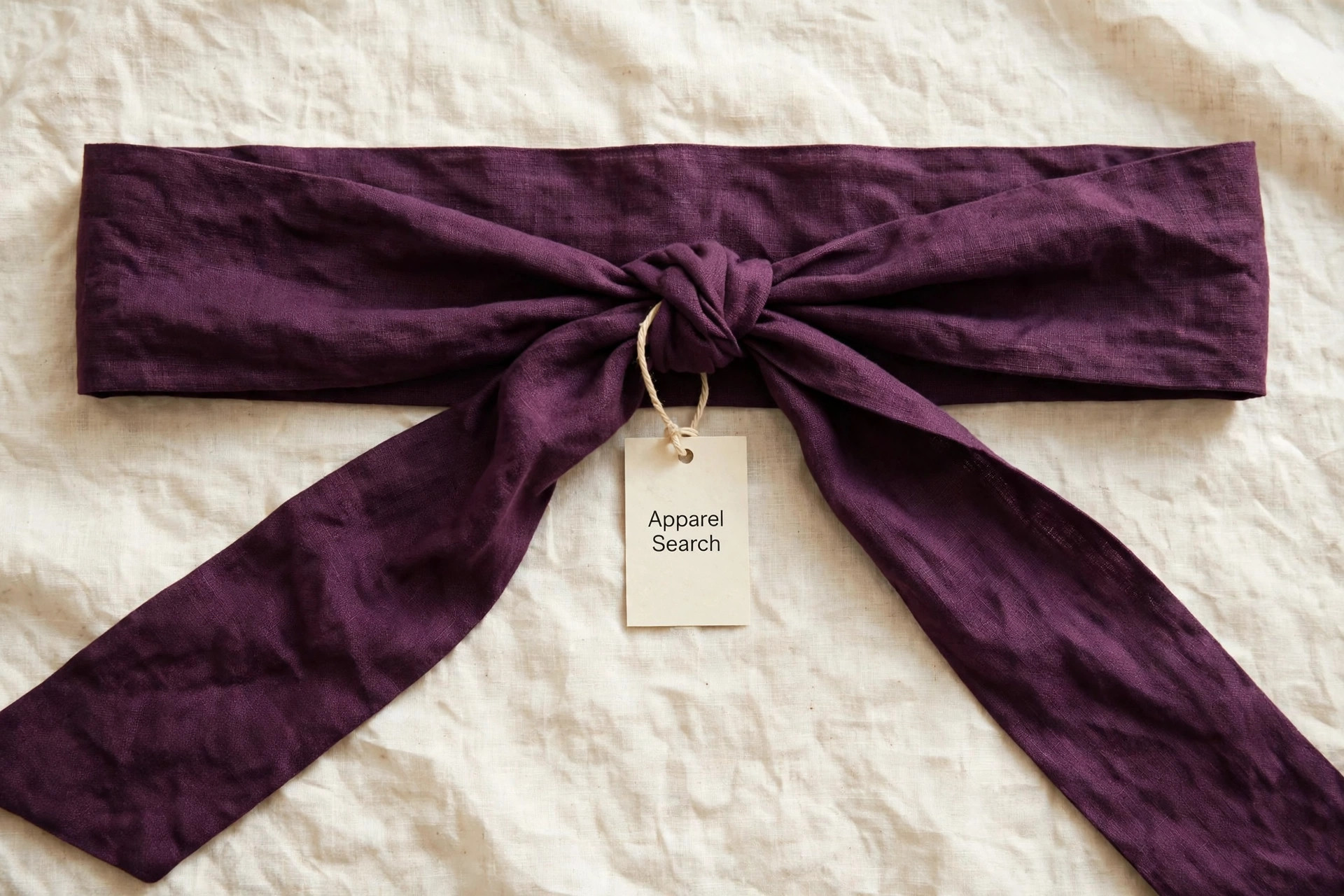
An obi belt is a wide, soft wrap belt — a broad panel, widest at the center front, with long ties extending from each end — that wraps around the natural waist, often twice, and fastens by tying in a knot or soft bow. It borrows its name and shape from the sash of the Japanese kimono. With no buckle, holes or hardware, it is infinitely adjustable and entirely dependent on placement: the obi only works at the natural waist.
01 / Anatomy of an Obi Belt
Anatomy of an Obi Belt
An obi belt is three parts in one strip. The center panel — usually four to six inches wide — is the shaped front that does the waist-defining; it is often lightly interfaced or made in double fabric so it lies smooth instead of collapsing. From each side, tapered wraps narrow as they travel around the back, and at the ends the ties continue as long, slim straps that cross, knot and finish in a flat knot or a soft bow at the front or just off-center. Total lengths commonly run from about 90 to 130 inches, because the belt must circle the waist twice before it ties.
Materials run the full register: soft leather (the tailored classic, which molds to the waist and holds a crisp panel), faux leather at friendlier prices, and fabric versions — cotton, linen, silk and brocade — that tie the softest bows and double as the outfit's pattern or color story. Reversible two-tone obis are a quiet bargain: two belts in one strip, flipped depending on the dress beneath.
02 / From Kimono Sash to Fashion Belt
From Kimono Sash to Fashion Belt
The original obi is the wide sash that secures a kimono, tied in elaborate bows and knots whose styles carry meaning in Japanese dress. The fashion obi belt is a simplified Western borrowing — it keeps the wide panel, the wrap and the tie, and discards the formal tying systems for a single easy knot. It entered Western wardrobes in waves, notably in the 1970s and again in the 2000s, each time attached to soft, flowing clothing that needed a waist drawn onto it.
That origin explains the type's manners: the obi is a soft structure. It does not cinch like a corset belt or punctuate like a buckle — it gathers, wraps and smooths, which is why it pairs naturally with the unstructured garments — shirt dresses, tunics, kimono jackets, long cardigans — that defeat stiffer belts.
03 / How to Wrap & Tie an Obi Belt
How to Wrap & Tie an Obi Belt
The standard wrap: hold the center panel against your front waist, exactly at the natural waist. Take both ends around your back, cross them, and bring them to the front again — the panel has now been circled twice and lies flat over itself. Finish by tying the ends in a flat knot or a soft bow at the front, centered or an inch off-center, with the tails hanging a few inches. Smooth the panel with your palms as you go; the obi's whole effect is an unbroken band, and a twisted wrap or a fold in the panel undoes it.
Troubleshooting: if the belt rides up, it is sitting below the natural waist — reposition it higher, where the torso narrows. If the panel rolls at the top edge, the belt is too wide for your torso length (a petite frame usually wants the narrower end of the range). If the knot bulks, tie it flatter — a reef-style flat knot instead of a rounded bow — or finish at the side, where the tails fall along the hip.
04 / Styling the Obi Belt
Styling the Obi Belt
The obi's home ground is the unstructured dress: shirt dresses, wrap dresses that need reinforcement, tunic dresses and straight knits all gain a waist from one wrap. Over long layers — open cardigans, duster coats, kimono jackets — the obi closes and shapes what would otherwise hang. Over a plain top and skirt, it plays the role of a cummerbund, joining the two pieces into a single silhouette. Keep the rest of the waist zone empty: no second belt, no competing waistband detail, and let necklaces rather than scarves do the upper-body work, since the obi already brings ceremony.
Color logic is simple: contrast to define (a dark obi on a light dress draws the waist in ink), tone-on-tone to soften (a fabric obi near the dress's color suggests a waist rather than announcing one), and pattern only when the garment beneath is plain — a brocade obi over a print dress is a duel nobody wins.
05 / Choosing Well & Care
Choosing Well & Care
Judge an obi belt by its panel and its length. The panel should be wide enough to shape but not so wide it reaches ribs and hips at once — four to five inches suits most torsos; the wrap must circle twice with ties to spare, so check total length against your waist rather than trusting size labels. Leather versions should be supple enough to wrap without cracking at the fold; fabric versions should be double-layered or interfaced so the panel stays smooth. Store the belt rolled or hung with the tie loosened, never folded sharply; fabric obis press flat with a cool iron, and leather ones want the same occasional conditioning as any leather belt — a soft accessory, but a hardworking one.
Shop Obi Belts
Ready to shop? Product links are kept in one place on the Apparel Search shopping guide:
Shop Obi Belts on AmazonThis link opens the Apparel Search shopping guide for Amazon, where the product links are kept in one place.
Questions
Common Questions
Where exactly should an obi belt sit?
At the natural waist — the narrowest point of the torso, usually just above the navel. The obi is designed around that narrow point: worn lower it slides and folds, worn at the waist it stays put and shapes. If yours keeps migrating, it is almost certainly sitting too low.
How long should an obi belt be?
Long enough to circle your waist twice with tying length left over. Most obi belts run about 90 to 130 inches end to end; measure your waist over the garments you will belt, double it, and add at least 12 inches for the knot or bow before choosing.
Can you wear an obi belt with trousers?
It is not the type's strength. The obi needs a smooth, soft surface to wrap and a waist to define; over a trouser waistband with its own button, belt loops and bulk, the wrap sits awkwardly and the tie competes with the fly. Reserve it for dresses, tunics and long layers, and use a braided or leather belt for trousers.
Is an obi belt flattering on a short torso?
Yes, in the narrower widths. A four-inch panel defines the waist without consuming the torso; the very wide six-inch versions can crowd a short waist. Choose slim, tie the knot small and flat, and match the belt's color closer to the garment to lengthen the line.
More to Explore
Back to Belt Types & Styles
Every named belt type in brief — obi, chain, corset and braided — with placement and styling, as part of the handbag types and styles guide.