The Short Answer
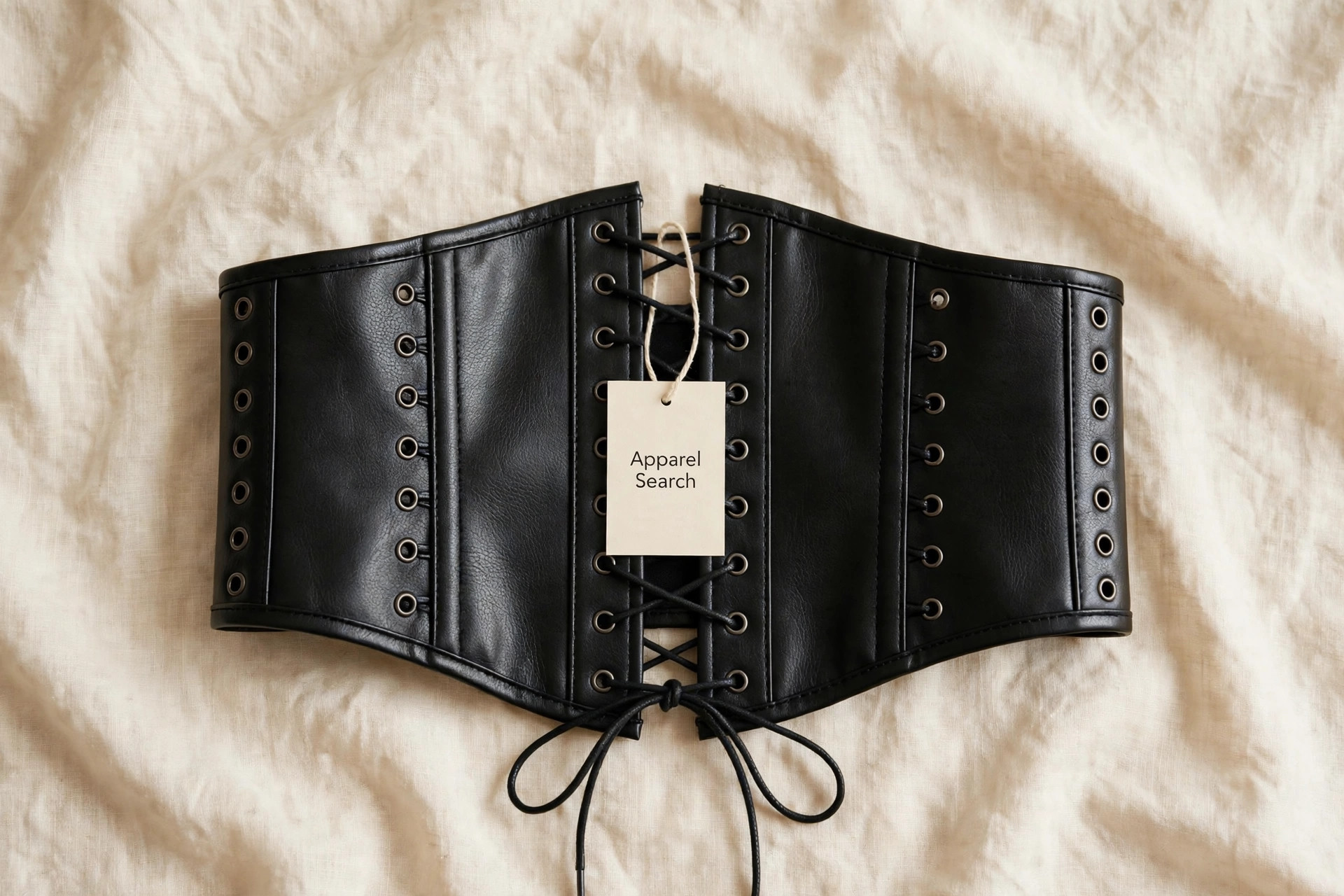
A corset belt is a wide, structured waist belt — typically three to six inches deep — shaped and often lightly boned, that closes with lacing, buckles or hooks in deliberate echo of the corset. It is worn over clothing at the natural waist, where it imposes a defined waistline on straight, soft or oversized garments. It is a fashion accessory, not shapewear: it defines the waist visually and should never be laced tightly.
01 / Anatomy of a Corset Belt
Anatomy of a Corset Belt
Three features separate a corset belt from an ordinary wide belt. First, depth: at three to six inches it covers the whole waist zone rather than drawing a line across it, which is what lets it reshape a silhouette. Second, structure: panels are cut on a curve to follow the waist, and better versions carry light flexible boning or stiffened interfacing at the seams so the top and bottom edges do not roll or fold when you sit. Third, the closure, worn at the front as part of the design: criss-cross lacing through eyelets is the signature (and the most adjustable), wide buckle fronts read more like armor, and hook-and-eye or busk fronts give the smoothest line under the lacing's opposite — choose by how much visual drama you want the closure to carry.
Materials follow the drama: leather and faux leather for the tailored versions, elastic-panel hybrids for comfort versions that flex when you sit, and fabric or brocade for evening. The lining matters more than shoppers expect — a smooth lining slides over dresses without gripping, while a suede or unfinished back can creep and twist.
02 / Where the Corset Belt Comes From
Where the Corset Belt Comes From
The corset belt is the corset's long echo. As the full corset left everyday dress in the early twentieth century, its waist-defining job passed to girdles and wide cinch belts — the waspie and waist-cincher belts of the 1940s and 1950s that sharpened the New Look silhouette. The modern corset belt arrived with the 1980s and 1990s, when designers wore corsetry openly over shirts and dresses as a statement, and it has cycled back regularly since: whenever oversized, unstructured clothing dominates, the corset belt returns as the quickest way to put a waist back on it.
That cycle is the styling clue: the corset belt exists to contradict the garment beneath it. It earns its place over volume and softness — and has nothing to add to a garment that already fits closely at the waist.
03 / How to Wear a Corset Belt
How to Wear a Corset Belt
The reliable formulas: over a straight shirt dress or tunic, where it manufactures the waist the dress skipped; over an oversized blazer or long cardigan, pulling the volume in at the waist; over a plain knit dress in a contrasting material — leather over jersey, brocade over crepe; and over a coat in place of the coat's own tie belt, for a sharper outline. In every case the belt sits at the natural waist, the torso's narrowest point — worn lower it slides, folds and reads as a mistake.
The rules that keep it chic: one statement per outfit — a corset belt is a headline, so necklines, jewelry and prints around it stay quiet; one layer underneath — it belongs over a single garment, not stacked over a sweater plus a jacket; and contrast with intent — the belt should visibly differ from the garment in color, material or both, because a perfect match reads as a costume piece rather than an accessory.
04 / Fit, Sizing & Comfort
Fit, Sizing & Comfort
Fit is where corset belts succeed or fail, so be exact. Measure your natural waist over the kind of garment you will wear it with, and choose the size whose range centers on that measurement with the lacing nearly closed — a lace-up belt worn with the laces gaping wide is the wrong size, not a look. Fastened, the belt should feel like a firm hug: you can breathe fully, sit comfortably and slip one finger under the edge. It should never be laced to compress — fashion corset belts are not built or intended for tightlacing, and forcing one distorts its panels and your day in equal measure.
Comfort checks before buying: sit down in it (edges that dig when seated will not improve), look for boning that is flexible rather than rigid, and prefer a closure you can manage alone — back lacing on a belt is decorative fiction unless someone else dresses you. Elastic-back hybrids trade some structure for all-day wearability and are the sensible first corset belt.
05 / Care & Storage
Care & Storage
Store a corset belt flat or rolled loosely with the lacing slack — hanging a structured belt by its end lets gravity pull the panels out of true, and folding it sharply cracks leather and creases interfacing along the fold. Keep laces loosely tied so eyelets are not strained. Wipe leather versions with a dry cloth and condition occasionally; fabric and brocade versions spot-clean only, since immersion warps the stiffening that gives the belt its shape — the one accessory in the drawer whose entire job is keeping its shape.
Shop Corset Belts
Ready to shop? Product links are kept in one place on the Apparel Search shopping guide:
Shop Corset Belts on AmazonThis link opens the Apparel Search shopping guide for Amazon, where the product links are kept in one place.
Questions
Common Questions
Is a corset belt the same as a waist trainer?
No. A corset belt is a fashion accessory worn over clothing to define the waist visually for an outfit; it is not shapewear, is not designed to compress, and should be fastened only to a firm, comfortable fit. If a belt is being sold on promises of changing your body's shape, it is a different product wearing this one's name.
What do you wear a corset belt over?
Over a single, relatively unshaped layer: a straight dress, a long shirt or tunic, an oversized blazer, cardigan or coat. It fights garments that are already fitted at the waist and disappears on anything it matches too closely — contrast in color or material is what makes it read as an accessory.
How tight should a corset belt be?
Snug, never tight: full breathing, comfortable sitting, one finger of ease at the edge, and — for lace-up styles — the lacing nearly closed rather than spread wide. If you need it tighter to get the effect, the size is wrong or the garment underneath is too bulky.
Can a corset belt work for plus sizes?
Yes — the type is genuinely size-friendly because the wide panel and adjustable lacing distribute fit evenly. Look for longer lacing ranges, flexible boning and a size that centers your waist measurement, and see our plus-size belts guide for more waist-belt options cut with the same logic.
More to Explore
Back to Belt Types & Styles
Every named belt type in brief — obi, chain, corset and braided — with placement and styling, as part of the handbag types and styles guide.