Apparel Search Consumer Guides
Structured Handbag Styles
Top-handle, frame and doctor bags: the handbag types built on stiffened panels and hardware — how each is constructed, how it closes, what it holds, and the days each one is for.
Structured bags are the engineered end of the handbag family: panels stiffened, bases reinforced, mouths held open by hardware, so that the bag you buy is the bag you still have in ten years, in the same silhouette. This guide covers the three built types in depth — the top-handle, the frame bag and the doctor bag — as part of our handbag types and styles guide. What unites them is intent: these are bags designed around a job — carrying papers flat, presenting a polished outline, opening wide enough to load like a case — and each type trades a little softness for a lot of order.
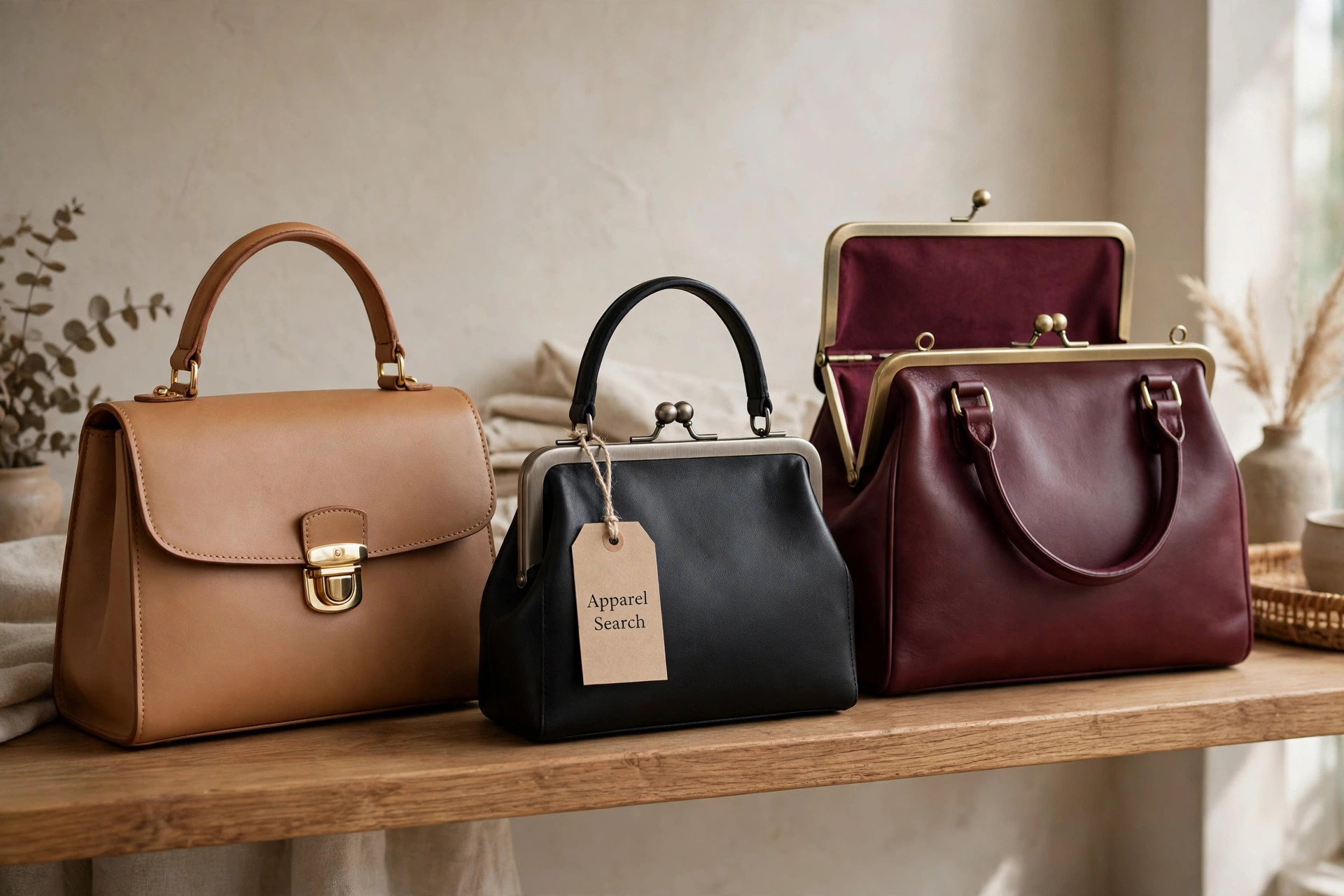
The Top-Handle Bag
The top-handle bag is defined by its carry: one or two short, rigid handles that hold the bag in the hand or in the crook of the elbow, with the body hanging in a clean, upright silhouette beneath. Everything else follows from that posture. Because the bag is never crushed against the body on a long strap, its maker can use firmer leathers, sharper corners and flap or frame closures that would suffer on a shoulder bag. The result is the most formal silhouette in everyday use — the bag of boardrooms, ceremonies and photographs — and also the most protective: contents sit in a rigid box, unbent and unsquashed.
When a top-handle works: at work, where it reads as equipment rather than ornament; at events, where it is set down and picked up rather than worn; and whenever the contents include things that crease. When it does not: on days that demand free hands, long walks, or a bag that can be flung into a car. Many top-handles add a detachable shoulder strap as a compromise, and it is a real one — but worn on the strap the bag hangs differently, and purists buy the type precisely for the carried look.
The Frame Bag
A frame bag is built on a rigid metal frame set into the mouth of the bag, closing with a clasp — classically the kiss-lock, two knobs that press past each other with a click. The construction is nineteenth-century in origin and completely logical: the frame defines the opening, supports the leather hung below it, and gives the bag its characteristic gathered or pleated body where soft material meets hard hardware. Frames appear on evening clutches, on day bags in the vintage manner, and on coin purses at every scale.
The frame's strengths are order and security: the bag opens fully, presents its contents, and snaps shut with a finality no magnet matches. Its limits are the frame's own: capacity is fixed by the geometry, and overstuffing strains the clasp and the hinge line. Judge a frame bag by the frame — it should be evenly finished, firmly anchored into the body, and snap with a single confident click, not a fiddle. A good frame outlives the leather hung from it, which is one reason quality vintage frame bags remain genuinely usable.
The Doctor Bag
The doctor bag scales the frame idea up: a hinged metal frame runs the full top of a deep, wide body, so the bag gapes open like the physician's case it descends from and can be loaded and searched like one. A clasp — often with a lock plate or padlock detail — closes the frame at the center, and short top handles carry what is usually a substantial weight of leather and contents.
No other structured type carries as much or shows it as clearly. The doctor bag is the choice for people whose day bag doubles as a small suitcase — files, a book, a bottle, a change of layer — and who are tired of excavating a deep tote. The trade-offs are weight and formality of line: even empty, a leather doctor bag has heft, and its wide, boxy stance reads purposeful rather than delicate. In return it offers the single most satisfying opening in handbags, and an interior you can actually see.
The Satchel, in Context
Most bags sold as satchels live in this family too: structured, handled, usually flap-closed, with the schoolbag's double-strap DNA still visible. Our women's handbags guide covers the satchel among the everyday types; treat the satchel as the top-handle's relaxed sibling — same architecture, softer manners, and a long strap almost always included.
Shop Structured Handbags
Ready to shop? Product links are kept in one place on the Apparel Search shopping guide:
Shop Structured Handbags on AmazonThis link opens the Apparel Search shopping guide for Amazon, where the product links are kept in one place.
Choosing Among the Three
Choose the top-handle when the silhouette is the point — polish, presence, contents kept pristine — and your hands are mostly free. Choose the frame bag when you want order in a smaller compass and the click of a real closure; it is also the natural bridge to evening, since the same construction scales down into clutches. Choose the doctor bag when capacity and visibility outrank everything — the carry-it-all day, the commute with cargo, the trip where the bag is the luggage you keep at your feet. Whichever you choose, store it as it was built: stuffed, upright, and unstacked, and the architecture will hold for decades.
Common Questions
What is the difference between a top-handle bag and a satchel?
They overlap, and shops use the words loosely. A satchel is the older, broader term: a structured bag with a flap or double-strap closure, top handles and often a long shoulder strap, descended from book and school bags. Top-handle describes the carry — short rigid handles — and includes flap-less, open-top and zip-top silhouettes a satchel label would not cover. In practice: if it has a flap and a strap option it will be sold as a satchel; if the handles are the design's whole point, as a top-handle bag.
Are frame bags secure?
Yes — a frame bag's clasp is a real mechanical closure, and a good kiss-lock snaps shut firmly enough that the bag cannot gape open in a crowd or spill in a car footwell. What a frame does not offer is expansion: the mouth opens exactly as wide as the frame and no wider, so a frame bag suits a disciplined load. Check any vintage frame bag by opening and closing it repeatedly; a tired clasp announces itself immediately.
What fits in a doctor bag?
More than in any other structured type — that is the design's purpose. The hinged frame opens the mouth to nearly the full width of the bag, and the body below is a single deep compartment: wallet, phone, cosmetics pouch, paperback, water bottle and a folded scarf or light layer all fit in a medium doctor bag, visible at a glance because the wide mouth lights the interior. What it does not do is organize; small items need pouches, or they migrate to the bottom.
Do structured bags soften or lose their shape over time?
Leather structured bags relax slightly with use — the handles settle, the body takes on a gentle lived-in slouch — but a well-built one keeps its architecture for years. Shape is lost by storage, not by carrying: keep a structured bag stuffed with tissue, standing upright, in its dust bag, never hung by its handles or crushed under other bags. Bags built on a true frame barely change at all, which is why so many mid-century frame bags survive in working order.
Back to the Handbag Types & Styles Guide
The full type map — structured against soft, day against evening — with every named handbag type defined in brief.