Men's V-Neck Sweaters Guide
A men's V-neck sweater is a knitted pullover with a neckline that dips to a point at the chest, designed especially for layering over collared shirts. The open V frames a shirt collar and, when worn, the knot of a tie, while adding warmth without the bulk of a high crew neck. It works in business, smart casual, and weekend settings, and bridges a shirt and jacket more formally than a crew neck sweater of similar weight.
Shop Men's V-Neck Sweaters Now
Shop Men's V-Neck Sweaters on Amazon Shop Men's V-Neck Sweaters on eBayThe Amazon and eBay links on this page are affiliate links. If you make a purchase through them, Apparel Search may earn a commission.
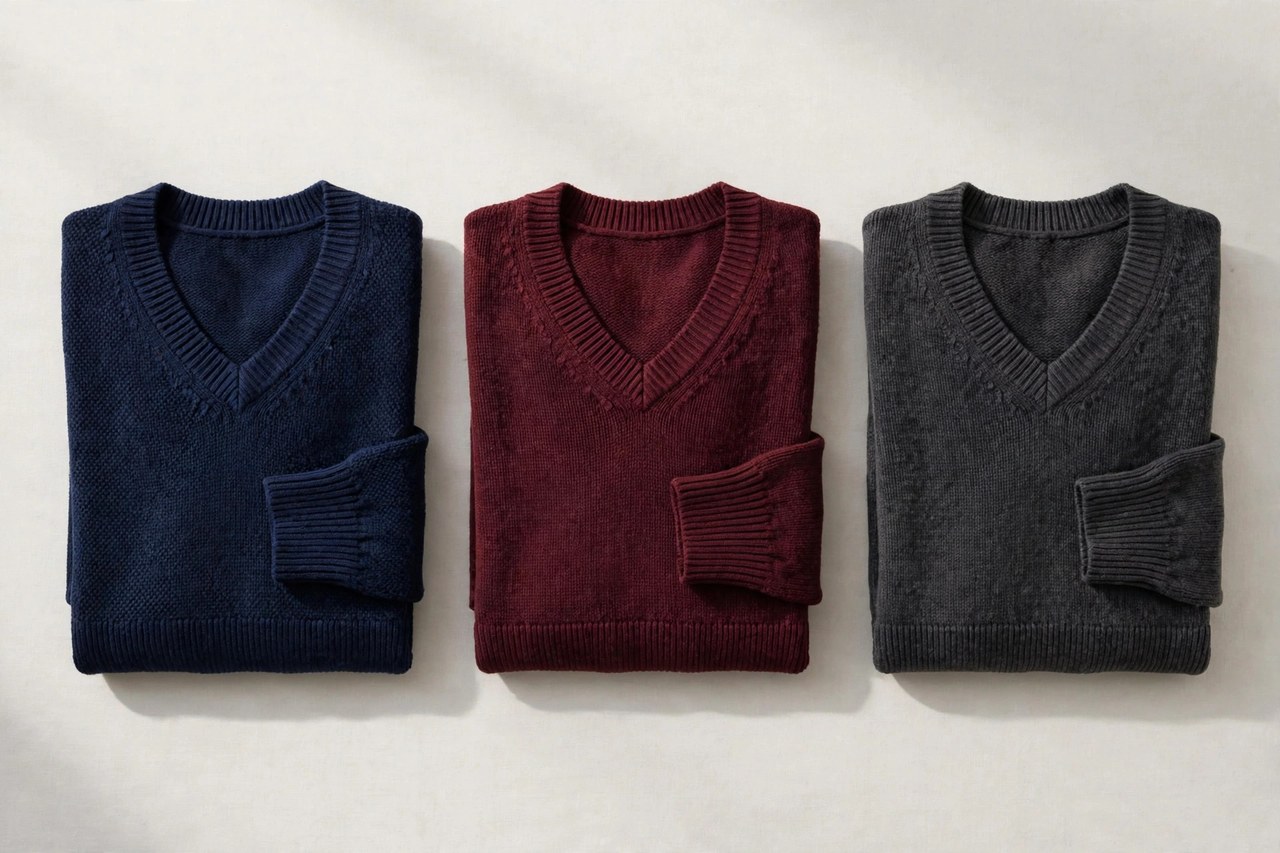
A men's V-neck sweater is a knitted pullover with a neckline that dips to a point at the chest, designed especially for layering over collared shirts. The open V frames a shirt collar and, when worn, the knot of a tie, while adding warmth without the bulk of a high crew neck. It works in business, smart casual, and weekend settings, and bridges a shirt and jacket more formally than a crew neck sweater of similar weight. This guide is built around the questions buyers actually ask: which style, which size, which fabric, and what will it look like after a year of real use - answered in order, with the trade-offs stated plainly.
Styles and Construction
Common yarns include merino wool for smooth fine-gauge layering, lambswool and Shetland wool for texture and warmth, cotton for cooler transitional wear, and cashmere blends for softness. Fine gauges slip easily under a blazer, while chunkier gauges suit outer layers. Check that the V band is knitted or linked neatly, ribbed cuffs and hems recover after stretching, and shoulder seams sit cleanly. Fully fashioned shaping and even stitching generally indicate more careful construction than loose, uneven knit panels.
Judge knitwear by gauge, ply and finishing rather than by softness in the shop, because every knit feels kind on day one. Gauge counts stitches per inch - finer gauges drape and layer, coarser gauges insulate and read casual. Ply counts the strands twisted into the yarn: more plies mean more warmth, roundness and price. Fully-fashioned shaping, knitted in rather than cut and sewn, marks better garments, and linked seams at the shoulders and neck lie flatter and last longer than overlocked ones.
Fit and Sizing
A V-neck sweater should skim the body with room for a shirt beneath, neither clinging at the chest nor pooling at the waist. The V should sit high enough to frame the collar and show only a modest amount of shirt and tie. Sleeves should reach the wrist bone over a shirt cuff, and the hem should cover the waistband without extending far below it. Knits relax slightly with wear, so a firm but comfortable new fit is usually preferable.
Fit knitwear by the body, not the shoulders alone: a sweater should skim rather than cling, with ease for a shirt beneath at the chest, sleeves ending at the wrist bone, and body length covering the waistband without pooling. Knits relax with wear - a slightly firm new fit is often the right long-term fit - but ribbed cuffs and hems should recover when stretched, and a neckline should sit flat against the base of the neck, neither gaping nor strangling.
Wearing and Care
Follow the yarn label: many wool sweaters prefer gentle hand washing or a wool cycle in cool water with knitwear detergent, while cotton knits may tolerate careful machine washing. Never wring the sweater; roll it in a towel, reshape it, and dry it flat. Fold for storage rather than hanging, which stretches the shoulders, and use cedar or lavender to help deter moths. Rest the sweater for a day between wears so the fibers recover loft and shape.
Knitwear care is gentle by default: wash cool by hand or on a wool cycle with knitwear detergent, never wring, roll in a towel to lift water, and dry flat on a mesh or towel, reshaped to its measurements. Fold for storage - hangers stretch shoulders into points - with cedar or lavender against moths, and rest a sweater a day between wears so its fibers recover their loft. Depill with a comb or electric shaver; pilling is loose fiber migrating, not the garment failing.
The most famous V-neck sweater in the world is the cricket sweater - cable-knit, cream, and striped at the neck in club colors.
Common Questions
What shirt works best under a V-neck sweater?
A collared dress or button-down shirt works best because the V is shaped to frame the collar points and placket. Keep the collar inside the neckline for a tidy look. A plain crew T-shirt can work casually, but avoid competing patterns or a collar that bunches at the V.
Can a V-neck sweater be worn without a shirt underneath?
Yes, a fine-gauge V-neck can be worn directly against the skin for a cleaner casual look, provided the depth is moderate and the yarn feels comfortable. This shortens the interval between washes less kindly than layering does, so air it after wearing and wash only when needed.
How deep should the V be for wearing with a tie?
Choose a classic, moderately high V that frames the collar and shows the tie knot and a short length of tie below it. Very deep fashion Vs reveal too much shirt front and fight the tie, while an extremely shallow V can crowd the collar and look like a crew neck.
More in Men's Clothes Guide V
Background
Before we discuss the neckline of this type of garment, we have one question for you. Do you know what a sweater is? A sweater is a knitted garment intended to cover the torso and arms. A sweater is either a pullover or a cardigan, distinguished in that cardigans open at the front while pullovers do not. If you are British you may refer to a sweater as a jumper or jersey. What is a V-neck sweater? First of all, we are talking about the shape of the garments neckline. V-neck (2–4 linear edges, side edges diverge) originate from the middle east, these are formed by two diagonal lines from the shoulders that meet on the chest creating a V shape. The depth of the V can vary, ranging from demure styles to plunging. The surplice version of this neckline (known as a portrait neckline) is an alternative. The V may also be truncated by a small bottom edge, forming a trapezoid.
More to Explore on Apparel Search
Looking for Men's Clothing Stores?
This guide explains men's v-neck sweaters. To browse where to buy, visit our men's clothing store directory, where you can find retailers that carry them.