Men's Wool Fiber Guide
Wool is the fiber that built menswear: a protein fiber grown by sheep (and, in luxury forms, goats, rabbits and alpacas) whose natural crimp traps air for warmth, whose scales manage moisture, and whose spring lets a tailored garment shed wrinkles overnight. Learning how wool is graded, spun and woven is the fastest way to understand why two apparently similar garments differ so much in price and performance.
Shop Men's Wool Fiber Now
Shop Men's Wool Fiber on Amazon Shop Men's Wool Fiber on eBayThe Amazon and eBay links on this page are affiliate links. If you make a purchase through them, Apparel Search may earn a commission.
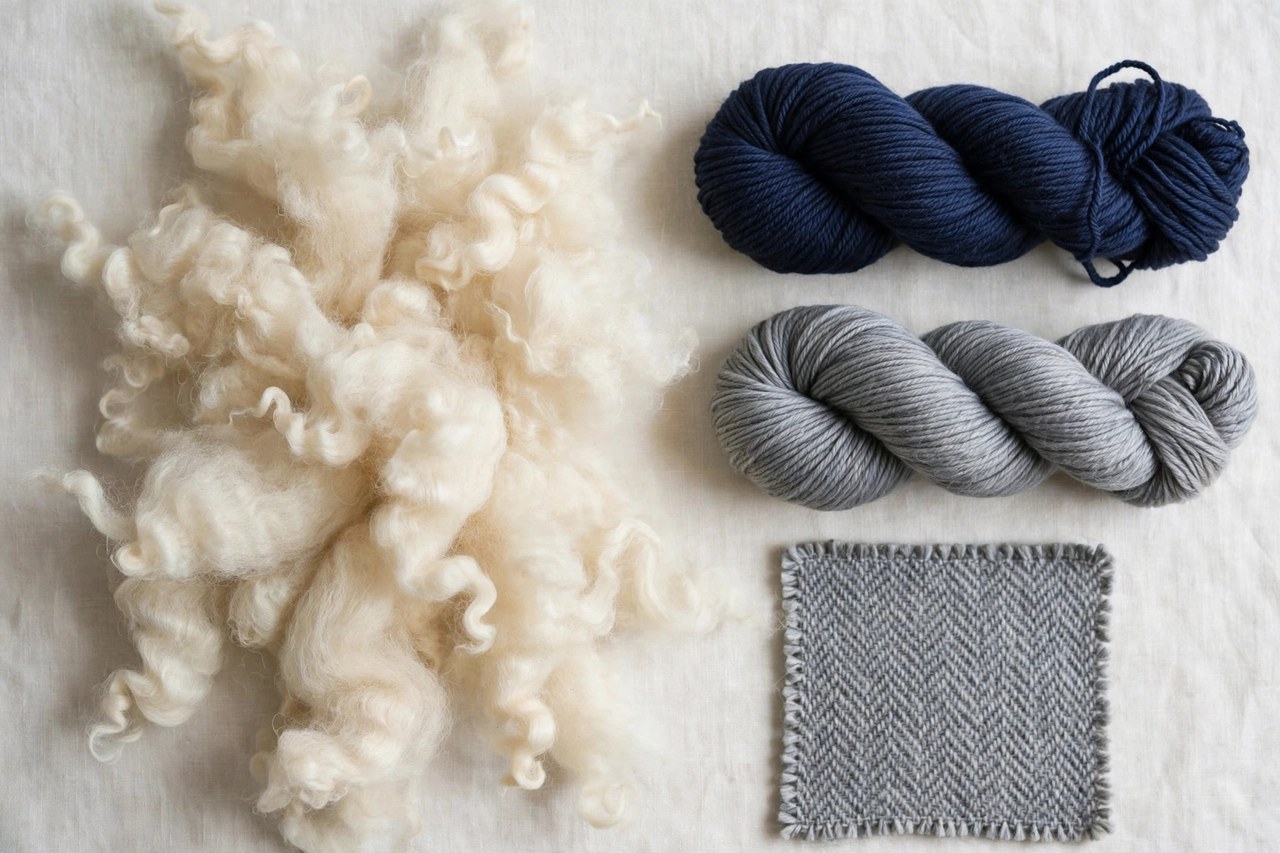
Wool is the fiber that built menswear: a protein fiber grown by sheep (and, in luxury forms, goats, rabbits and alpacas) whose natural crimp traps air for warmth, whose scales manage moisture, and whose spring lets a tailored garment shed wrinkles overnight. Learning how wool is graded, spun and woven is the fastest way to understand why two apparently similar garments differ so much in price and performance. This guide walks through the choices that matter - style, fit, fabric and finish - with the practical detail a product listing rarely gives you, and closes with the care habits that keep the garment in service.
Styles and Construction
Grading starts with fineness: fiber diameter is measured in microns, and the traditional Super numbers (Super 100s, 120s, 150s) rise as the wool gets finer - finer means smoother, lighter and more luxurious, but also less abrasion-resistant. Staple length, the length of the individual fibers, decides yarn strength: long-staple worsted yarns are combed parallel and woven into smooth suiting and gabardine, while short-staple woolen yarns are carded into soft, fuzzy flannels and tweeds. Merino is the fine apparel breed standard; lambswool is the soft first shearing; Shetland and other hardy wools trade softness for character and durability. Blends add silk for luster, cashmere for softness, or a little synthetic for strength - each at a cost to purity of hand and drape.
Judge wool first as a fiber, before the garment cut gets a vote. Fineness is measured in microns: merino at roughly 18-22 microns feels smooth against skin, while coarser wools trade softness for abrasion resistance and a drier hand. Crimp - the natural wave of the fiber - is what traps air for warmth and gives wool its spring and wrinkle recovery. Staple length matters too: longer staples spin into stronger, smoother yarns that pill less. Then read the cloth: twill weaves like gabardine shed wrinkles and water, flannels brush up into matte warmth, plain-weave tropical wools breathe, and knits trade structure for stretch and comfort.
Fit and Sizing
You use wool grading every time you choose a garment: pick finer, lighter worsteds for dress clothing and warm offices, midweight flannels and woolen cloth for cold-weather character, and coarser, hardier wools where abrasion rules, like socks and outer layers. Handle cloth before judging numbers - a well-made Super 100s from long staple will outwear a fragile Super 150s, and honest weight in the hand predicts warmth better than marketing words. Match the micron to your skin, too: men who find wool itchy usually need finer merino or a lining, not a different fiber altogether.
Wool care starts with rest and air: wool resists odor and soil, so airing a garment overnight after wear replaces most washing. Wash when needed in cool water with wool detergent - hand wash or a true wool cycle - never hot, never agitated hard, because heat plus agitation plus moisture is felting. Roll in a towel to lift water, dry flat or hang tailored pieces on broad hangers, and store clean in a breathable bag with cedar or lavender, since moths target dirty wool. Steam refreshes wrinkles better than pressing; if you press, use a cloth and moderate heat so the surface does not shine.
Wearing and Care
Wool asks for rest more than washing: air garments after wear, brush surface soil away, and wash gently and rarely in cool water with wool detergent, since heat, agitation and moisture together felt the fibers permanently. Dry flat for knits, hang wovens on broad hangers, steam rather than hard-press, and store everything clean with cedar or lavender - moths are wool's one true enemy, and they find dirty wool first. Treated this way, quality wool is among the longest-lived fibers in a wardrobe.
Fit wool with its behavior in mind: wool gives a little with body heat and wear, then recovers with rest, so a new garment should start neat rather than sloppy. Woven wool should skim without pulling at closures; knitted wool should follow the body without compressing the stitch open, which lets wind through and shortens the garment's life. Check drape from the side - good wool falls in clean vertical folds - and remember that tailored wool can usually be let out a seam allowance, while knits can be blocked modestly but never truly resized.
Common Questions
What do the Super numbers on a suit label mean?
They grade the fineness of the wool yarn: the higher the number, the finer the fibers used. Super 100s to 120s is the durable dress standard; higher numbers feel more luxurious and drape more fluidly but wear faster and cost more. The number says nothing about construction quality.
Why does some wool itch and some not?
Itch comes from coarse, stiff fiber ends prickling the skin - fibers above roughly 30 microns bend less and trigger it. Fine merino, at 18 to 22 microns, bends on contact and feels smooth to most men. Blends, linings and a base layer solve it for coarser, hardier wools.
Is wool naturally water resistant?
Partly: the fiber's outer scales shed light rain, and wool can absorb up to a third of its weight in moisture before it feels wet, which is why it insulates even when damp. It is not waterproof - sustained rain soaks through - but it outperforms cotton, which chills when wet.
More in Men's Clothes Guide W
Learning More About Wool
Below are a few resources to help you learn more about wool fiber, production, and different types. Hopefully this will help you better understand various aspects of what goes into wool clothing. The topics include woolen, shearing, shearing sheds, wool classing, wool measurement, wool bales, staple wool, worsted, angora wool and merino wool. If you have questions regarding wool used for menswear, you are welcome to contact us. See also Benefits of Wool.
More to Explore on Apparel Search
Men’s Clothes Guide by Letter: Wool Menswear
Looking for Men's Clothing Stores?
This guide explains men's wool fiber. To browse where to buy, visit our men's clothing store directory, where you can find retailers that carry them.