Merino Wool
Fiber Definitions — fine sheep wool from Apparel Search
Search Apparel Search
At a Glance
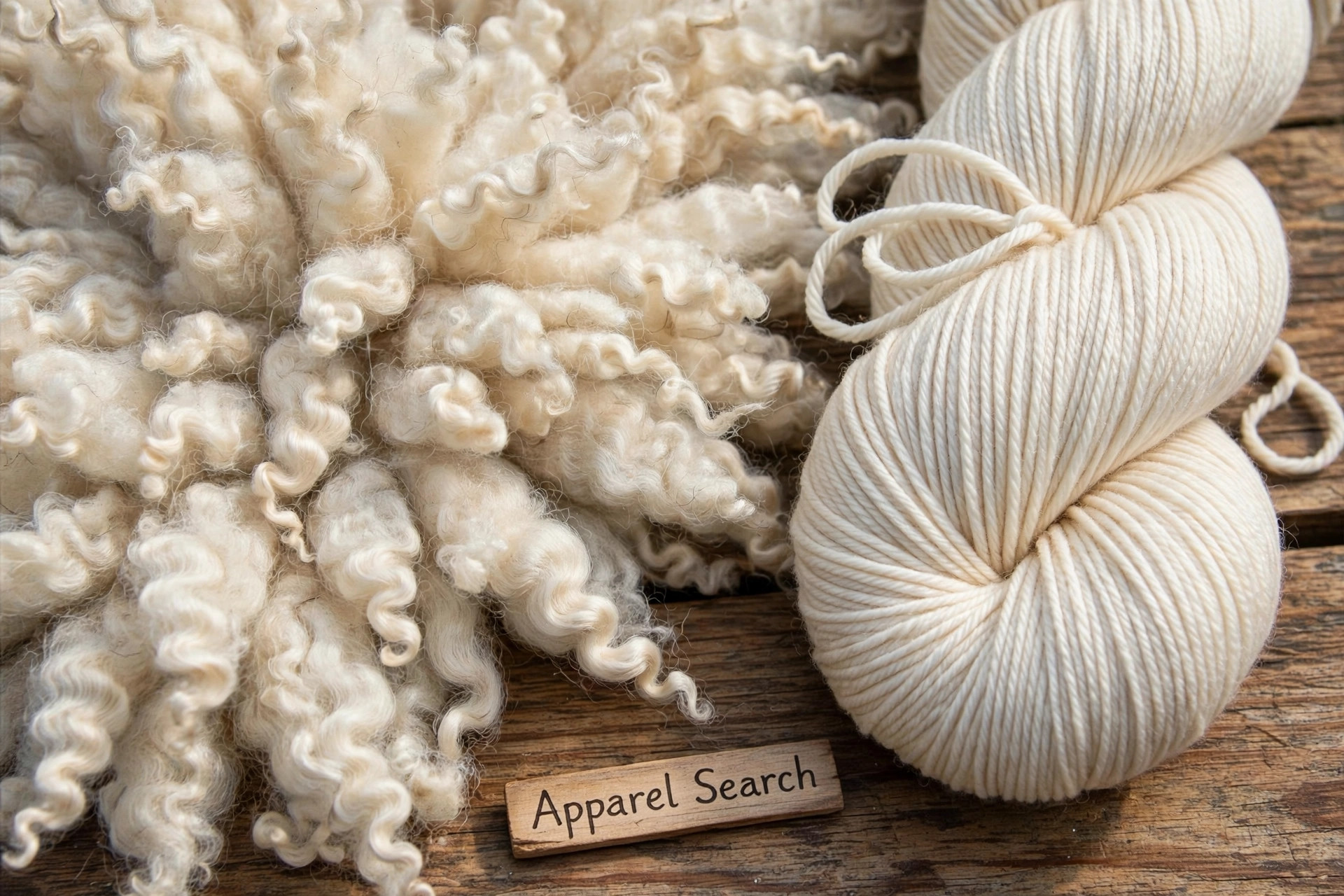
Definition: Merino wool is the finely crimped, soft wool of the Merino sheep, generally under 24 microns in diameter, with staples commonly 2.5 to 4 inches long.
Category: Fiber Definitions
Word Origin
Two origins are proposed for the Spanish word merino. It may adapt the name of a Castilian official inspector, a merino over a merindad, who may also have inspected sheep pastures — the word comes from medieval Latin majorinus, a steward or head official of a village, from major, meaning great. Or it may come from the name of a Berber tribe, the Marini (in Castilian, Benimerines), which intervened in the Iberian peninsula during the 12th and 13th centuries.
The Merino is the most economically influential breed of sheep in the world, prized for its wool. Superfine Merinos are regarded as having the finest and softest wool of any sheep. Merino wool is finely crimped and soft, and the breed behind it — an excellent forager, very adaptable, and bred predominantly for wool — carries a history that runs from Spain's fine-wool monopoly to the Australian flocks that now produce most of the world's supply.
On This Page
The Wool Itself: Fineness, Staple and Yield
Merino wool is finely crimped and soft. Staples are commonly 2.5 to 4 inches (65 to 100 mm) long, and Merino wool is generally less than 24 microns in diameter. The basic types are graded by that diameter: strong (broad) wool at 23 to 24.5 microns, medium wool at 19.6 to 22.9 microns, fine at 18.6 to 19.5 microns, superfine at 15 to 18.5 microns and ultra fine at 11.5 to 15 microns. Ultra fine wool is suitable for blending with other exclusive fibers such as silk and cashmere.
Yields vary sharply by strain. A Saxon Merino produces 3 to 6 kg of greasy wool a year, while a good quality Peppin Merino ram produces up to 18 kg. New Zealand also retails luxury, lightweight knits made from Merino wool and possum fur. For the trade that handles the clip, see wool classing, wool measurement and the wool bale.
The Sheep: Forager First, Meat Animal Second
The Merino is an excellent forager and very adaptable. It is bred predominantly for its wool, and its carcase size is generally smaller than that of sheep bred for meat — though the low price of wool has recently led to more emphasis on the market and sale of the animal's meat, and the South African Meat Merino (SAMM) and the merinofleischschaf have been bred to balance wool production and carcase quality. Poll Merinos have no horns (or very small stubs, known as scurs), while horned Merino rams have long, spiral horns which grow close to the head.
In Argentina, Australia, New Zealand, South Africa and the western United States, where sheep are bred for their wool rather than their mutton, Merino sheep dominate. Australia produces about 80% of the world's Merino wool. In Australia and New Zealand, Merino ewes are crossed with Border Leicesters and other English long-wool breeds to produce first-cross prime lamb mothers and prime lamb wethers; the mothers are crossed again with Poll Dorsets and other short-wool breeds, and the resulting second-cross lambs are slaughtered as prime lambs. Background on the animal itself is gathered on the Apparel Search sheep education pages.
Spain's Fine Wool Monopoly and the Mesta
The Phoenicians introduced sheep from Asia Minor into North Africa, and the foundation flocks might have been introduced into Spain as late as the 12th century by the Beni-Merines, a tribe of Arabic Moors. In the 13th and 14th centuries genetic material from England was introduced, an influence openly documented by Spanish writers of the time. Spain became noted for its fine wool (spinning count between 60s and 64s) and built up a fine wool monopoly during the 12th to 16th centuries, with wool commerce to Flanders and England a source of income for Castile in the Late Middle Ages.
Most of the flocks, known as cabanas or cavanas, were owned by nobility or the church; the sheep grazed the Spanish southern plains in winter and the northern highlands in summer. The Mesta was an organisation of privileged sheep owners who developed the breed and controlled the migrations. The three great studs that founded most of the world's Merino flocks were the Royal Escurial flocks, the Negretti and the Paula; the Infantado, Montarcos and Aguires studs also had an influence on the Vermont bloodlines. Before the 18th century, the export of Merinos from Spain was a crime punishable with death.
From Saxony and Rambouillet to Australia
In the 18th century a new era began, as small exportations of Merinos from Spain and local sheep were used as the foundation of Merino flocks in other countries. Escurials were sent to Saxony in 1765 and 1774, to Hungary in 1775 and to Prussia in 1786, and in 1786 Louis XVI of France received 366 sheep selected from 10 different cavanas, which founded the stud at the Royal Farm at Rambouillet. Though a French stud, Rambouillet had an enormous influence on the development of the Australian Merino. From 1765 the Germans in Saxony crossed the Spanish Merino with the Saxon sheep to develop a dense, fine type (spinning count between 70s and 80s) adapted to its new environment; by 1802 the region had four million Saxon Merino sheep, and German wool was the finest in the world.
The breed reached Britain and the southern hemisphere through royal flocks: Sir Joseph Banks procured two rams and four ewes in 1787 by way of Portugal, and in 1792 purchased 40 Negrettis for King George III to found the royal flock at Kew; in 1808, 2,000 Paulas were imported. The King of Spain also gave Escurials to the Dutch government in 1790, and these thrived in the Dutch Cape Colony (South Africa). Sheep from that Cape Town stock reached Sydney in 1797 and were sold to Captain John MacArthur, Samuel Marsden and Captain William Cox. MacArthur, who brought seven rams and one ewe from the first dispersal sale of King George III's stud in 1804 and returned with them to Australia in 1805, is considered the father of the Australian Merino industry — though in the long term his sheep had very little influence on the development of the Australian Merino.
In North America, Colonel David Humphreys, United States Ambassador to Spain, initiated the Vermont strain in 1802 with 21 rams and 70 ewes from Portugal and a further 100 Infantado Merinos in 1808; the British embargo on wool exports before the War of 1812 then fed a "Merino Craze," with William Jarvis importing at least 3,500 sheep between 1809 and 1811. The Napoleonic wars (1793–1813) almost destroyed the Spanish Merino industry as the old cavanas were dispersed or slaughtered, and from 1810 onwards the merino scene shifted to Germany, the United States and Australia.
Australia Takes the Lead
By 1801 Australia had 33,818 sheep; the first Australian wool boom occurred in 1813 when the Great Dividing Range was crossed, and by 1830 the Australian sheep population was nearly 2 million. At the first sheep show held in Australia, in 1823, a gold medal was awarded to W. Riley ('Raby') for importing the most Saxons — Riley also imported Cashmere Goats into Australia. In 1841 John Murray at Mt Crawford in South Australia established a flock of Camden-blood ewes mated to Tasmanian rams, thought to include some English Leicester blood to broaden the wool and give the animals size; the resulting sheep were the foundation of many South Australian strong-wool studs.
The Peppin brothers took a different approach at Wanganella Station in the Riverina, selecting station-bred ewes that thrived under local conditions and using mainly Saxon and Rambouillet rams — one imported ram, 'Emperor,' cut an 11.4 kg fleece (5.1 kg clean). Their harder, longer-stapled, broader-wool sheep contrasted with the Vermont rams imported in the 1880s, whose fleeces were heavy but low-yielding, greasy, uneven and fly-strike prone, with lower lambing percentages — an introduction that had a devastating effect on many famous fine-wool studs. In 1889 several U.S. Merino breeders formed the Rambouillet Association to protect the Rambouillet (sheep) line in the U.S., and today an estimated 50 percent of the sheep on U.S. western ranges are of Rambouillet blood. The federation drought of 1901–1903 reduced the Australian flock from 72 to 53 million and ended the Vermont era, with the Peppin and Murray strains becoming dominant in the pastoral and wheat zones. Related strains covered on Apparel Search include the Delaine Merino and the prolific Booroola Merino.
In Australia today, a few Saxon and other fine-wool German bloodline studs exist in the high-rainfall areas; Peppins and Collinsville sheep (21 to 24 microns) are popular in the pastoral and agriculture country, and Collinsville strains in the drier areas. The development of the Merino is entering a new phase, in which objective fleece measurement and Best Linear Unbiased Prediction are used to identify exceptional animals. Reference material includes the Oklahoma State University Merino reference page and The Australian Association of Stud Merino Breeders.
What "Merino" Means in the Trade
The term merino is widely used in the textile industries with very varied meanings. Originally it denoted the wool of Merino sheep reared in Spain, but due to the superiority of Australian and New Zealand wools the term now has broader use. In the dress-goods and knitting trades the term "Merino" still implies an article made from the very best soft wool — the meaning a shopper meets in sweaters and fine knits. The clip behind those garments passes through shearing and the shearing shed on its way to woolen and worsted cloth. For the shopper's version of the best-known comparison, see cashmere vs merino wool — which fiber suits sweaters, base layers and budgets of different sizes. The wider wool guide and the wool fiber definition cover the parent fiber, and woolen hat retailers show one retail end of the trade.
Common Questions
What are the grades of Merino wool by diameter?
Strong (broad) wool is 23 to 24.5 microns, medium wool 19.6 to 22.9 microns, fine 18.6 to 19.5 microns, superfine 15 to 18.5 microns and ultra fine 11.5 to 15 microns. Ultra fine wool is suitable for blending with silk and cashmere.
How much wool does a Merino produce?
A Saxon Merino produces 3 to 6 kilograms of greasy wool a year, while a good quality Peppin Merino ram produces up to 18 kilograms.
Where is most Merino wool produced?
Australia produces about 80 percent of the world's Merino wool. Merino sheep dominate in Argentina, Australia, New Zealand, South Africa and the western United States, where sheep are bred for their wool rather than their mutton.
What does the word Merino mean on a garment label?
The term originally denoted the wool of Merino sheep reared in Spain, but it now has broader use; in the dress-goods and knitting trades, Merino still implies an article made from the very best soft wool.