Men's Wool Sweaters Guide
Men's wool sweaters are the knitwear core of the cold-weather wardrobe: crew necks, V-necks, cardigans, roll necks and fisherman knits in yarns from gauzy merino to rope-thick lambswool. No garment shows wool's range better - the same fiber makes a sweater thin enough to layer under a suit jacket and one warm enough to serve as a coat.
Shop Men's Wool Sweaters Now
Shop Men's Wool Sweaters on Amazon Shop Men's Wool Sweaters on eBayThe Amazon and eBay links on this page are affiliate links. If you make a purchase through them, Apparel Search may earn a commission.
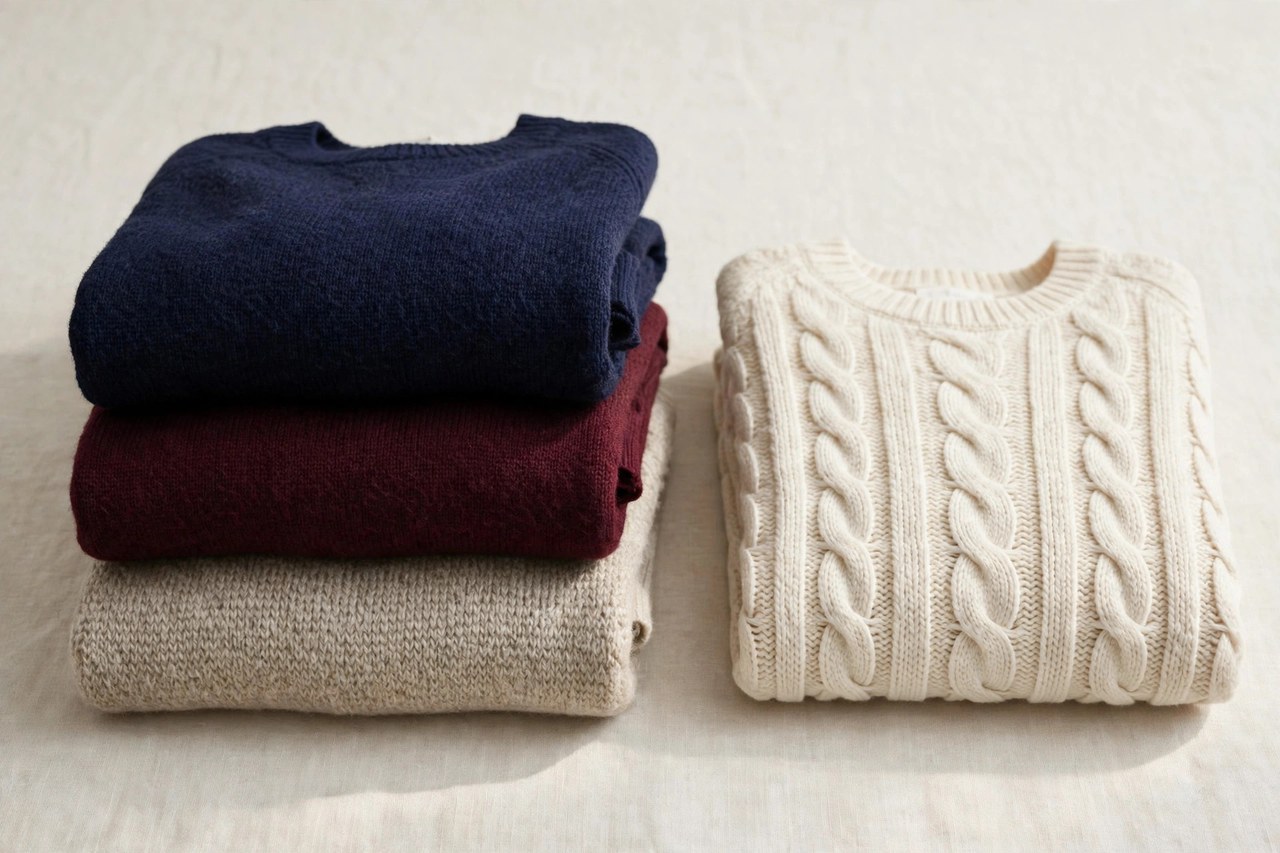
Men's wool sweaters are the knitwear core of the cold-weather wardrobe: crew necks, V-necks, cardigans, roll necks and fisherman knits in yarns from gauzy merino to rope-thick lambswool. No garment shows wool's range better - the same fiber makes a sweater thin enough to layer under a suit jacket and one warm enough to serve as a coat. This guide covers the styles worth knowing, the fit points that decide comfort, the fabrics and construction that separate a good buy from a regret, and the simple care that makes the garment last.
Styles and Construction
Choose by yarn, gauge and ply. Merino gives fine, smooth sweaters for layering and office wear; lambswool gives loft, texture and value; Shetland gives a dry, hardy hand and flecked color; cashmere blends give luxury at wear and price premiums. Gauge sets formality - fine gauges (14 and up) dress, mid gauges live daily, chunky low gauges read casual and rustic. Ply adds warmth and roundness. Construction tells quality fastest at the seams: fully-fashioned sweaters, shaped in the knitting with linked seams, lie flat and last; cut-and-sew sweaters cost less and bulk at every join. Ribbed cuffs and hems should recover crisply when stretched.
Judge knitwear by gauge, ply and finishing rather than by softness in the shop, because every knit feels kind on day one. Gauge counts stitches per inch - finer gauges drape and layer, coarser gauges insulate and read casual. Ply counts the strands twisted into the yarn: more plies mean more warmth, roundness and price. Fully-fashioned shaping, knitted in rather than cut and sewn, marks better garments, and linked seams at the shoulders and neck lie flatter and last longer than overlocked ones.
Fit and Sizing
A wool sweater should skim, not cling and not slump: chest ease for a shirt beneath on layering styles, sleeves to the wrist bone, body covering the waistband without pooling at the belt. Knits relax over the first wears - buy the fit you want after that settling, which usually means the slightly firm one. Roll necks should stand without strangling; V-necks should frame a collar and tie knot; cardigans should button without the placket rippling. Try sweaters seated: that is where length and chest ease tell the truth.
Fit knitwear by the body, not the shoulders alone: a sweater should skim rather than cling, with ease for a shirt beneath at the chest, sleeves ending at the wrist bone, and body length covering the waistband without pooling. Knits relax with wear - a slightly firm new fit is often the right long-term fit - but ribbed cuffs and hems should recover when stretched, and a neckline should sit flat against the base of the neck, neither gaping nor strangling.
Wearing and Care
Knitwear care is wool care at its gentlest: wash cool and rarely, by hand or wool cycle with knitwear detergent; never wring; roll in a towel; dry flat reshaped to its measurements; fold for storage, since hangers point the shoulders. Rest sweaters a day between wears, depill with a comb rather than pulling, and store the season's knits clean with cedar or lavender. A wool sweater treated this way measures its life in decades of winters, not seasons.
Knitwear care is gentle by default: wash cool by hand or on a wool cycle with knitwear detergent, never wring, roll in a towel to lift water, and dry flat on a mesh or towel, reshaped to its measurements. Fold for storage - hangers stretch shoulders into points - with cedar or lavender against moths, and rest a sweater a day between wears so its fibers recover their loft. Depill with a comb or electric shaver; pilling is loose fiber migrating, not the garment failing.
Common Questions
Merino or lambswool sweater for a first purchase?
Merino, in a fine-to-mid gauge crew or V-neck, in navy or grey: it layers under jackets, dresses up or down and feels smooth against skin. Lambswool is the better second sweater - warmer, more textured, more casual, and the classic for weekends and country wear.
Why does my wool sweater pill, and is it a defect?
Pilling is loose surface fiber migrating into balls where friction rubs - under arms, at the sides, where bags strap. It is normal in the first wears of softer yarns, not a defect; remove pills with a comb or electric shaver and they diminish as the loose fiber clears. Very persistent pilling signals short-staple yarn.
Can I hang wool sweaters on hangers to save drawer space?
No - a hung knit stretches at the shoulders under its own weight, permanently pointing them within a season. Fold sweaters, or drape them folded over a wide hanger bar if drawer space is impossible. Storage shape is the shape the sweater keeps.
More in Men's Clothes Guide W
Background
Not all sweaters are the same. Some feature a chunky, thick knit and are an excellent pick for cozying up by a fire. A merino wool sweater typically has a finer rib and is perfect for pulling over a button down shirt and wearing to work, or for wearing underneath a matching cardigan. Sweaters were traditionally made from wool, but can now be made of cotton, synthetic fibers, or any combination thereof. Wool is the textile fiber obtained from sheep and other animals, including cashmere and mohair from goats, qiviut from muskoxen, angora from rabbits, and other types of wool from camelids. A sweater (North American English) is a knitted garment intended to cover the torso and arms. A sweater is either a pullover or a cardigan, distinguished in that cardigans open at the front while pullovers do not. In British English, a pullover may also be called a jumper or jersey.
More to Explore on Apparel Search
References & Further Reading
Looking for Men's Clothing Stores?
This guide explains men's wool sweaters. To browse where to buy, visit our men's clothing store directory, where you can find retailers that carry them.