Women's Cutout Leggings Guide
Leggings with an edit — mesh panels, laser-cut patterns, and lace-up details that vent, decorate, and demand an opacity check.
Shop Women's Cutout Leggings Now
Shop Women's Cutout Leggings on Amazon Shop Women's Cutout Leggings on eBayThe Amazon and eBay links on this page are affiliate links. If you make a purchase through them, Apparel Search may earn a commission.
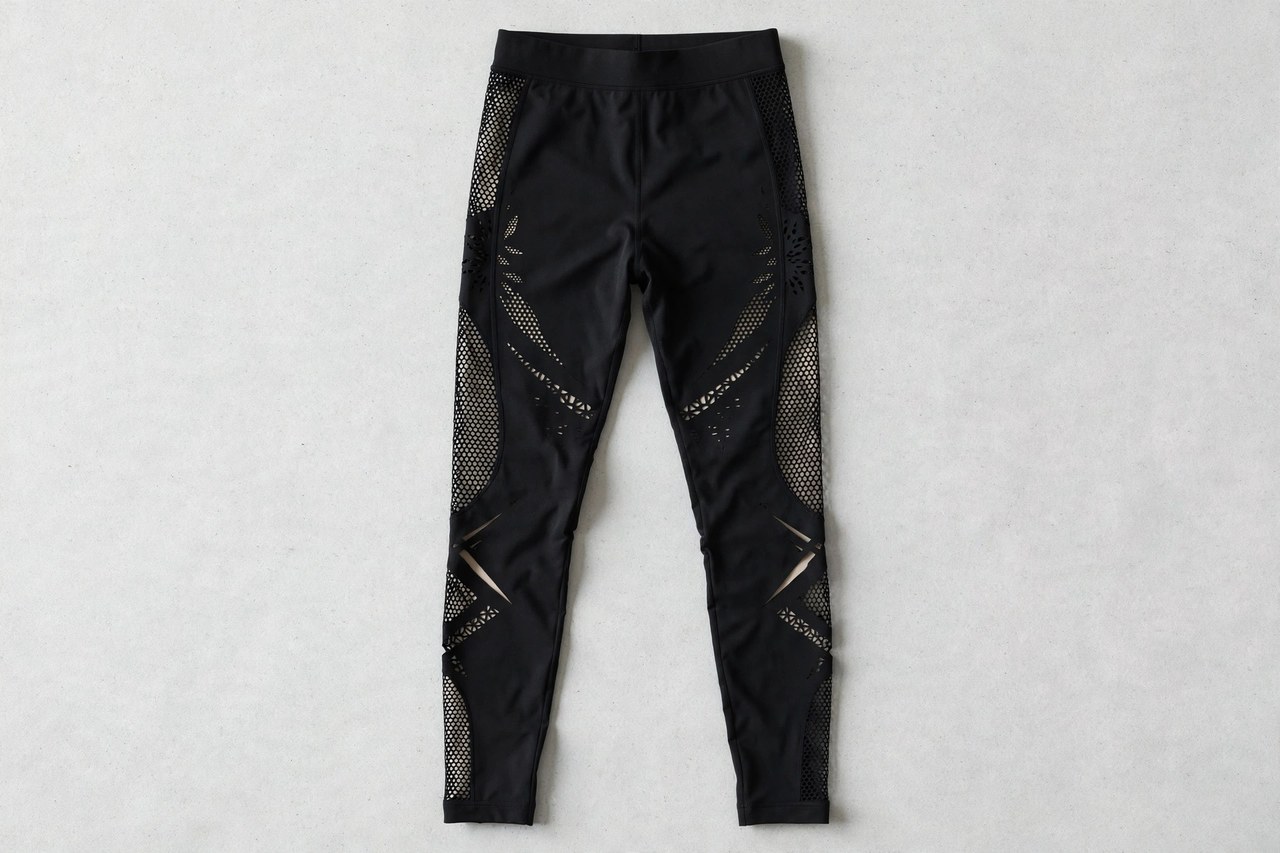
Cutout leggings take the standard full-length legging and edit it: panels removed, mesh inserted, patterns laser-cut, straps and laces added. The results range from genuinely functional workout leggings, where mesh behind the knee and along the calf vents heat during training, to purely decorative athleisure styles where cutouts at the thigh, hip, or ankle are there to be seen. That dual identity is the key to buying them well, because a legging designed for a hot yoga studio and a legging designed for coffee after class make different promises about coverage, support, and durability. Cutout placement also changes how the garment behaves: every opening interrupts the fabric's compression and stretch, so where the holes are matters as much as how they look. This guide sorts the styles, explains what to check for workouts, and covers the one test every pair must pass before the tags come off.
Styles: Mesh, Laser-Cut, Lace-Up, and Strappy
Mesh-panel leggings are the most common and most practical style, with breathable mesh replacing solid fabric behind the knees, along the calves, or in diagonal panels down the thigh. The mesh vents heat and adds a color-contrast or sheer effect while keeping the legging's structure mostly intact. Laser-cut leggings have patterns — dots, slashes, scallops, geometric rows — cut precisely into the fabric and heat-sealed at the edges; they read as decoration up close and texture at a distance. Lace-up and corset-detail leggings weave straps through eyelets at the calf, ankle, or waist for an edgy, adjustable accent, while strappy cutout styles crisscross bands around the lower leg or open a small window at the hip or thigh. Placement predicts purpose: ventilation cutouts sit where heat builds, decorative cutouts sit where eyes land, and the best designs are honest about which job they are doing.
Fabrics, Compression, and How Cutouts Change Them
Performance leggings are knitted from nylon or polyester blended with elastane, and the fabric weight decides almost everything. Heavier, tightly knitted fabric gives real compression, smooth coverage, and the recovery that serious training leggings promise; lighter fashion knits drape softer but show more and support less. Cutouts subtract fabric, so a legging with large mesh sections compresses less across those zones and relies on the remaining panels for its fit. Well-designed styles compensate by keeping the waistband, seat, and front panel fully solid and placing openings where compression matters least. Check the mesh itself: power mesh is denser and more supportive, while fine tulle-like mesh is delicate and can ladder like hosiery if it snags. Laser-cut edges should be cleanly sealed, because an unsealed cut in a knit can run or curl. Four-way stretch is essential — the fabric must recover instantly when stretched in any direction, or cutout edges will gape and distort the pattern within a few wears.
The Opacity Check and Workout Suitability
Every pair of cutout leggings must pass the squat test before it earns a workout. In bright light, wearing the underwear you would train in, squat deeply, bend forward, and lunge in front of a mirror — or ask a trusted friend — because stretched legging fabric thins, and cutouts near the seat or hip stretch widest exactly when coverage matters most. Quality workout styles keep the seat fully solid and opaque, confining cutouts to the lower leg, and use a gusseted crotch that survives movement without seams straining. For high-impact training, running, and heavy lifting, choose mesh-panel styles with moderate compression and a high, wide waistband that stays put; save hip cutouts, waist cutouts, and delicate laser patterns for yoga, barre, walking, and athleisure, where the forces are gentler. Honest matching of legging to workout prevents both embarrassment and returns.
Styling Cutout Leggings Beyond the Gym
Athleisure styling is where decorative cutouts shine. Black mesh-panel leggings with a longline sweatshirt or an oversized tee and trainers is the standard polished-casual formula; the mesh detail does the visual work, so the rest of the outfit can stay simple. Lace-up calf styles pair well with cropped hoodies and chunky sneakers for a streetwear edge, while subtle laser-cut patterns at the ankle dress up a plain legging enough for errands with a tunic and ankle boots. Keep proportions in mind: leggings are a close fit from waist to ankle, so volume on top — a boxy jacket, a long cardigan, a relaxed blazer — balances the silhouette. Color strategy matters too. Black and deep neutrals hide the boundary between fabric and mesh most elegantly and work across seasons. Treat highly detailed cutouts as the outfit's statement and avoid competing patterns elsewhere.
Care: Protecting Mesh and Cut Edges
Cutout leggings are the most delicate leggings you own, and washing is where they usually die. Turn them inside out, place them in a mesh laundry bag, and wash cold on a gentle cycle with similar smooth fabrics — never with towels, denim, or anything with zips and hooks that can snag mesh and lace-up straps. Skip fabric softener, which coats performance fibers and weakens elastane, and never tumble dry: heat is the enemy of both stretch and sealed laser-cut edges, so hang or lay flat to dry away from direct sun. Inspect cut edges and mesh panels after the first few wears; a small snag in mesh can often be stopped with a single stitch or a dot of fabric-safe adhesive, while an ignored one becomes a laddered panel within a month. Store leggings folded or rolled rather than hanging by the waistband, which stretches the elastic over time. Cared for this way, a good pair keeps its pattern crisp and its compression honest for many seasons of training and wearing out.
Related Women's Guides
Photos

More to Explore on Apparel Search
Looking for Women's Clothing Stores?
This guide helps you choose women's cutout leggings by style, material and fit. To browse where to buy, visit our women's clothing store directory, where you can find retailers that carry them.