Women's One-Piece Swimwear Guide
The one-piece swimsuit is swimwear's foundation garment: a single, continuous suit that dresses the torso in one piece — in more styles, fabrics and functions than any other swim category.
Shop Women's One-Piece Swimsuits Now
Shop Women's One-Piece Swimsuits on Amazon Shop Women's One-Piece Swimsuits on eBayThe Amazon and eBay links on this page are affiliate links. If you make a purchase through them, Apparel Search may earn a commission.
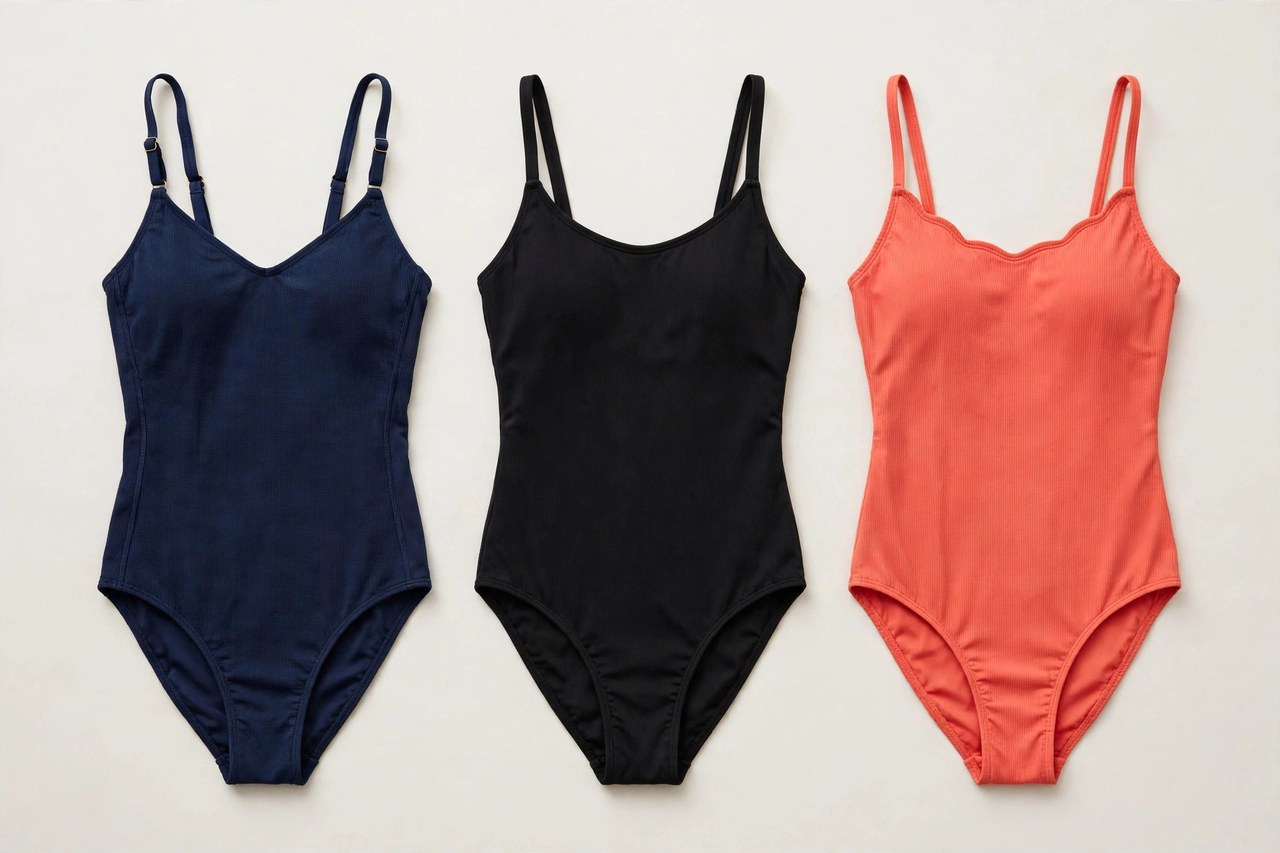
A one-piece swimsuit (a one-piece, or in older usage a maillot) is a single garment covering the torso, knitted or woven from stretch swim fabric, without a separate top and bottom. It is the original modern swimsuit and still the most versatile: the same basic architecture serves Olympic training pools, resort beaches, water-aerobics classes and hotel spas, changing only its cut, fabric and detail from one job to the next. This umbrella guide maps the whole category, then points you to our specialist pages for the two great back constructions.
Everything about a one-piece is a product decision, and this guide treats it that way: necklines and backs as engineering, fabrics as chemistry, support as construction, and sizing as measurement. Read it as the map of the territory; the racerback guide (for athletic and training suits) and the scoop back guide (for the classic open-back silhouette) are the detailed charts for their corners of it, and both are linked below.
Necklines, Backs and Leg Cuts
The back is the suit's structure. The scoop back is the classic open U, easiest to wear and the subject of its own guide. The racerback converges between the shoulder blades for sport, also with its own guide. Between them sit the cross-back and keyhole backs, which trade a little openness for strap security, and high backs that close the back almost entirely for maximum hold and sun coverage. Straps may be fixed, adjustable, or tie-fastened; for any suit you will swim actively in, fixed or adjustable straps outlast ties.
The front sets the style. Necklines run from high and athletic (for training and coverage) through scoop and square (the classics) to sweetheart, wrap and plunge (the dressier end). Leg cuts run the same spectrum: low and boyshort for coverage, moderate as the standard, and high-cut to lengthen the leg line. None of these choices is decorative only — neckline height changes sun exposure and stroke freedom, back style changes strap security, and leg cut changes how the suit stays seated in surf or on a waterslide. Choose them as functions first.
Fabrics, Lining and Support
Swim fabric is always a stretch blend, and the base fiber decides the suit's working life. Nylon-elastane is the softest and most comfortable, ideal for holidays and occasional swimming, but chlorine degrades it fastest. Polyester-elastane and PBT blends are the chlorine-resistant workhorses for regular pool swimmers. Recycled-fiber suits (from regenerated nylon or recycled polyester) now match standard fabrics in feel and are worth choosing where the hand feel suits you. Whatever the fiber, a suit needs roughly a fifth elastane to hold its shape wet and dry.
Lining and support are the hidden half of quality. A fully lined suit (or at minimum a lined front and gusset) stays opaque when wet, lasts longer, and feels smoother. Built-in support ranges from none (racing suits), through shelf linings and removable soft cups, to molded cups and underwires in suits designed for fuller busts. Some suits add tummy-control panels — an extra firm lining layer at the front — which smooth without the squeeze of shapewear. And for outdoor wear, check the UPF rating: tightly knitted polyester suits commonly reach UPF 50, turning the one-piece into genuine sun protection for the torso it covers.
Sizing by Torso, and Care
One-pieces fail more often on length than on width, so measure your torso loop (over one shoulder, down the front, through the legs and up the back) and compare it with the maker's size chart before ordering. Dress size is a rough guide only. A correct fit is snug without strap dig, with leg openings that stay seated when you lift a knee, and enough length that the neckline sits where designed when you raise both arms. Between sizes for a holiday suit, choose comfort; for a training suit, choose snugness — fabric relaxes in the water. Long-torso and petite-torso ranges exist in most major lines and solve most fit complaints in this category.
Care is uniform across the category and doubles a suit's life. Rinse in cold fresh water after every wear, even after sunbathing only — sunscreen and sweat degrade elastane too. Hand wash with mild soap, never bleach, never wring hard, and dry flat or folded over a rail away from heat and direct sun. Keep suits out of hot tubs where possible (hot chlorinated water is the fastest elastane killer), rotate two suits on a trip, and store the suit dry, un-folded at the straps. A one-piece cared for this way holds its fit and color for seasons; neglected, even the best fabric gives up within one.
Related Women's Guides
Looking for Women's Clothing Stores?
This guide helps you choose women's one-piece swimsuits. To browse where to buy, visit our women's clothing store directory, where you can find retailers that carry them.