Women's V-Neck Shirts Guide
A V-neck shirt is a woven or dress shirt whose neckline plunges in a V from the collar, in button-front, popover and blouse styles, cut from cotton poplin, silk, rayon and polyester fabrics.
Shop Women's V-Neck Shirts Now
Shop Women's V-Neck Shirts on Amazon Shop Women's V-Neck Shirts on eBayThe Amazon and eBay links on this page are affiliate links. If you make a purchase through them, Apparel Search may earn a commission.
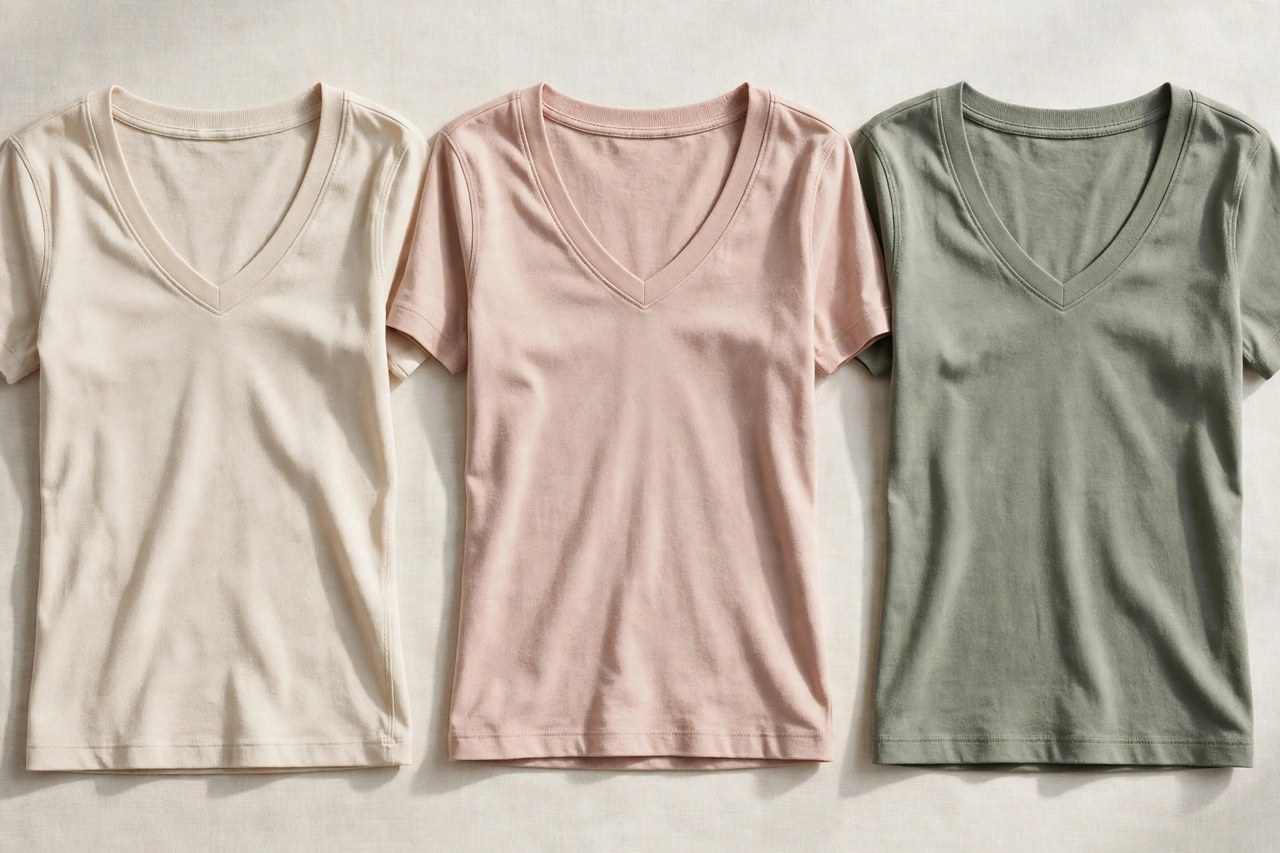
A V-neck shirt is a woven or dress shirt whose neckline plunges in a V from the collar, in button-front, popover and blouse styles, cut from cotton poplin, silk, rayon and polyester fabrics. This guide covers the V-neck in its tailored form: how the plunge is constructed on a woven shirt — facing, collar band and button placement — and how depth, fabric stiffness and shoulder fit decide whether the shirt reads formal or relaxed.
This guide covers v-neck shirts in the order a careful buyer needs it: what the product is made from, how it is constructed, how it should fit, how to choose it for real use, and how to care for it so it lasts. The focus is on measurable details, named materials and checks you can perform in a shop or on a parcel's arrival, rather than general fashion language.
Neckline Construction and Fabrics
A V-neckline is finished one of two ways: banded, with a strip of ribbing or self fabric sewn around the opening, on tees, sweaters and tanks; or faced, with a shaped facing turned to the inside, on woven shirts and blouses. The fabric decides the character — jersey drapes and clings, poplin holds a pressed edge, fine knits frame a collarbone cleanly, and fluid crepe softens the angle into a curve.
Construction details predict how the neckline behaves after a month of wear: a band attached with stretch stitching recovers, a faced edge stays flat if the facing is interfaced, and a cheaply finished V twists toward the side with the weaker stitching. On a woven V-neck shirt the plunge depth is fixed by construction, not adjustable: measure it from the shoulder seam, because two shirts with the same labelled size can differ by two inches of depth. Check the point of the V first — it takes the most strain and shows faults earliest.
Depth, Fit and Layering
Fit a V-neck by its finished depth, measured from the shoulder seam at the neck to the point of the V, compared against a top you already wear happily. Shallow Vs end near the collarbone; deep Vs approach the sternum. Bust fit interacts with depth: a V that sits perfectly standing can pull or gape seated if the front lacks ease, which is why shaped fronts and small modesty snaps exist.
Layering is the V-neck's second fit question. A V frames whatever is beneath it — collared shirt, camisole, fine crew tee — so the depth should be chosen against the intended layer: deep enough to show it, not so deep the layer becomes the whole story. Under knitwear and blazers, a banded V lies flatter than a faced one of the same depth.
Choosing the Right V-Neck
Choose v-neck shirts by measurable criteria in a fixed order: finished depth in inches, finish type (banded or faced) for the formality you need, fabric for the season and care you will actually give it, and only then colour. In practice, rank these checks in the order your own use demands — frequency of wear first, then weather, washing facilities and budget — because that order differs by wardrobe, and it is the real reason two careful buyers can correctly choose differently from the same rail.
Judge price by the neckline's finishing and the fabric's recovery. A V that keeps its angle after washing — true band stitching, interfaced facing, quality knit — is the whole product; a V that twists or relaxes ruins an otherwise sound garment, and it is the first thing to inspect on a parcel's arrival.
Washing and Storage
Wash V-necks inside out, cool, with similar colours; reshape the neckline while damp and dry flat or on a padded hanger, because a wet V hung by its shoulders stretches at exactly the point you care about. Knitted Vs should always be dried flat and stored folded.
Store woven V-neck shirts on hangers that reach the shoulder point, knits folded, and tanks by their straps only if the straps are wide — narrow straps stretch under a garment's hanging weight. A V that has relaxed slightly often recovers with a cool wash and flat dry; one whose band has lost its stitching needs a tailor, not a wash.
Common Questions
How deep should a V-neck shirt plunge for office wear?
For office wear, choose a plunge that ends above the bust line — roughly a hand's width below the collarbone — in a faced or collar-band construction that lies flat. Deeper plunges in woven shirts cannot be adjusted, so check the depth measurement or a worn photograph before buying.
Why does the V on my woven shirt gape when I sit?
Gaping usually means the facing is too light for the fabric or the bust needs more room across the front panel. A shirt cut with a slightly shaped front and a button or snap at the plunge point sits closed; a straight-cut front in stiff poplin will always pull open when you sit.
What fabric makes a V-neck shirt look tailored rather than casual?
Cotton poplin and matte silk hold a pressed, structured V because the weave keeps its edge. Soft rayon and crepe drape into a relaxed V instead — the same pattern in a fluid fabric reads as a blouse, not a shirt.
Related Women's Guides
Photos

Looking for Women's Clothing Stores?
This guide helps you choose women's v-neck shirts. To browse where to buy, visit our women's clothing store directory, where you can find retailers that carry them.