Aida Cloth
Fabric Definitions — fabric and textile definitions from Apparel Search
Search Apparel Search
At a Glance
Definition: Aida cloth is an even-weave fabric woven in visible blocks of threads, forming a counted grid of squares that makes it the standard ground cloth for cross-stitch embroidery.
Category: Fabric Definitions
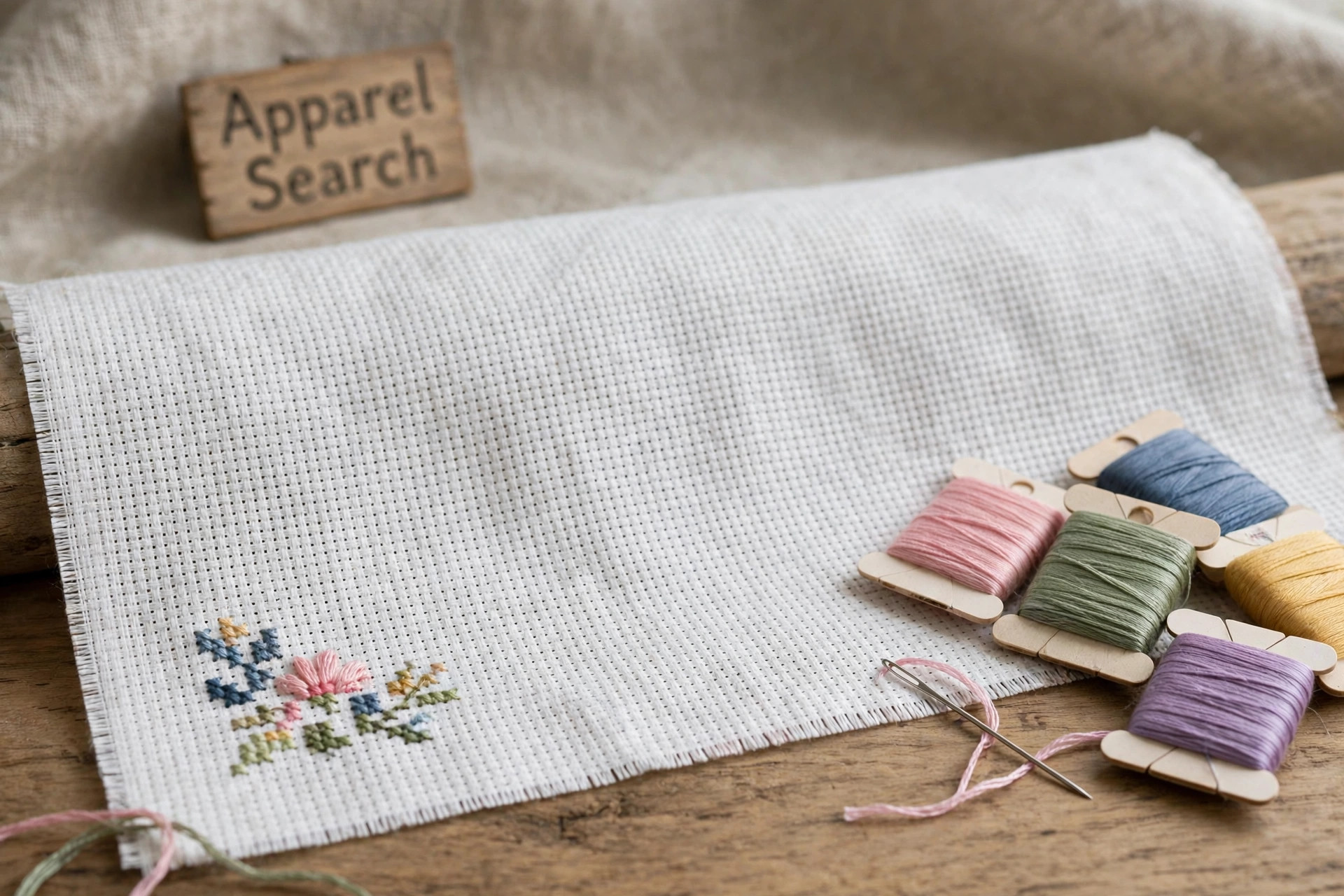
Aida cloth is the ground fabric most closely associated with cross-stitch. Its threads are grouped into distinct blocks, so the surface reads as a regular grid of squares with a clear hole at each corner, and every stitch sits inside one square. Because the grid can be counted at a glance, a stitcher follows a chart square for square instead of counting single threads. The cloth is sold by count — the number of squares to the inch — and is most often cotton, given a light stiffness in manufacture so that it can be worked in the hand.
A Weave Built for Counting
Aida answers the central difficulty of cross-stitch: setting down thousands of identical X-shaped stitches in exact rows without losing count partway through. An ordinary plain weave offers nothing to count against. Aida's threads are bundled instead — woven together in groups so the cloth resolves into squares, each one with an obvious hole at its corners. The needle travels through those holes rather than piercing threads, which holds every stitch to the same size and keeps the finished design symmetrical. That readability is why Aida became the standard teaching cloth for cross-stitch and the ground named in most charted kits: a beginner can work from a chart square for square from the very first stitch. The wider craft it serves is covered in the embroidery definition.
Counts, Sizes and Fabric Choice
Common counts run from 11 to 18 squares per inch, with finer specialty cloths beyond that range. Choosing a count is a sizing decision as much as a texture decision. A sampler charted at 140 by 200 stitches measures roughly 12.7 by 18 inches on 11-count, 10 by 14.3 inches on 14-count, and under 8 by 11.2 inches on 18-count — one design at three scales and three levels of fineness. Coarser counts leave the grid open and suit bold designs, children's first projects and pieces meant to be read at a distance. Finer counts close the grid up, render shading and fractional stitches more smoothly, and call for smaller needles and fewer strands of floss. Aida is most often cotton, stiffened slightly during manufacture so it can be worked in the hand; the stiffness washes out, and for large pieces most stitchers still work in a hoop or frame to keep the tension even. The base material itself is the general fabric of woven fibre described elsewhere in these definitions.
Aida Among the Even-Weaves
Aida belongs to the even-weave family, and stitchers move between its members as their skill grows. Hardanger cloth groups its threads in pairs and supports cutwork as well as cross-stitch. Jobelan and other cotton even-weaves give a smoother surface with a less visible grid at similar counts. Linen even-weave offers the softest drape and the most traditional appearance, at the price of slightly uneven threads that test a stitcher's counting. All of them share the defining even-weave property: warp and weft threads of the same size, so a stitch covering a set number of threads measures the same horizontally and vertically. Aida remains the only member whose grid a newcomer can read without instruction — which is exactly the job it was designed to do. As a woven cloth worked with needle and thread, it also sits within the broader sewing crafts.
Common Questions
What does the count of Aida cloth mean?
The count is the number of squares, and therefore of stitches, in one inch of cloth. A design 140 stitches wide finishes 10 inches wide on 14-count, smaller and finer on 18-count, and larger and bolder on 11-count. Changing the count changes the finished size, not the design itself.
How is Aida cloth different from even-weave linen?
Both are even-weaves with warp and weft matched, but Aida is woven in distinct blocks of threads with a clear hole at each corner, which makes counting almost automatic. Linen even-weave is made of single, sometimes slightly irregular threads, and stitches are usually worked over two of them — a finer, softer result that demands more attention.
How should Aida cloth be handled before and after stitching?
Raw edges fray readily, so stitchers tape or oversew them before starting work. Finished pieces are washed gently to remove handling marks and pressed from the back, often over padding so the stitches are not flattened, before framing or making up.