Burlap
Fabric Definitions — fabric and textile definitions from Apparel Search
Search Apparel Search
At a Glance
Definition: Burlap is a strong, coarse, loosely woven cloth made from jute, flax or hemp, usually left unbleached in its natural light brown colour and used for bags, backing and rustic decoration.
Also known as: Hessian cloth, or simply Hessian
Category: Fabric Definitions
Word Origin
The cloth's second name, Hessian, comes from Hesse in Germany: Hessian soldiers were historically associated with uniforms connected to the fabric, and the name attached itself to the coarse jute cloth as it was traded around the world. Hessian remains the everyday term in British and Commonwealth use, while burlap is the North American name for the same cloth.
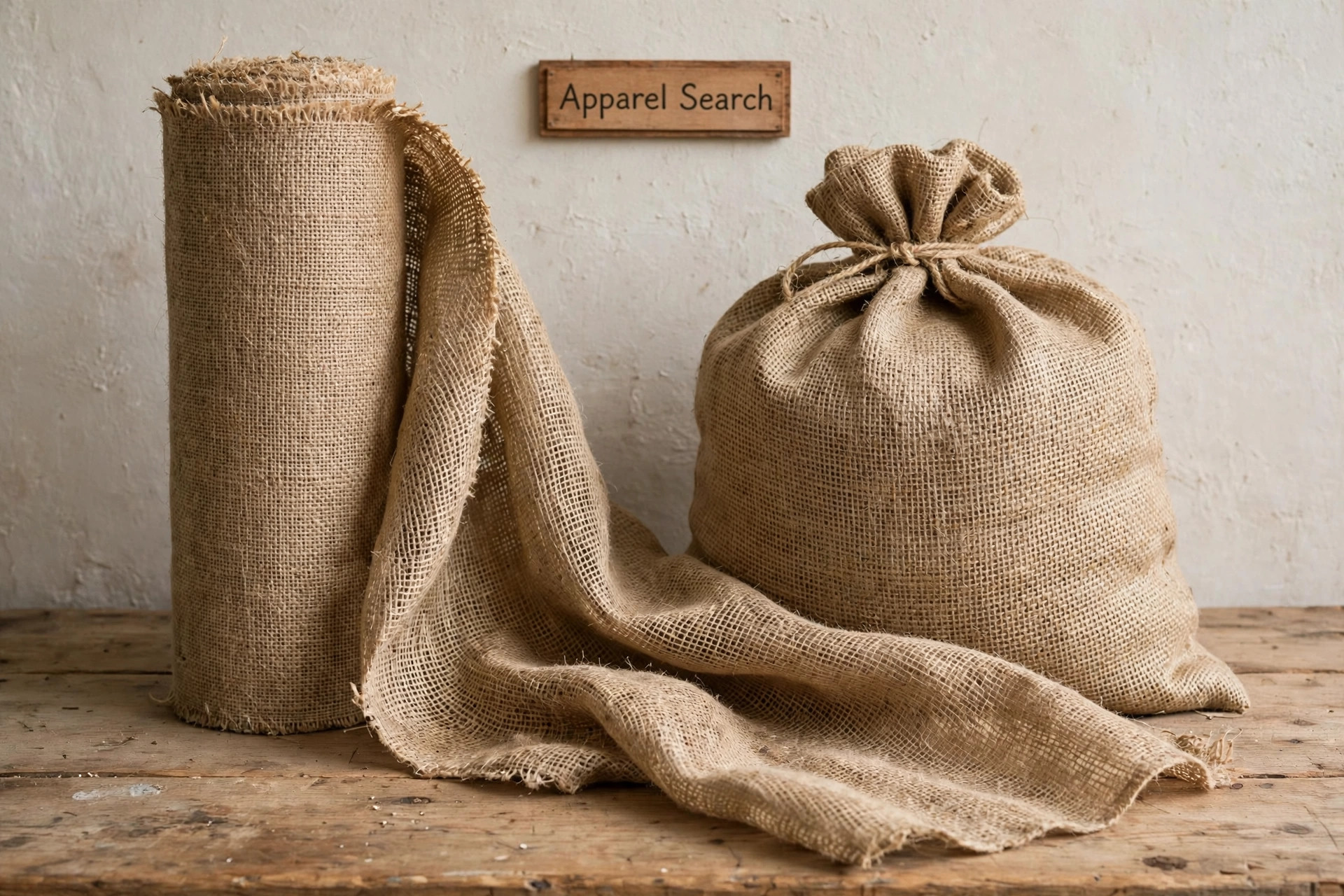
Burlap is a tough, coarse cloth woven loosely from the fibers of jute, flax or hemp. It goes into sacks and bags, serves as a reinforcing layer under linoleum, and appears in interior decoration, with a finer grade of the same kind of cloth made for curtains. It is normally sold unbleached, in the natural light brown of its fibre, and it travels under a second name — Hessian cloth, or simply Hessian.
A Cloth Graded by the Job It Does
Few textiles are specified as purely by function as burlap. Its sack grades are woven to carry weight — coffee, potatoes, grain and similar produce — while still letting the contents breathe, and to cost little enough that the sack can be treated as part of the packaging; the bag definition covers the made-up forms. Woven heavier and tighter, the same cloth becomes a backing and reinforcement material: it strengthens linoleum, backs carpets, wraps the root balls of trees being transplanted, and is laid over slopes as an erosion-control mat that holds the soil until plants establish, then rots away.
At the fine end of the range, an even-textured Hessian turns into a furnishing cloth — curtains of the kind the original definition already noted, wall coverings, bulletin-board surfaces and rustic decoration for events, where the natural light brown colour and the openly visible weave are themselves the decoration. A single fibre family and one simple weave cover that whole span from sack to curtain. What changes between grades is only the size of the yarn, how densely it is woven, and how the cloth is finished.
Why It Costs So Little
Burlap's price is set in the field more than in the mill. Its principal fibre, jute, is a long bast fibre taken from the stems of a plant that grows fast in warm, wet conditions and reaches the loom with far less processing than an apparel fibre demands. The weaving then adds as little as possible: a loose, plain construction that uses the fibre close to its natural state, with no bleaching, no dyeing and minimal finishing. Skipping nearly every costly step in textile production is the whole economics of the cloth — its cheapness is not a compromise made in manufacture but the direct result of steps never taken.
Working Properties and Limits
In use, burlap offers strength out of proportion to its cost, breathability, and the ability to biodegrade when its work is done. Its limits are equally definite. The loose weave frays at every cut edge, so pieces intended for decoration are hemmed or sealed; the cloth sheds short fibres and carries the earthy smell of jute until it has been aired. Left damp it rots, prolonged sunlight weakens it, and washing cannot be expected to leave it the same shape — care means shaking out, airing and spot cleaning rather than laundering.
Those limits fix its place among textiles. Burlap makes no claim to be a clothing fabric, and inside its own territory — sacks, backing, ground work and rustic texture — it has outlasted many finer materials because nothing cheaper performs its jobs as well. It is a useful corrective to the idea that a fabric is ranked by refinement: burlap is refined exactly as far as its work requires, and no further.
Common Questions
Why is burlap also called Hessian?
Hessian takes its name from Hesse in Germany, whose soldiers — Hessians — were historically associated with uniforms of the fabric, and the name travelled with the coarse jute cloth in worldwide trade. Hessian is the everyday word in British and Commonwealth usage; the same cloth is called burlap in North America.
Why is burlap made from jute so inexpensive?
Jute is a long bast fibre stripped from the stems of the jute plant, which grows quickly in warm, wet conditions and needs far less refinement than apparel fibres. Burlap's loose, plain weave uses that fibre nearly as it comes — unbleached, undyed and minimally finished — so most of the cost stays in the growing rather than the making.
Can burlap be used for clothing?
Ordinary sack-grade burlap is too coarse, stiff and irritating against skin for garments, and its loose weave frays and sheds fibres. Its clothing-adjacent uses are rustic decoration, costumes and accessories, where the texture is the point and skin contact is limited; the fine Hessian grades are made for curtains and interiors instead.