Kepi
Hat & Headwear Definitions — hats, caps, helmets and headwear terms from Apparel Search
The kepi is a cap with a flat circular top and a visor. The word came into English from French, in which it is written with an acute accent, képi. It is the most common headgear in the French Army and the French Gendarmerie, particularly the French Foreign Legion, and in the United States it is most often associated with the American Civil War era and the Indian Wars.
The kepi is a cap with a flat circular top and a visor. The word came into the English language from French, in which it is written with an acute accent: képi.
It is the most common headgear in the French Army and the French Gendarmerie particularly, the French Foreign Legion, whose members are sometimes called Képis blancs ("white kepis"), because of the the unit's regulation white headgear. In the United States it is most often associated with the American Civil War era, and into the Indian Wars.
|
The above article is licensed under the GNU Free Documentation License. From Wikipedia, the free encyclopedia https://en.wikipedia.org/wiki/kepi 6/11/05 |
Photos
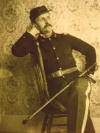
Flat Circular Top and Visor
The kepi is a cap, not a hat, and its definition rests on two features working together: a flat circular top and a visor. The top is flat and round, giving the cap a level, disc-like crown quite different from the rounded or creased crowns of most caps and hats. Below that flat top the body of the cap sits around the head, and at the front a visor projects to shade the eyes. That pairing produces the kepi's familiar military silhouette, neat and level above, shaded in front, smart enough for uniform dress and simple enough for general issue. Because the shape is so consistent, the kepi can be recognised across countries and periods even when its colour, material or trim changes: look first for the flat circular top, then for the visor, and the cap in view is a kepi whatever uniform it completes.
Even its name records its origin. The word kepi came into the English language from French, in which it is written with an acute accent: képi. English use dropped the accent mark but kept the word itself, a common path for military vocabulary borrowed from the French Army, whose dress and drill influenced many other forces. Knowing the French spelling helps when reading older or French sources, where képi and kepi refer to exactly the same cap, and it explains why the word does not follow ordinary English spelling patterns. The name, like the cap, is French first and international second, adopted elsewhere along with the headgear it describes.
The Cap of the French Army and the Civil War
The kepi is the most common headgear in the French Army and the French Gendarmerie. That breadth of use within France, across both the army and the gendarmerie, makes it a national military cap in a way few other countries match with a single style. Its best-known French wearers are the French Foreign Legion, whose members are sometimes called Képis blancs, white kepis, because of the unit's regulation white headgear. A nickname drawn from a cap shows how completely the headgear identifies the unit: the white kepi is not one option among several for the Legion, it is regulation dress, visible in every formal image of the force, and distinctive enough that the men are named after it. White as a regulation colour also sets the Legion's kepi apart at a glance from the kepis of other French services, while the flat top and visor keep the shared form clear underneath the colour difference.
Outside France, the kepi carries a different set of associations. In the United States it is most often associated with the American Civil War era, and into the Indian Wars. For American readers and collectors, therefore, the same flat-topped, visored cap that means modern French service in Europe means 19th-century American soldiers at home. Both associations are correct, and together they show the kepi's unusual double life: a living item of French uniform, still the most common headgear of the French Army and Gendarmerie, and a historical emblem of American warfare of the Civil War period and the years that followed. When a kepi is described or sold, colour, markings and context decide which chapter it belongs to, French regulation white pointing to the Foreign Legion, while American Civil War context points to the era with which the cap is most often linked in the United States.
Common Questions
What shape is a kepi?
A kepi is a cap with a flat circular top and a visor. The flat round crown combined with the forward visor gives the cap its distinctive military profile.
Where does the word kepi come from?
The word came into the English language from French, in which it is written with an acute accent as képi. English dropped the accent while keeping the French pronunciation and meaning.
Why are Foreign Legion members called white kepis?
Members of the French Foreign Legion are sometimes called Képis blancs, meaning white kepis, because of the unit's regulation white headgear. The white kepi is the Legion's regulation form of the cap.