Yarn Length
Converting yarn counts into lengths you can order by
Yarn is bought by weight and used by length, so someone in every mill has to convert count into metres. This page collects the working formulas: yarn length in metres from English cotton count and weight (l/m = 1693 x lm/nec x m/kg), cotton count from denier (lm/nec = 5315 / denier), and cotton count from tex (lm/nec = 590.5 / tex) — remembering that English cotton count is an indirect system, so the higher the count, the finer the yarn. Around the formulas sit the length units they rely on: the thread of 54 inches, the bundle of 10 pounds, and the lea of 80 threads or 120 yards.

yarn is a long continuous length of interlocked fibres, suitable for use in the production of textiles, sewing, crocheting, knitting, weaving, embroidery, and ropemaking.
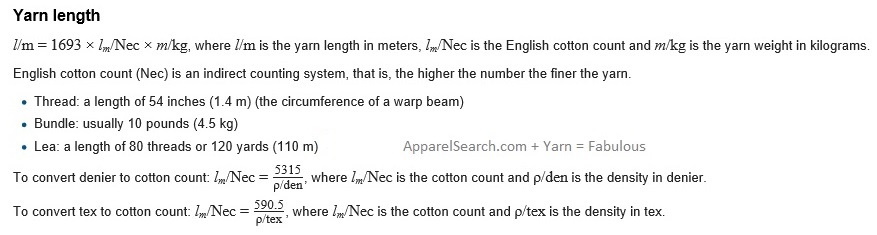
l/m = 1693 × lm/nec × m/kg, where l/m is the yarn length in meters, lm/nec is the English cotton count and m/kg is the yarn weight in kilograms.
English cotton count (Nec) is an indirect counting system, that is, the higher the number the finer the yarn.
- Thread: a length of 54 inches (1.4 m) (the circumference of a warp beam)
- Bundle: usually 10 pounds (4.5 kg)
- Lea: a length of 80 threads or 120 yards (110 m)
To convert denier to cotton count: lm/nec = 5315/ρ/den, where lm/nec is the cotton count and ρ/den is the density in denier.
To convert tex to cotton count: lm/nec = 590.5/ρ/tex, where lm/nec is the cotton count and ρ/tex is the density in tex.
Below is another look at the formulas above that we saved into a different format because we are having difficulty typing to show division line.
Have you ever asked yourself, what is a hank of cotton or silk? You can read the hank definition if you are curious.
Thank you for using the Apparel Search website.
Why the Constants Look Strange
Numbers like 1693, 5315 and 590.5 look arbitrary until their ingredients are visible: each constant is a bundle of unit conversions — yards into metres, pounds into kilograms, and the 840-yard hank or the 9000-metre denier definition — pre-multiplied so the mill clerk multiplies once instead of five times. That is also why the constants must never be borrowed across systems: the 590.5 that converts tex to cotton count already knows tex weighs 1000 metres, and using it on a denier figure, which weighs 9000, would quietly produce a count nine times adrift. The formula diagram kept with this page presents the same relationships in visual form for readers who prefer to see the division lines drawn out.
From Formula to Purchase Order
In practice the conversions answer purchasing questions: how many kilograms of a 30 Ne yarn are needed to weave a given length of cloth, or how far a delivered lot will actually run. Working them in the open, with the system named at every step — Nec for English cotton count, tex and denier by their definitions — keeps the whole chain auditable, and the unit definitions linked from this page (hank, denier, tex, thread) let any reader re-derive a constant they do not trust. A conversion you can re-derive is a conversion you can defend when a shipment and a specification disagree.
Common Questions
How is yarn length calculated from cotton count and weight?
Using l/m = 1693 x lm/nec x m/kg, where l/m is yarn length in metres, lm/nec is the English cotton count and m/kg is the yarn weight in kilograms.
How do you convert denier and tex to cotton count?
Cotton count = 5315 / denier, and cotton count = 590.5 / tex, using the constants for each system.
What are the thread, bundle and lea in yarn length terms?
A thread is 54 inches (the circumference of a warp beam), a lea is 80 threads or 120 yards, and a bundle is usually 10 pounds.