Elsa Schiaparelli Profiles
The life behind the surrealist couture — Paris, knitwear, Dalí, and 1954.
Elsa Schiaparelli (1890–1973) was an Italian fashion designer. Along with Coco Chanel, her greatest rival, she is regarded as one of the most prominent figures in fashion between the two World Wars. This profiles page tells her story in order: the Paris start under Paul Poiret's encouragement, the closure of 1926, the knitwear relaunch of 1927, and the surrealist collaborations that made her the most original couturier of the 1930s. Of all the pages in this series, this is the one the others depend on.
Starting with knitwear, Schiaparelli's designs were heavily influenced by Surrealists like her collaborators Salvador Dalí and Alberto Giacometti. Her clients included the heiress Daisy Fellowes and actress Mae West. In Paris, Schiaparelli — known as “Schiap” to her friends — began making her own clothes; with some encouragement from Paul Poiret, she started her own business, but it closed in 1926 despite favourable reviews. The biography searches in the references gather the wider career coverage; the house's official website is also linked there.
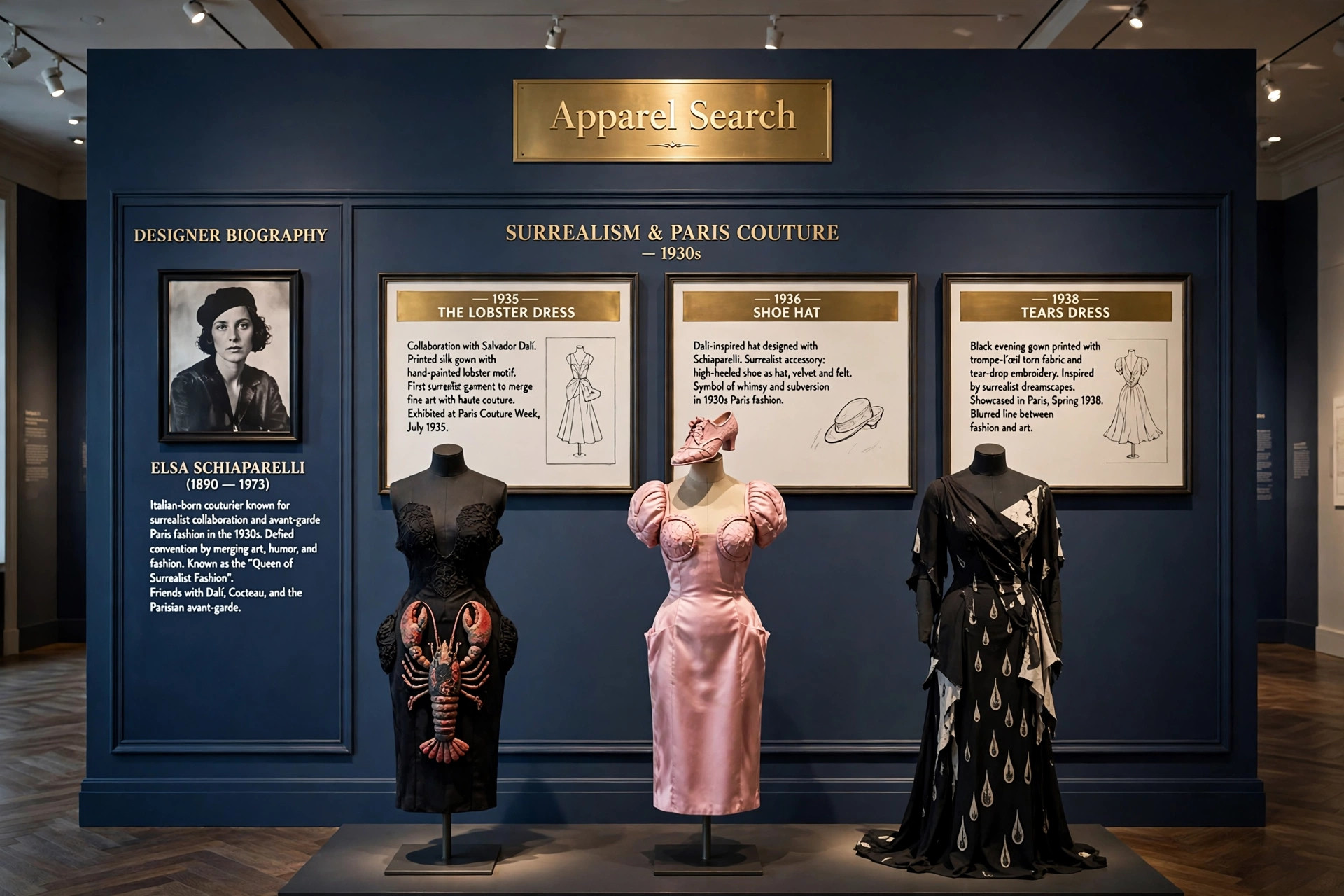
Illustrative image created for this guide — an artistic impression, not this designer's own garments.
News, Photos & VideoCollectionsFall FashionsFashion WeekNewsProfilesRunwaySpring Fashions
Knitwear, 1927 and the Rise
She launched a new collection of knitwear in early 1927 using a special double layered stitch — a technical idea, executed by skilled knitters, that turned a humble category into couture news and rebuilt the business the 1926 closure had ended. From that foundation the house grew into the defining Paris couture story of the following decade: clothes designed with artists, in which a surrealist idea — a motif borrowed from a painting, a shape borrowed from sculpture — was carried through with complete couture seriousness.
The rivalry with Chanel framed the era: two Italian-and-French opposites, one preaching restraint and the other invention, between them defining what fashion between the wars could be. The collections, fall and spring pages in this series file the design record; the runway and fashion week pages follow its presentation.
War, Change and 1954
Schiaparelli did not adapt to the changes in fashion following World War II, and her business closed in 1954. The postwar silhouette belonged to a different idea of femininity, and the house that had defined the 1930s did not follow it. Closure, though, is not the end of her record: the surrealist vocabulary she put into clothes — art worn on the body, wit engineered as couture — became a permanent part of fashion's language, quoted by designers ever since.
Read with the collections page, the profile completes its arc: the Italian designer who arrived in Paris, failed once, relaunched on a knitting stitch, and — with Dalí and Giacometti beside her — made the most inventive clothes of her generation. The profiles record keeps the order straight: Poiret's encouragement, the 1926 closure, the 1927 knitwear, the great surrealist years, and 1954.
Common Questions
Who was Elsa Schiaparelli?
Elsa Schiaparelli (1890–1973) was an Italian fashion designer who, along with Coco Chanel, her greatest rival, is regarded as one of the most prominent figures in fashion between the two World Wars.
How did Schiaparelli start in Paris?
In Paris — where she was known as “Schiap” to her friends — she began making her own clothes and, with encouragement from Paul Poiret, started her own business; it closed in 1926 despite favourable reviews, and she relaunched with a collection of knitwear in early 1927 using a special double layered stitch.
Why did the Schiaparelli business close?
She did not adapt to the changes in fashion following World War II, and her business closed in 1954. Her clients in her great years had included the heiress Daisy Fellowes and the actress Mae West.