Judith Leiber Profiles
The life behind the crystal clutch — Budapest, wartime, and New York in 1947.
Judith Leiber (1921–2018) was an American fashion designer and businesswoman, born Judith Peto in Budapest to Helene, a Vienna-born homemaker, and Emil, a commodities broker; she had one sister, Eva. She built her name on a single object perfected over fifty years: the evening handbag, raised from accessory to jewel. This profiles page tells the career in order — the London chemistry plan that war interrupted, the Budapest handbag apprenticeship, the founding of her house in 1963, and the crystal minaudières that followed. Of all the pages in this series, this is the one the others depend on.
The biography searches in the references gather the wider career coverage, and the house's official website is linked there as well. The collections, runway and news pages in this series file the work the life produced.
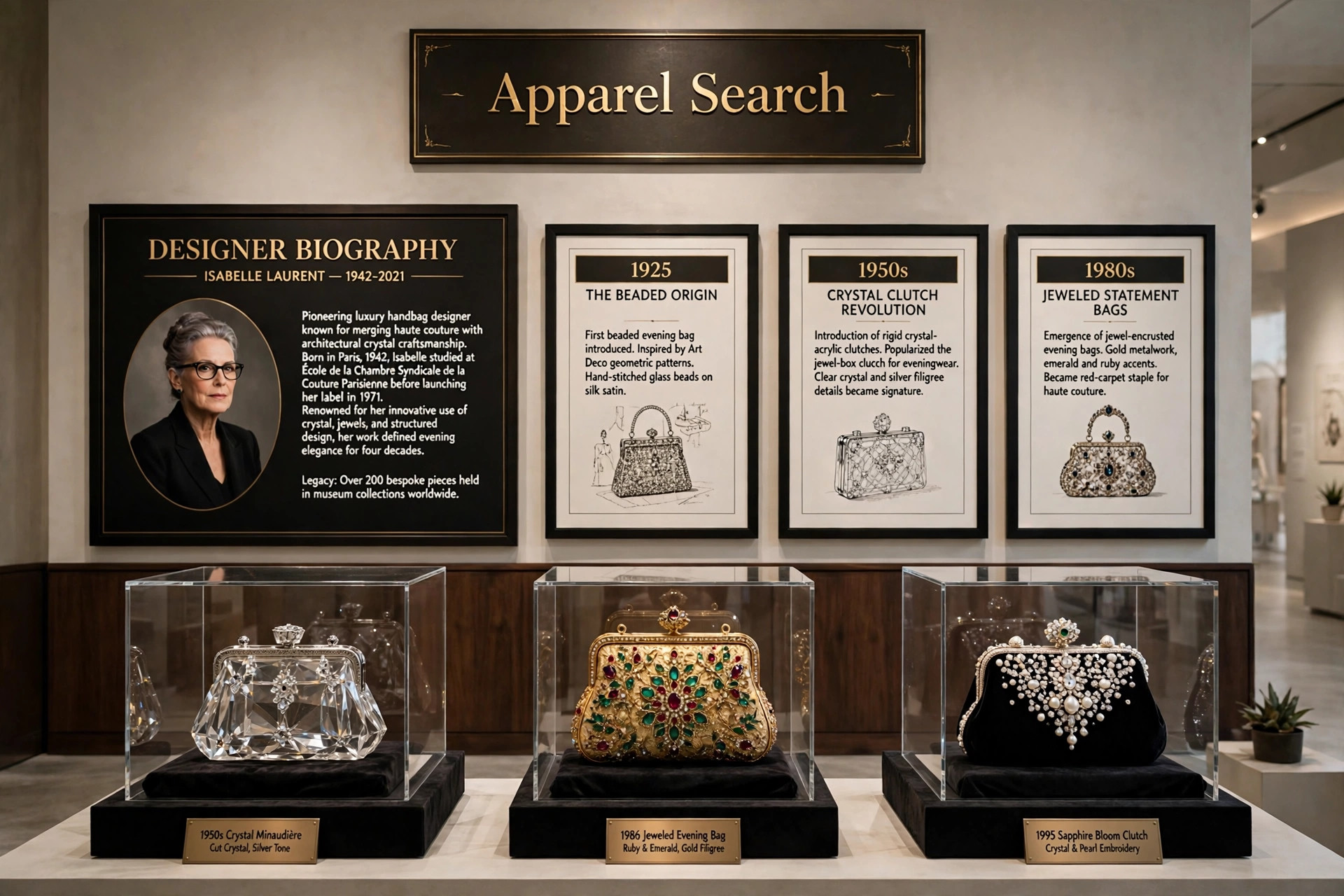
Illustrative image created for this guide — an artistic impression, not this designer's own garments.
News, Photos & VideoCollectionsFall FashionsFashion WeekNewsProfilesRunwaySpring Fashions
London, Budapest and the Handbag Trade
In 1938 her family sent her to King's College London to study chemistry for the cosmetics industry, in part since her father thought she would be safer in London in the case of a war. She returned to Budapest, where the future she chose was not chemistry but craftsmanship: she apprenticed in a handbag workshop, learning pattern-cutting, stitching and construction from the bench up, and rose to master craftswoman — the technical grounding behind everything she later designed. She survived the war in Budapest, working in the trade.
In 1946 she married Gerson Leiber, an American serviceman and artist, and in 1947 the couple emigrated to New York. There she spent more than fifteen years designing handbags for other manufacturers, learning the American market from inside — what sold, what failed, and what no one was offering: an evening bag made to the standard of a jewel.
1963 and the Crystal Minaudière
In 1963, with a small workshop and her husband handling the business side, she founded Judith Leiber and began making the bags her way. The signature arrived as a solution to a practical problem — a metal evening bag whose finish kept tarnishing was covered in crystals to save it — and became the minaudière: a sculpted metal clutch entirely encrusted with hand-set crystals, shaped as animals, flowers, food and objects, each one taking weeks of handwork. Gala dressing adopted them completely; her bags were carried by First Ladies including Nancy Reagan, Barbara Bush and Hillary Clinton, and by singers and actresses on the largest stages.
She sold the company in 1993 and stepped back from design later that decade; the house continued under her name. Judith and Gerson Leiber died on the same day, April 28, 2018, after seventy-two years of marriage. Read with the collections page, the profile completes its arc: the chemistry student who became a master of the handbag bench, and turned an evening accessory into collectible sculpture.
Photos

Common Questions
Who was Judith Leiber?
Judith Leiber (1921–2018), born Judith Peto in Budapest, was a Hungarian-born American fashion designer and businesswoman who founded her own handbag house in New York in 1963 and became famous for crystal minaudières — jeweled evening clutches sculpted as animals, flowers and objects.
How did Judith Leiber come to design handbags?
Sent to King's College London in 1938 to study chemistry for the cosmetics industry, she returned to Budapest and trained in handbag making instead — becoming a master craftswoman in the trade before emigrating to New York in 1947 and designing bags for other firms until she founded her own house in 1963.
What is a Judith Leiber minaudière?
A small, hard evening clutch of sculpted metal completely encrusted with hand-set crystals — famously shaped as animals, food, flowers and objects. Her bags were carried by First Ladies and singers to inaugurations and galas, and are held in museum collections.