Fashion on Television · Screen Style Topics
Bridgerton: The Costumes That Launched Regencycore
On Christmas Day 2020, Netflix released a Regency romance whose ballrooms were dressed like couture shows — and within weeks, the data platforms were recording a run on corsets, empire waists and feather headbands, and the trend had a name. This guide tells the design story behind Bridgerton's wardrobe: the designer who built it, the department of 238 people who made it, the two family palettes that carry its drama, and the successors who turned a heightened 1813 into an Emmy-winning house style.
At a Glance
- Series
- Bridgerton (Netflix, 2020– ), produced by Shondaland, created by Chris Van Dusen from Julia Quinn's novels
- Setting
- London's ton — high society in the Regency era, beginning in 1813
- Costume designers
- Ellen Mirojnick (season 1), Sophie Canale (season 2), John Glaser (seasons 3–4)
- The scale
- About 7,500 costume pieces making up some 5,000 costumes for season one, built by a department of 238 people
- Signature silhouette
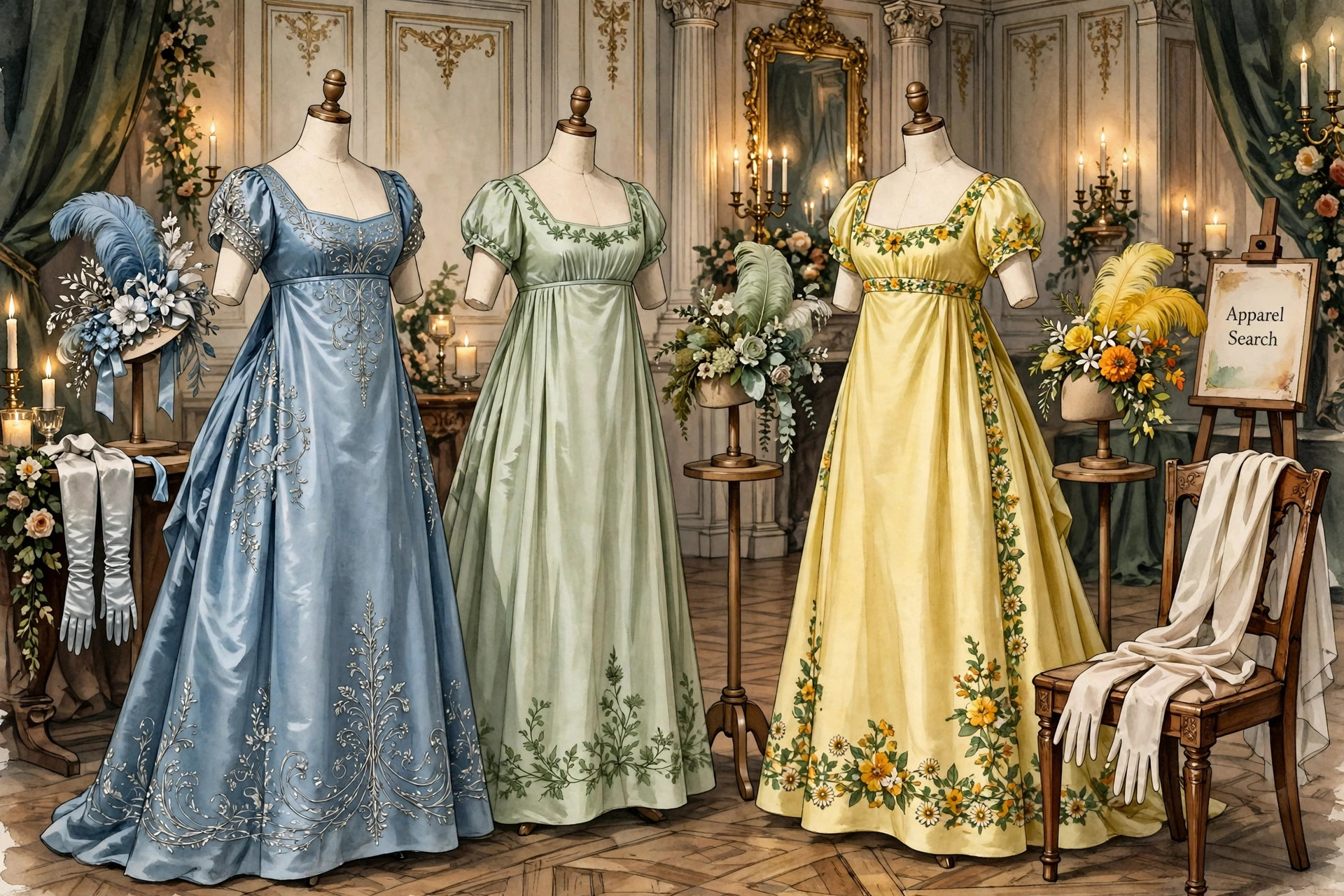
- The empire line — waist just under the bust, low scooped neckline, layers of organza and tulle
- The fashion effect
- "Regencycore," named by Lyst in January 2021; corset searches up 123 percent in the premiere's wake
The Design Brief
Aspirational, Not Accurate: Mirojnick's 1813
Every period production begins with a decision about how much of the past to keep. Ellen Mirojnick, the veteran costume designer Shondaland hired to build Bridgerton's world, made hers openly. Studying Regency London through drawings and paintings, she concluded that the series "had to be aspirational, as opposed to historically accurate" — a fictionalised romance drama, in her words, not a historical one. The silhouettes would stay true to the early 1800s; almost everything else was open to reinvention.
The reinvention had a specific address. "From the 19th century, I immediately went to the 1950s and 1960s," Mirojnick said, citing the Victoria & Albert Museum's Christian Dior exhibition as a wealth of inspiration. That detour explains the wardrobe's particular glamour: the empire line of 1813 finished with the polish, saturation and embellishment of post-war couture. Colors became more modern and saturated than the period's own; fabrics were chosen for how they photographed, not how they would have woven in 1813; and some period staples were simply refused — "another no-no," she noted, "were muslin dresses," the plain white cotton gowns that fill real Regency portraits.
The result is a wardrobe that reads instantly as "Regency" to a modern audience while being, piece by piece, something richer and more deliberate than the real thing. For what the real thing actually was — the high-waisted, classically influenced dress of about 1795–1820, and how it changed in the decade after — see our guide to fashion in the 1820s, where the empire waist begins its long descent. Bridgerton's achievement was to freeze the silhouette at its most flattering moment and dress it for the camera.
It worked on contact. The first season reached a streaming record of 82 million households within its first month, and the audience did not just watch the clothes — it went shopping for them, a response this guide traces in the Regencycore section below. First, the wardrobe itself.
The Wardrobe
The Regency Wardrobe, Piece by Piece
The empire line. Everything stands on one silhouette: a waistline set just under the bust, a low, scooping neckline, and a skirt that falls in a long column to the floor — the empire silhouette that defined women's dress at the turn of the nineteenth century. Mirojnick kept that foundation exact and built upward, layering organza, organdy and tulle over it, and embroidering and embellishing until a simple Regency shape carried ballroom-level richness. Her successors kept the faith: "We always kept true to the Empire waistline that was popular in the Regency period," season three's George Sayer said — and in season four it remained, in his words, "the starting point" of the heroine's gown.
Corsetry, heightened. The show's bodices are more sculpted than the period's own. Real Regency underpinnings were comparatively soft — short stays rather than the rigid corsetry of the Victorian age — but Bridgerton's department included, in Mirojnick's own list of her team, "the extraordinary Mr Pearl," the celebrated couture corset maker, as its corset maker. That credit tells the story: the waistlines on screen are Regency in placement and couture in construction, one more place where the 1950s detour shows.
Headpieces, not bonnets. "There were no bonnets," Mirojnick said, "but we do nod to them with our hair accessories. We took that half-moon shape and created these straw pieces accented with flowers or feathers that sit on top of the head." The half-moon feather-and-flower headpiece became one of the show's most copied details — a silhouette a viewer could buy and wear without a ballroom.
Gloves and finish. Evening dress in the show is completed the period way: long gloves, fans, reticules and jewellery doing the final work of rank and occasion. The gloves in particular had a second life off screen, as the Regencycore numbers below show.
The men. The menswear runs on tailoring: high-collared tailcoats, waistcoats, cravats and boots, cut close and kept immaculate. Its signature is small enough to miss — deliberately. "The symbol of the Bridgerton family is the bumblebee," Luke Newton, who plays Colin, has pointed out, "and there's tiny little bumblebees on our waistcoats that you wouldn't even notice." The bee recurs on lapels, collars and a hairpin for Eloise: a family crest worked into the clothes at embroidery scale, rewarding the close-looking audience the streaming era creates.
Character in Color
Two Families, Two Palettes
Bridgerton's costume design does its storytelling in color, and the system is a duel. On one side, the Bridgertons: the ton's first family, dressed to look inevitable. On the other, the Featheringtons: new money, dressed to be noticed. Mirojnick described the contrast in her own words, and it is worth hearing in full.
"We wanted their color palette to be powdery — these pale blues, silvers, and greens that feel like whispers of color."
The Bridgerton women wear those whispers — powder blue above all, the family's signature — with embroidery in silver thread and jewellery in cool metals. Within the system there is a biography: as Daphne, the first season's heroine, moves from debutante to duchess, "the colors become duskier. The pinks and blues are richer and the silvers deepen as she grows and matures. She begins as a porcelain doll and becomes a woman." Costume as character arc, told in saturation.
The Featheringtons are the opposite register. "The Featheringtons are new money and Portia needs to marry her daughters off," Mirojnick explained. "Their color palette is overly citrus because she wants those girls to be seen… They're bolder, brighter and more brazen than everyone else, and everything is overly embellished." Citrus yellows, oranges and hot florals, gold jewellery where the Bridgertons wear silver — a palette that reads, across a crowded ballroom and on a phone screen alike, as effort. The show's second season extended the code to a third family, dressing the incoming Sharmas in rose gold between the two poles.
The system's finest payoff came in season three, when Penelope Featherington — dressed for years in her mother's citrus — stepped out in a self-chosen gown of emerald green and black. Designer John Glaser was explicit about the mechanics: she "had been wearing those citrus colours because her mother was forcing those colours on her." A heroine's independence, announced by leaving a color palette. It is the clearest demonstration in modern television of costume doing narrative work that dialogue never has to mention.
The Making
7,500 Pieces: Inside the Department
Scale is the other half of the story. "It took five months to prepare before we went to shoot," Mirojnick recalled. "The costume team came to 238 people. This is inclusive of the pattern cutters, the extraordinary Mr Pearl who was our corset maker, a tailoring department, an embellishing department, embroiderers and my co-captain John Glaser, among others… In the end, there were about 7,500 pieces — from hats to shawls, to overcoats — that made up the 5,000 costumes that went before the camera."
Read that again: roughly five thousand complete costumes, assembled from seven and a half thousand made pieces, for a single season of television. The leading lady alone — Phoebe Dynevor's Daphne — accounted for 104 costumes. The work was spread across a revived international craft network, with clothes made in Budapest, Italy, Spain, the UK and New York, and the whole of it had to be ready, as Mirojnick noted, within two and a half months of the five-month preparation window. A film wardrobe is an atelier's season; this was a small fashion house, run at couture standards, inside a television schedule — and it set the production benchmark every season since has had to meet, down to the 172 looks the fourth season's team crafted for its masquerade ball sequence alone.
The Fashion Effect
Regencycore: A Trend With Receipts
Television fashion effects are usually asserted. Bridgerton's was measured. In January 2021, weeks after the premiere, the fashion data platform Lyst gave the surge a name — Regencycore — and published the numbers behind it. In the period following the first season's launch, Lyst recorded searches for corsets up 123 percent, empire-line dresses up 93 percent, pearl and feather headbands up 49 percent and long gloves up 23 percent. The show had not merely been watched; it had been shopped, item by item, and the items were precisely the ones its costume department had foregrounded.
Bridal felt it next. Lyst's 2021 Wedding Report recorded searches for empire-waist wedding dresses up 133 percent — the show's silhouette walking down real aisles, a crossover our empire dress guide explores from the garment side. And the effect renewed with each season: in the days after season two premiered in March 2022, the shopping platform Love the Sales recorded searches for Regency dresses up 84 percent, floral-print dresses up 146 percent, silk gloves up 63 percent and — the menswear echo — men's waistcoats up 77 percent.
Retail then made the connection official. Hill House Home's Nap Dress — itself an empire-waisted phenomenon — arrived in a Bridgerton collaboration in 2021. The London shoemaker Malone Souliers released a Bridgerton shoe collection in 2022, and Bloomingdale's built a pop-up around the show the same spring, including a capsule by Tracy Reese. In December 2023 the effect came full circle: Allure Bridals launched a Bridgerton wedding collection designed by Lyn Paolo — the costume designer of the prequel, Queen Charlotte — so the screen's own designer began dressing real brides in the world she had costumed. (The show's beauty collaborations, led by Pat McGrath Labs, ran alongside; the clothes, though, were the headline.)
The mechanism matters, and our Fashion on Television overview names it: repetition and intimacy. A film costume gets two hours; Daphne's wardrobe got eight episodes in the world's living rooms at the exact moment its audience was dressing for a post-lockdown social season. Regencycore was the proof that a streaming series could launch a named, measured trend the way a designer collection does — the moment television costume design became a branch of the fashion industry itself.
The Succession
Canale, Glaser and the Emmy
A wardrobe this large becomes an institution, and institutions need custodians. Season two passed the department to Sophie Canale, who had been an assistant on the first season and inherited, as she described it, the show's tremendous workshop and in-house atelier with its 200-plus team of embroiderers, embellishers, builders and jewellery designers. Her season kept the house codes — the anachronistic bold palettes, the contemporary fabrics, the family color system — and earned the show's second consecutive Emmy nomination for Outstanding Period Costumes, for the episode "Harmony."
Season three brought back John Glaser — Mirojnick's "co-captain" on season one, and her co-credited fellow costume designer on its Emmy nomination — now as lead. Glaser pushed the pendulum back toward fantasy: season two, he judged, "was more historically accurate — and that's something that I don't do. We've taken the show and made it more fanciful." His department dressed Colin Bridgerton in trousers cut from denim and moved the men's silhouette a decade ahead to escape breeches and stockings — anachronism worn openly, as house style. The industry ratified the approach: for season three's "Into the Light," Glaser and his team won the 2025 Emmy for Outstanding Period Costumes, the series' first costume Emmy, alongside a Costume Designers Guild nomination.
Glaser remained lead designer for season four, released in two parts in January and February 2026, and the Academy nominated the season's costumes again — the show's fourth consecutive showing in the category across its run. Four seasons, three lead designers, one continuous wardrobe: the succession itself is the craft lesson, the same one the great period series keep teaching. The designer changes; the world, its palettes and its empire waist endure — and the audience, which has learned that world by heart, would notice any break in it.
Common Questions
Questions & Answers
Who designed Bridgerton's costumes?
Ellen Mirojnick designed the first season (2020), with John Glaser as her co-captain; the season's Emmy nomination credited both as costume designers. Sophie Canale, promoted from the first season's team, designed season two. John Glaser returned as lead designer for seasons three and four, winning the 2025 Emmy for Outstanding Period Costumes for season three.
What is Regencycore?
Regencycore is the name the fashion data platform Lyst gave, in January 2021, to the wave of Regency-inspired dressing that followed Bridgerton's first season: empire-waist dresses, corsets, pearl and feather headbands and long gloves. In the weeks after the premiere, Lyst recorded searches for corsets up 123 percent and empire-line dresses up 93 percent.
Are Bridgerton's costumes historically accurate?
Deliberately not, in designer Ellen Mirojnick's own framing: the series had to be aspirational, as opposed to historically accurate. The silhouettes stay true to the early 1800s — the empire waist, the low neckline, the tailcoat — but the colors are more saturated, the fabrics more modern and the embellishment richer than the period's own, drawing on 1950s and 1960s couture as much as on 1813.
In This Series
The Fashion on Television hub this guide belongs to, the parent film section, and the profile of the designer who opened television's modern fashion era.
Search Apparel Search