Fashion on Television · Screen Style Topics
Downton Abbey: The Wardrobe That Walked From 1912 to the Runway
When Downton Abbey opened in 1912, with the Titanic sinking off screen and an Edwardian house party dressing for dinner, nobody expected an ITV period drama to become one of the defining fashion programmes of its decade. Yet within two years a Ralph Lauren runway was opening to its theme music, and its costumes were on their way to a world-touring exhibition. This guide follows the wardrobe across six seasons and three designers — Susannah Buxton, Caroline McCall and Anna Robbins — from the corseted certainties of 1912 to the beaded freedom of the 1920s.
At a Glance
- Series
- Downton Abbey (ITV / PBS, 2010–2015), six seasons
- Setting
- A Yorkshire country house and its estate, 1912 into the mid-1920s
- Costume designers
- Susannah Buxton (seasons 1–2), Caroline McCall (seasons 3–4), Anna Robbins (seasons 5–6)
- Signature look
- Edwardian formality evolving in real time — high-waisted lace and corsetry giving way to dropped waists, rising hems and 1920s beading
- The fashion effect
- Ralph Lauren's Fall 2012 runway opened to the Downton theme, widely reported as Downton-inspired; the costumes toured in the Dressing Downton exhibition
The Design Brief
A House Dressed by Three Designers
Downton Abbey's costume history is a relay, and each runner's leg is documented in the award records. Susannah Buxton founded the wardrobe across the first two seasons, setting the house in 1912 and carrying it through the First World War. Working beside her in the first season, as her assistant designer, was Caroline McCall — closely enough that the two shared the season one Emmy for its costumes, a rare joint credit that tells you how collaborative the founding wardrobe was. McCall then took over the department for seasons three and four — she has recalled that her first episode as lead designer, after the 2011 Christmas special, was Lady Mary's wedding — and won the BAFTA Craft award for the fourth season. The final two seasons belonged to Anna Robbins, who earned two Emmy nominations for her work and later became the wardrobe's curator in the most literal sense, as the exhibition section below explains.
The relay mattered because the assignment kept changing underneath it. Most period series hold a single era still; Downton had to move. Between the first episode and the last, the story crosses roughly a decade and a half in which real fashion underwent its fastest transformation of the century — the collapse of the corseted Edwardian silhouette, the practical dressing of wartime, and the arrival of the loose, short, beaded 1920s. Each designer therefore inherited not just a cast but a point on fashion's steepest slope, and the wardrobe's continuity across the handovers — the sense that these are the same people, ageing through changing clothes — is the department's central achievement.
There was a second axis to dress as well as the passage of time: the stairs. Downton is a drama of two households in one house, and its costumes draw the line between them daily — the family's evening dress, jewellery and lace above; the servants' uniforms, aprons and working clothes below, each rank with its own prescribed dress. A viewer can read any scene's social geometry from its clothes before a word is spoken, and that readability, maintained across six seasons and three designers, is why the wardrobe rewards the close attention this guide gives it.
The Wardrobe
The Downton Wardrobe, Piece by Piece
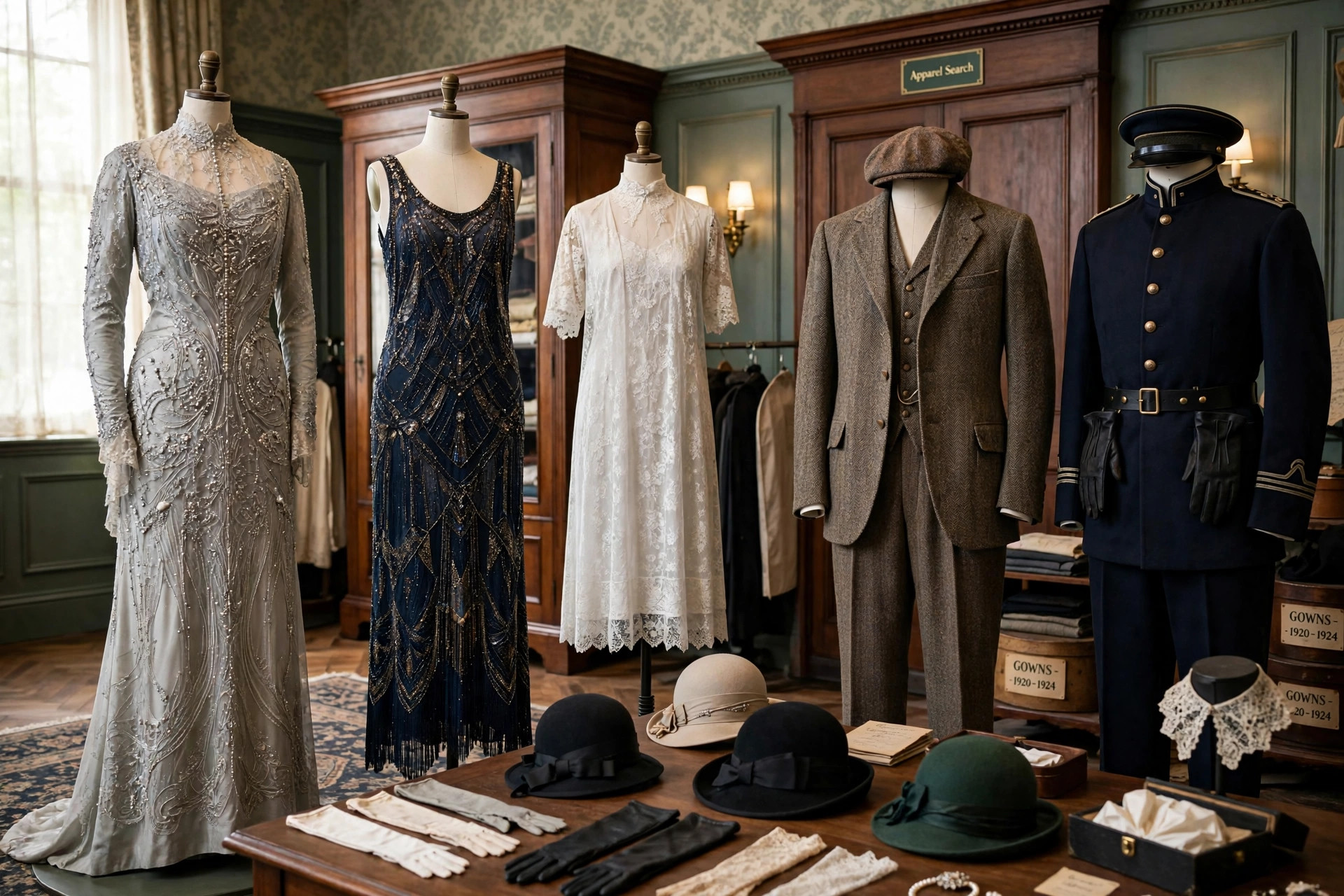
The Edwardian foundation, 1912. The early seasons stand on the last great age of formal dressing: high waists just under the bust, long corseted lines, lace tea gowns for the afternoon, and evening dress built on silk, embroidery and gloves to the elbow. Women's hair is dressed up and pinned; hats are large and serious; jewellery is inherited and worn as a duty as much as an ornament. Buxton's founding wardrobe had to establish all of it at once — a complete vanished system of dress, with its own rules for every hour of the day — and make an audience fluent in it within an episode.
Wartime dressing. The war seasons loosen the system from inside. Practicality enters the great house: simpler day dresses, darker colours, clothes that can be worn by women now working, nursing and managing an estate short of men and money. The change is gradual and social rather than sudden — a hem and a fabric at a time — which is exactly how the real transformation happened, and the wardrobe's restraint here is what makes the 1920s arrival, when it comes, feel earned.
The 1920s arrival. By the final seasons the younger women's dressing has crossed into the new world: waists dropped to the hip, hemlines risen, bodices loosened, and evening dresses carrying the era's signature surface — dense beading and embroidery that moves and catches light as the wearer dances. Headbands and cloche shapes replace the Edwardian hat; hair is cut. McCall's and then Robbins's seasons dress that transition as a generational story: the clothes themselves announce that the pre-war world is not coming back.
The Dowager's refusal. Against all that movement stands the series' finest costume joke, which is also its finest costume truth: the Dowager Countess barely changes at all. Her silhouette stays high-waisted, corseted and Edwardian to the end, her hats and lace intact, because for her generation changing one's dress would be a surrender. Two eras of fashion sit at the same dinner table in the later seasons, arguing without words — and the argument is the history of 1910s and 1920s dress told in a single frame.
Below stairs. The servants' wardrobe is a uniform system as exact as the family's is fashionable: the housemaid's print dress and apron, the footman's livery, the cook's working whites, the butler's formal black. Its costume work is the discipline of repetition — the same prescribed clothes, kept immaculate, marking rank as precisely as any title. The contrast is the series in miniature: upstairs, clothes express personality within fashion; downstairs, clothes express position within a hierarchy, and individuality has to be smuggled in through a brooch, a collar, a Sunday dress.
Character in Clothes
Three Sisters, Three Silhouettes
Downton's most quoted costume storytelling is sororal. The three Crawley sisters share a house, a dinner table and a dress code, and dress as three different answers to their era. Mary, the eldest, wears the sharpest line — the most fashion-forward tailoring and the boldest evening choices, her clothes hardening and refining as her responsibilities grow. Edith, long dressed as the overlooked sister, blooms sartorially as her life expands beyond the house, her wardrobe brightening into the 1920s with her career. Sybil, the youngest, is the rebel, and the series dressed her rebellion literally: she is the sister associated with the era's most daring experiments in women's dress, the clothes arriving in the story as a small scandal, the way new fashion actually arrived in houses like Downton.
At Downton, the passage of time is not announced in captions. It is worn — a waistline dropping, a hem rising, a grandmother refusing to change.
The men carry the same storytelling in a narrower register: black tie and white tie observed with liturgical precision, tweeds for the estate, uniforms for the war, and the slow intrusion of the lounge suit as formality relaxes. And across the whole cast, mourning does heavy narrative work — the house passes in and out of black as the story's losses accumulate, so that the family's collective colour palette darkens and lightens with its fortunes. It is history written in dress, at the pace of real life, which is precisely the pace television — alone among the screen arts — has the hours to honour.
The Making
Dressing Downton: The Wardrobe on Tour
When the series ended, its costumes did something television wardrobes rarely do: they went on tour as themselves. “Dressing Downton” — the exhibition of the show's costumes, later travelling in expanded form as the Downton Abbey exhibition — carried the wardrobe to audiences internationally, with stops including Singapore and New York on its United States and world touring life. The curator was Anna Robbins, the designer of the final two seasons: the person who had dressed the last era of the house became the keeper of all of them, selecting and presenting garments from across the six seasons and three design tenures.
An exhibition changes what a costume is. On screen, a Downton evening dress exists for seconds at a time, in motion, in candlelight, as part of a conversation. In a gallery it stands still for inspection — the beading, the lace, the construction and repair all open to the close looking that the streaming audience had been practising at home. That the wardrobe withstood that inspection, and drew audiences city after city, is the material evidence for what the award records already say: this was couture-grade television work, built to a standard that survives the harshest light a garment can be shown in.
The Fashion Effect
The Night the Runway Played the Theme
Downton's fashion effect has a single most documented moment, and it happened remarkably early. In February 2012, with the series still young, Ralph Lauren's Fall 2012 runway show in New York opened to the Downton Abbey theme music — and the collection that followed, all country-house tweeds, tailored coats and aristocratic polish, was widely reported across the fashion press as Downton-inspired. A serving American design house, opening its show with a British television programme's theme and dressing its models in that programme's world: there is no clearer receipt for a TV wardrobe crossing into fashion's own house.
The timing explains the mechanism. Downton arrived when the fashion cycle was ready for it — after a decade of casualisation, a beautifully documented vision of dressed-up formality landed as both nostalgia and instruction. Our Fashion on Television overview calls this television's mood-setting power: a series need not sell a single garment to change what a season feels like, and Downton changed the feeling of early-2010s dressing toward tailoring, heritage fabrics and occasion wear. The exhibition crowds belong to the same effect, read from the other side: the audience that had absorbed the mood came, in person, to stand in front of the clothes that set it.
It is worth being precise about the claim, because precision is what separates Downton's documented effect from mere period-drama atmosphere. The runway moment is a matter of record — the music, the season, the reporting. The exhibition is a matter of record — its curator, its cities, its run. Together they make Downton the rare heritage drama whose fashion influence can be pointed to, dated and named, rather than simply felt.
Legacy
What Downton Left Behind
Downton Abbey's deepest legacy is procedural: it proved that a long-running period series could treat fashion history as a moving subject rather than a backdrop — that an audience would follow, and relish, a wardrobe evolving year by year through the fastest-changing decades in dress history, and that three designers in succession could sustain one house's dressing without breaking its spell. Buxton founded it and shared its first Emmy with her assistant; McCall carried it through its wartime and wedding years to a BAFTA; Robbins closed it with two Emmy nominations and then curated its afterlife. The relay is the record.
The series also reset expectations for every country-house and heritage production that followed, on both sides of the camera: viewers now arrive knowing how 1912 differs from 1925, and productions know they will be checked. Set among the guides on our Fashion on Television hub, Downton stands as the great demonstration that accuracy itself can be popular — that getting the beading, the mourning and the dropped waist right is not pedantry but pleasure, and that a wardrobe which honours its era can end up, theme music and all, on a New York runway.
Common Questions
Questions & Answers
Who designed Downton Abbey's costumes?
Susannah Buxton designed seasons one and two, with Caroline McCall as her assistant designer in season one — the two shared the season one Emmy. McCall then led seasons three and four, winning the BAFTA Craft award for season four, and Anna Robbins designed seasons five and six, earning two Emmy nominations.
How did the costumes change as the series moved from 1912 into the 1920s?
The wardrobe follows the real arc of fashion across those years: the high-waisted, corseted Edwardian silhouette of 1912 softens through the war years, waists drop and hemlines rise, and by the final seasons the younger women wear the looser, beaded, dropped-waist dresses of the mid-1920s — while the Dowager Countess keeps the older silhouette, so two eras of dress share the same dinner table.
Did Downton Abbey influence real fashion?
Yes, and the clearest documented moment came early: Ralph Lauren's Fall 2012 runway show opened to the Downton theme music and was widely reported as Downton-inspired. The costumes themselves then toured the world in Dressing Downton, the exhibition curated by the show's final designer, Anna Robbins, which travelled internationally including stops in Singapore and New York.
In This Series
The Fashion on Television hub this guide belongs to, the parent film section, and two companion guides to television's great period wardrobes.
Search Apparel Search