Fashion on Television · Screen Style Topics
The Crown: Dressing the Most Photographed Wardrobe in the World
Most period dramas invent a past nobody can check. The Crown, Netflix's six-season life of Queen Elizabeth II and her family, had the opposite problem: its leading lady was the most photographed woman of the twentieth century, and every famous dress she ever wore exists in an archive, waiting to be compared. This guide tells how three costume designers — Michele Clapton, Jane Petrie and Amy Roberts — met that challenge, won an Emmy apiece for doing it, and sent viewers off in search of a handbag named for a princess.
At a Glance
- Series
- The Crown (Netflix, 2016–2023), six seasons
- Setting
- Britain and the royal world, from the late 1940s through the early 2000s
- Costume designers
- Michele Clapton (season 1), Jane Petrie (season 2), Amy Roberts (seasons 3–6), with Sidonie Roberts as associate costume designer
- Signature look
- Documented royal dress recreated at full ceremony — coronation robes, wedding gowns, tour wardrobes — set against invented private-life clothes in the same taste
- The fashion effect
- “Dianacore” — the Lady Dior bag among eBay's top-searched styles globally, January–September 2023
The Design Brief
Three Designers, One Reign
The Crown ran from 2016 to 2023, and its wardrobe leadership changed the way a reign changes hands: in orderly succession, each holder leaving the institution stronger. Michele Clapton — one “l” in Michele, a spelling the award records are careful about — designed the first season, establishing the young Elizabeth of the late 1940s and early 1950s: the wedding, the accession, the coronation. Jane Petrie took the second season, carrying the court into the late 1950s and 1960s, as the Queen's silhouette met a changing fashion world. From the third season to the sixth, the department belonged to Amy Roberts, working with Sidonie Roberts as associate costume designer, through the recast middle years, the Diana era and the final seasons.
The industry marked each reign separately. Clapton won the Emmy for her season, and the Costume Designers Guild award in 2016; Petrie won the Emmy for hers, and the Guild award in 2017; Roberts won the Emmy for the fourth season — the season that introduced Diana, Princess of Wales, and had to dress the most scrutinised wardrobe of the late twentieth century. Three lead designers, three Emmy wins, one continuous royal wardrobe: the succession is itself the first fact of the show's costume story, and it mirrors the subject. The Crown is a drama about an institution outlasting individuals, built by a costume department that worked the same way.
The brief each designer inherited was unusually double. Half of it was documentary: the coronation gown, the wedding dresses, the tour outfits and state-visit ensembles all exist in photographs, newsreel and memory, and a large part of the audience could spot an error the way they would spot a wrong word in a famous speech. The other half was invention: the private moments — family rooms, shooting parties, grief, argument — where no camera ever was, and where clothes had to be created from the person's documented taste outward. A successful episode moves between those two registers without a visible seam, and the seam-hiding is the craft this guide examines.
The Wardrobe
The Royal Wardrobe, Piece by Piece
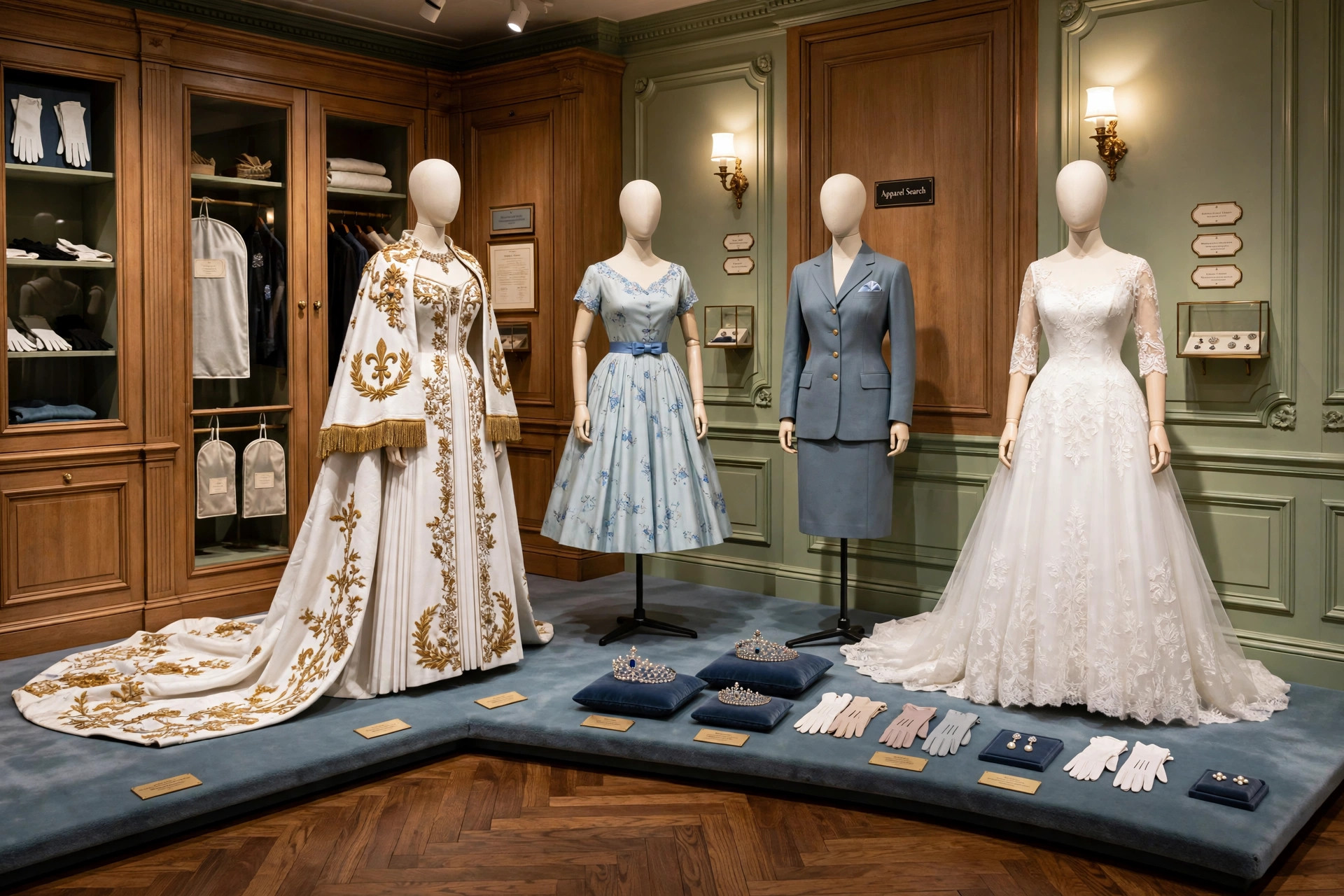
Ceremonial dress. The set pieces come first, because the series builds its authority on them. Coronation and wedding garments carry the heaviest load in royal dressing — embroidery, trains, veils, orders and jewels arranged by rules of precedence that the audience may not know consciously but recognises instantly when they are broken. Recreating them for television means rebuilding couture-weight garments that must read at ballroom distance and in close-up, on performers who have to move, sit and be filmed for long days in them. When those scenes convince, everything less formal around them borrows their credibility.
The Queen's working wardrobe. Between ceremonies sits the most quietly demanding costume work in the series: the day dress, the coat and headscarf, the twinset-and-pearls register of a woman whose clothes were a uniform of continuity. Elizabeth's real style changed remarkably little across decades by design — and a television series spanning those decades has to show time passing on a character whose whole point is that she does not change. The designers solved it the way the real wardrobe did: silhouette and fabric move gently with each era while the grammar — the brooch placement, the handbag on the arm, the gloves — stays fixed. It is characterisation by consistency, the hardest kind to act against and the most rewarding to watch closely.
Diana's wardrobe. The fourth season reversed the problem. Diana's clothes were not a uniform but a narrative — the shy early jumpers and demure dresses giving way, season by season, to the confident tailoring, the statement evening gowns and the famous off-duty combinations of cycling shorts, oversized sweatshirt and trainers. Every stage of it was photographed obsessively at the time, which meant the department was recreating not just garments but memories, for an audience many of whom had owned imitations of the originals. Roberts's Emmy for that season is the industry's verdict on how the balance was struck: recognisable at a glance, alive in performance, never a waxwork.
The men. Royal menswear runs on tailoring and uniform: morning dress, military dress with its medals and sashes, naval whites, shooting tweeds and the dark formal suiting of the court. Its costume work is precision work — the correct order of decorations, the right regiment's details, a tailcoat that sits as if its wearer had never worn anything else. In a series about a family that dressed by rule, the men's clothes carry the rulebook most literally, and the department's accuracy there is what lets the women's ceremonial dressing shine beside them.
Character in Clothes
Public Ceremony, Private Life
The deepest idea in The Crown's dressing is the gap between the two wardrobes every royal character owns. On duty, clothes are heraldry: they announce rank, occasion and allegiance, and the wearer disappears into them by design. Off duty, the series invents the opposite — the cardigans, headscarves, old tweeds and plain dresses of people whose private clothes were chosen for comfort and habit, not for cameras. The drama of the series lives in that gap, and the costume department is where the gap is drawn, episode by episode, fitting by fitting.
In The Crown, the most famous clothes in the world had to be remade — and the clothes nobody ever saw had to be invented so well that viewers believed they had.
That double task explains the show's unusual afterlife among costume professionals. A designer who recreates a documented gown is doing reconstruction; a designer who invents what the Queen wore at breakfast is doing portraiture. The Crown required both, at scale, across six seasons and three changes of cast, with each new cast inheriting not just a character but a wardrobe logic — how this person buttons, carries, repeats and refuses. The repeats matter: real royal dressing is full of reworn pieces, and the series honoured that habit, letting garments recur across episodes the way they recur in a real working wardrobe. It is a small truthfulness that builds, over sixty episodes, into the feeling of a life rather than a costume parade.
The supporting courts extend the lesson outward. Politicians, courtiers, in-laws and visiting heads of state each arrive with a dressing code of their own — the prime ministerial suit changing cut with each decade, the society hostess dressing a half-step ahead of the court, the American and Commonwealth tours bringing climates and customs that the royal wardrobe has to answer. Read as a whole, the series is an accidental survey of how the British establishment dressed across half a century, which is one reason its costumes kept escaping the screen and into exhibitions, as the next sections show.
The Making
From Screen to Museum to Saleroom
Costume departments usually disperse when a series ends. The Crown's work was catalogued instead — twice over, in public. For the fourth season, the Brooklyn Museum presented a virtual costume exhibition, “The Queen and the Crown,” placing the series' recreations in a museum frame and inviting viewers to compare screen dress with the institution's own holdings. A streaming drama's wardrobe, exhibited by a major museum while the series was still running: that is a measure of how completely the recreations had entered the public record of royal dress.
Then, in February 2024, after the final season, Bonhams auctioned the wardrobe itself: some 450 lots of costumes and props from across the six seasons. The auction house's own account of the sale is also the cleanest published summary of the design credits — costumes created by three award-winning designers, Michele Clapton for season one, Jane Petrie for season two and Amy Roberts for seasons three to six, working with Sidonie Roberts as associate. The saleroom gave the department's work a second, literal valuation: garments made to be filmed for a few days became collectible objects, bought to be kept. Between the museum exhibition and the auction, The Crown's costumes completed a journey no previous television wardrobe had made quite so publicly — from working clothes, to exhibits, to artefacts.
The Fashion Effect
Dianacore: The Bag, the Search, the Revival
The Crown's fashion effect arrived with its Diana seasons, and it has a name and a receipt. The name is Dianacore — the revival of interest in Diana's personal style that followed her arrival in the series. The receipt is resale data: eBay figures reported in the press put the Lady Dior bag — the handbag style so closely associated with Diana that it carries her title in its name — among the top-searched styles on eBay globally across January to September 2023. A bag from the 1990s, searched for around the world in 2023, because a television series had put its most famous carrier back on screen: that is the effect, documented rather than asserted.
Note what kind of effect it is. The Crown did not launch a new trend, the way a contemporary-set series can send viewers shopping for clothes they have just seen. It revived an existing, documented style — and revived it at the level of the original objects and their closest descendants, in the resale and vintage market where Diana's actual era survives. Our Fashion on Television overview sets this revival pattern beside television's trend-launching pattern; The Crown is the revival pattern's strongest modern case, a series whose fashion power ran backwards in time, revaluing a wardrobe the audience already half-remembered and sending it to search for the real thing.
The exhibitions and the auction belong to the same effect. A museum does not build a virtual exhibition around costumes nobody is looking at, and a saleroom does not catalogue some 450 lots of television dress without buyers in view. Dianacore, the Brooklyn Museum show and the Bonhams sale are three readings of one audience response: the recreations were so convincing that viewers wanted the originals, the story and the garments themselves — in that order, and in very large numbers.
Legacy
What The Crown Proved
The Crown ended in 2023 as the prestige benchmark for historical recreation on television — the series against which later productions' research, budgets and accuracy are measured. Its three-Emmy costume record, one for each of its lead designers, is unmatched as a demonstration that a wardrobe can change hands without dropping its standard: Clapton founded it, Petrie carried it into a new decade, and Roberts and her associate Sidonie Roberts sustained it through the hardest casting and subject changes of the run. For the designers who follow, the working lesson is the succession itself — build a wardrobe with rules clear enough to be inherited.
Its second legacy is the audience it trained. Six seasons of close-looking at documented dress taught millions of viewers to read clothes historically — to notice a silhouette's decade, a brooch's placement, a handbag's provenance — and that trained eye is now part of what period television is made for. The Fashion on Television hub places The Crown among the series that changed real wardrobes; its particular change was to make the archive fashionable, proving that the most powerful costume effect of the streaming age might not be inventing a look, but recreating one so faithfully that the world goes back to the original.
Common Questions
Questions & Answers
Who designed The Crown's costumes?
Michele Clapton designed season one, Jane Petrie designed season two, and Amy Roberts designed seasons three through six, working with Sidonie Roberts as associate costume designer. Clapton and Petrie each won the Emmy for their seasons, and Roberts won the Emmy for season four; Clapton and Petrie also won Costume Designers Guild awards in 2016 and 2017.
How did the designers handle clothes the public already knew from photographs?
For public moments — the coronation, royal weddings, famous tours — the department worked from the photographic record, recreating documented garments as closely as television craft allows. For private life, where no photograph exists, the designers invented within the person's known taste and the period's rules, so the invented clothes feel consistent with the documented ones beside them.
What fashion effect did The Crown have?
Its best-documented effect is Dianacore: eBay reported the Lady Dior bag among its top-searched styles globally from January to September 2023, as the Diana seasons renewed interest in her wardrobe. The costumes also reached museums and the saleroom — a Brooklyn Museum virtual exhibition for season four, and a Bonhams auction of some 450 costume and prop lots in February 2024.
In This Series
The Fashion on Television hub this guide belongs to, the parent film section, and two companion guides to television's great period wardrobes.
Search Apparel Search