Fashion on Television · Screen Style Topics
The Gilded Age: Rebuilding the 1880s, One Bustle at a Time
HBO's The Gilded Age is a drama about a war fought with calling cards, opera boxes and dinner invitations — which means it is a drama fought in clothes. Across the street from each other in 1880s New York, an old-money household and a new-money household dress their rivalry every morning, and costume designer Kasia Walicka-Maimone built the arsenal: a research archive of more than 40,000 images, and more than 5,000 costumes for the first season alone. This guide is a craft story — how the 1880s silhouette was researched, rebuilt and put to narrative work.
At a Glance
- Series
- The Gilded Age (HBO, 2022– )
- Setting
- New York City in the 1880s — old-money brownstones facing new-money palaces across 61st Street
- Costume designers
- Kasia Walicka-Maimone (all seasons to date)
- Signature look
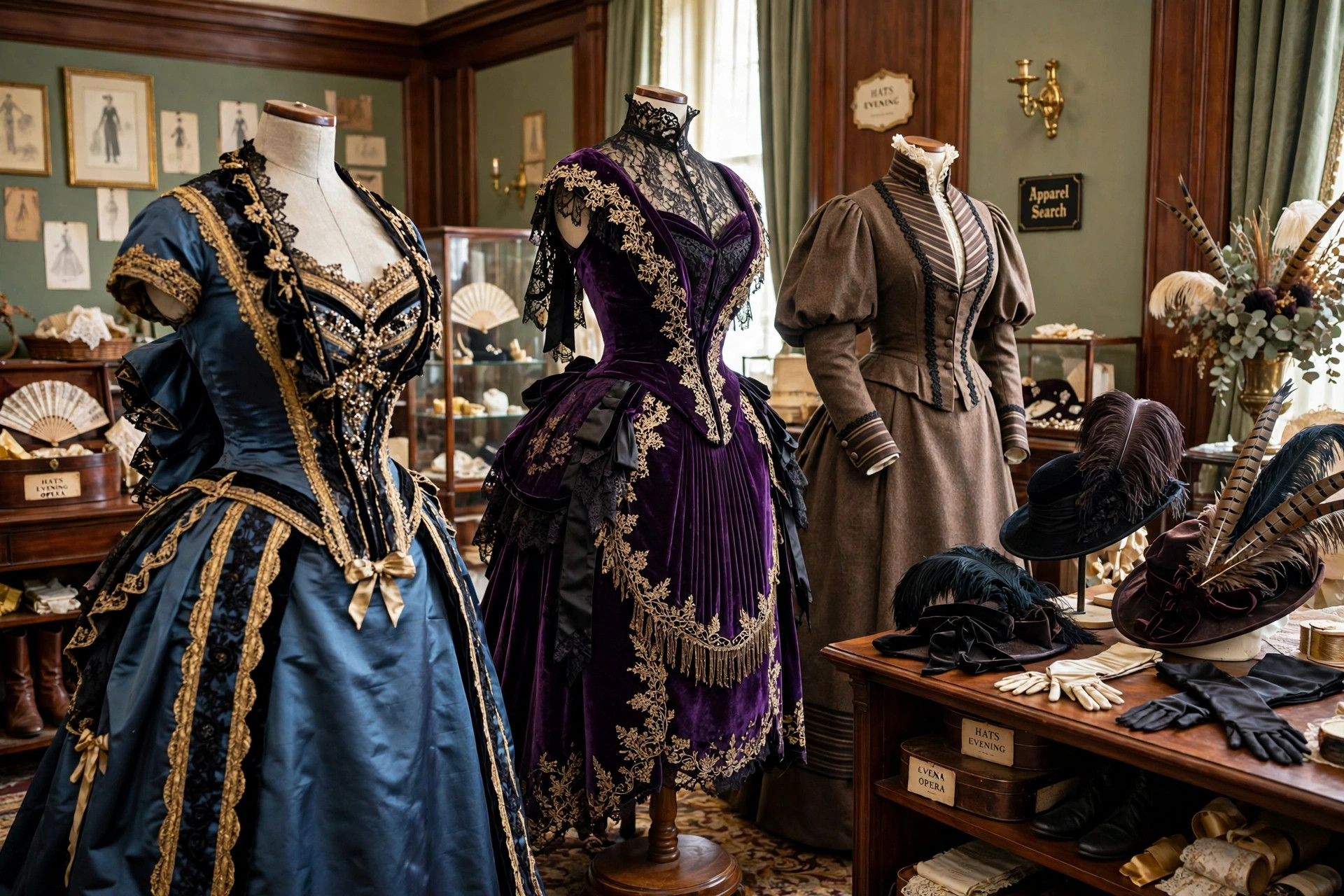
- The full 1880s silhouette rebuilt at period weight — corseted bodice, bustled and trained skirt, towering feathered hat — coded by household: inherited restraint versus new-money splendour
- The fashion effect
- Craft recognition: an Emmy nomination for the season two premiere and sustained critical attention to the research and construction behind the wardrobe
The Design Brief
One Designer, One Decade, Total Immersion
Where some period series pass their wardrobes from designer to designer, The Gilded Age has had a single hand on the rail from the start: Kasia Walicka-Maimone, costume designer for all seasons to date. That continuity shows in the work's defining quality — depth of research, pursued as a method rather than a mood. For the Television Academy's own profile of the production, the starting figure is the archive: more than 40,000 research images gathered before and during the building of the wardrobe. Forty thousand images is not a mood board; it is a reference library of a decade — its paintings, photographs, fashion plates, surviving garments and street scenes — assembled so that any dress, uniform or hat in any scene can be traced back to evidence.
The decade demanded it. The 1880s are one of the most structurally extreme periods in Western dress: the bustle era, when a woman's silhouette was engineered — a corseted torso, a skirt drawn back and draped over a cage or pad at the rear, a train behind, and above it all hats of increasing altitude and plumage. Nothing about that silhouette can be faked with modern clothes underneath; the understructure is the garment. A designer who wants 1882 to look right has to rebuild the period's foundations, literally, and then dress a whole city — two great households, their servants, their callers, their opera audiences, their church congregations and their street crowds — inside them.
The recognition has followed the method. Walicka-Maimone's costumes earned an Emmy nomination for the season two premiere episode — the industry's period-costume category being, season after season, the most research-heavy contest in television. Fashion coverage of the series has reached for editorial language, comparing its dressed street scenes to a late-nineteenth-century fashion editorial — praise aimed not at any single gown but at the density of the world: extras dressed with the same care as principals, a city that looks inhabited by its clothes rather than costumed for the camera.
The Wardrobe
The 1880s Wardrobe, Piece by Piece
The bustle silhouette. Everything stands on the period's architecture: a tightly fitted, corseted bodice; a narrow front skirt; fullness thrown to the back over the bustle; drapery, overskirts and trains arranged across it; and a hem that meets the ground. It is a silhouette of deliberate difficulty — it dictates how a wearer sits, walks, enters a carriage and passes through a door — and the series uses that difficulty as social information. The women who rule this world wear its hardest clothes with total ease; ease inside an engineered silhouette is what breeding looks like, and the costume department's first job was making that ease performable, fitting after fitting.
Day dress and the rules of hours. The 1880s dressed by the clock, and the series honours the timetable: morning dress at home, tailored walking dress for the street, visiting dress for calls, and full evening dress — décolletage, gloves, jewels, fan — for dinner, the opera and the ball. Each register has its fabrics, its neckline and its hat, and getting one wrong in 1882 was a social error the show's characters would notice instantly. For the wardrobe department, that means the costume plot of a single episode can require a principal to be built in four or five complete, code-correct outfits — one reason the season's costume count runs into the thousands.
Hats as headlines. In no other decade does headwear carry so much narrative. The 1880s hat — high-crowned, feathered, flowered, occasionally astonishing — is the most visible square foot of a woman's public dress, the first thing seen across a room and the clearest signal of taste, means and daring. The series leans on that legibility: a new hat is an event, an extravagant one a provocation, and the millinery throughout does the work that a raised voice would do in a ruder drama.
The men. Menswear in the 1880s is a study in controlled variation: frock coats and morning dress for the day, white tie for the evening, top hats whose height and finish mark the occasion — a wardrobe of blacks, greys and impeccable linen in which status hides in cut and cloth rather than colour. Against the women's engineered splendour, the men's restraint is itself the costume point: power, in this world, dresses quietly and lets its houses, its dinners and its wives' gowns speak.
Below stairs, across the street. The servants' liveries and uniforms, the working dress of the street scenes, and the clothes of Newport's summer colony all extend the system outward. Every layer of the city is dressed to its station and its hour, which is what makes the central rivalry — fought between two households in identical silhouettes — readable at a glance, as the next section shows.
Character in Clothes
Old Money, New Money: A War in Two Wardrobes
The Gilded Age's plot can be stated as a dress problem. On one side of the street, old New York: families whose position is inherited, whose houses are correct rather than large, and whose clothes obey rules so old they are never discussed — the right fabric, the right restraint, the right everything, worn as if no effort were involved, because effort would admit the position needed defending. On the other side, the new arrivals: railroad money, a palace of a house rising across the road, and a wardrobe of magnificent, Paris-weight splendour deployed as an argument — every gown a claim that its wearer belongs in the rooms she is determined to enter.
Both households wear the same silhouette. The drama is in the volume — one dresses by inherited rule, the other dresses to be admitted.
That is a gift of a brief for a costume designer, and Walicka-Maimone's department plays it in the period's own terms rather than in caricature. The old-money wardrobe is not dowdy and the new-money wardrobe is not vulgar; both are superb, because in 1882 both households employed superb dressmaking. The difference lives in calibration — in colour saturation, in the newness of the new, in how much splendour is spent on a single appearance, in the confidence to repeat a gown versus the need never to be seen in one twice. It is characterisation at the level of taste, and it works because the research underneath it is real: the audience may not know the 1880s code, but dressed this precisely, they can feel when it is being obeyed and when it is being spent.
The younger generation complicates the code beautifully — daughters dressed by their mothers' strategies, a young woman from a ruined Southern family learning New York dress as a foreign language, gloves and hats doing the work of passports. In a series where almost nobody says what they mean, the wardrobe is the most honest dialogue in the script.
The Making
40,000 Images, 5,000 Costumes
The numbers attached to this production deserve a section of their own, because they describe a method. More than 40,000 research images: the archive from which the department worked, per the Television Academy's profile. More than 5,000 costumes in the first season alone: the output. Between those two figures lies the whole craft — research at library scale, converted into garments at city scale, every one of them built on period understructure and finished to be read in close-up by a modern camera.
Consider what 5,000 costumes means in an 1880s silhouette. These are not rails of modern dress with hats added; a single principal's ball gown is an engineered assembly of corsetry, bustle, underskirts, draped overskirt, bodice, trim and train, and a ballroom scene multiplies that assembly by every dancer and spectator in the room — each one also hatted, gloved and correct for the hour. Crowd dressing is where period series usually economise; the counts here say this one did not, and the fashion press's editorial comparisons were aimed at exactly that density. The Emmy nomination for the second season's premiere suggests the industry noticed the same thing the critics did: the standard was not set once and coasted on, but renewed.
The Recognition
A Craft Story, Told Straight
This guide makes a deliberate choice, and it is worth stating plainly. Some series in this section changed what people bought; The Gilded Age, on the evidence available, is not documented to have done that — no retail collection, search spike or named street trend has been traced to it in the sources behind this guide, and its story is stronger told honestly than inflated. What is documented is craft recognition of a high order: the Emmy nomination, the Television Academy's process profile, and a run of critical attention that treats the wardrobe as the series' chief pleasure and its chief argument.
That distinction matters to how the show belongs on our Fashion on Television hub. Television costume influences fashion in more than one way: there is the trend, measured in searches and sales, and there is the slower influence of a wardrobe that re-teaches an audience's eye — that sends viewers away knowing what a bustle is, why a hat mattered, and how much of history is written in dress. The Gilded Age works in that second way, and it works on viewers who may never wear a trained skirt: they leave its ballrooms better readers of every period drama, museum gallery and fashion plate they meet afterwards. A guide that claimed more for it would be claiming less, because it would be trading a verifiable achievement for an unverifiable one.
One association, in particular, should not be made. The 2022 Met Gala's “Gilded Glamour” dress theme is sometimes loosely connected with the series in casual coverage; in fact it was the Costume Institute's own exhibition theme, chosen for its show about American fashion, and not a trend the HBO series created. The series and the exhibition simply drank from the same decade — which is itself a sign of the period's renewed hold on the fashion imagination, and all the connection the evidence supports.
Legacy
The Standard It Sets
The Gilded Age is still running, so its legacy is a standard in the process of being set — but the terms are already clear. It has re-established the 1880s, the most technically demanding decade in nineteenth-century dress, as television territory: proof that a modern audience will not merely tolerate the bustle silhouette but relish it, provided the research is deep enough and the dressing dense enough to make the vanished world feel inhabited rather than illustrated. For costume departments, Walicka-Maimone's archive-first method — tens of thousands of images before thousands of costumes — is the production's published recipe, and the Emmy nomination is its professional ratification.
Set beside its companions on the Fashion on Television hub, the series completes a trio of answers to the question of what period costume is for. One great wardrobe recreated a documented life; another carried its characters through fashion's fastest change; this one rebuilds a whole society's dress code so completely that its social war can be fought, and understood, entirely in clothes. That is not a lesser achievement than launching a trend. In the long history of fashion on screen, it may be the more durable one.
Common Questions
Questions & Answers
Who designed The Gilded Age's costumes?
Kasia Walicka-Maimone has designed the costumes for all seasons of The Gilded Age to date. Her work on the series earned an Emmy nomination for the season two premiere episode, and the Television Academy has profiled her research process, which began with an archive of more than 40,000 images.
How many costumes did the first season need?
More than 5,000 costumes in season one alone, according to the Television Academy's profile of the production. The number reflects the world being dressed: two rival households, their servants, and the balls, operas, churches and streets of 1880s New York, each with its own strict dress code for every hour of the day.
What is the design approach behind the costumes?
Research first, and accuracy as the house style: the department built an archive of more than 40,000 research images and rebuilt the 1880s silhouette — corseted bodice, bustle, trained skirt — at full period weight, then used dress to draw the show's central line between old money, which dresses by inherited rule, and new money, which dresses to be admitted.
In This Series
The Fashion on Television hub this guide belongs to, the parent film section, and two companion guides to television's great period wardrobes.
Search Apparel Search