Fashion on Television · Screen Style Topics
Peaky Blinders: The Suits That Dressed a Revival
A Birmingham gang came home from the Great War and dressed like it owned the city — and a century later, men everywhere copied the uniform. This guide tells the Peaky Blinders wardrobe story in the correct order: Stephanie Collie, the original designer who founded the look in Series 1; Alison McCosh, who succeeded her and evolved it through the later series; the cap, coat and three-piece suit piece by piece; and the revival that ran from the high street to a Beckham-backed designer capsule.
At a Glance
- Series
- Peaky Blinders (BBC / Netflix, 2013–2022), created by Steven Knight
- Setting
- Birmingham, England — the Shelby family's rise from 1919, in the aftermath of the First World War
- Costume designers
- Stephanie Collie (Series 1, originator); Alison McCosh (later series, succeeding Collie)
- Signature look
- The Shelby uniform — flat cap, three-piece tweed suit, long overcoat, watch chain — polish worn as armor
- The fashion effect
- A revival that, in the auction release's words, extended from the high street to designer collections; Kent & Curwen's Peaky-inspired Garrison Collection capsule, 2019
The Design Story
Collie Originated It, McCosh Carried It On
Peaky Blinders begins in Birmingham in 1919, in the direct aftermath of the First World War, with the Shelby family — bookmakers, veterans and rising criminals — walking streets of soot, horse traffic and industrial smoke. Before a word of dialogue lands, the clothes establish the family's whole strategy: they dress above their station on purpose. The three-piece suit in that setting is not vanity; it is armor, advertisement and threat at once. Getting that wardrobe right fell first to Stephanie Collie, the series' original costume designer for Series 1, and then to Alison McCosh, who succeeded her and continued to evolve the visual style through the later series. The order matters, and this guide states it as the record shows it: Collie originated, McCosh succeeded. (Lorna Marie Mugan and Alexandra Caulfield also carry costume design credits in series listings; no award or trade source pins their exact series, so this guide does not invent a split for them.)
Collie's founding decision was to treat working-class tailoring with couture respect. The Shelbys' suits are sharp — fitted jackets, waistcoats, immaculate shirts — but they remain clothes of their time and class: heavy tweeds and wools, detachable collars, boots made for bad streets. The tension between polish and grit is the show's visual engine. These are men who have come home from the trenches determined to be mistaken for nobody's inferiors, and the wardrobe makes the determination visible in every frame, even in silhouette, even in the rain.
McCosh inherited that engine and drove it up the social ladder with the family. As Shelby ambitions widen — from Small Heath bookmaking toward racecourses, mansions and Parliament — the clothes register each promotion: the tailoring refines, the occasions dressier, the women's wardrobes expanding from street clothes into evening glamour. A lesser succession would have redesigned the look; McCosh evolved it, keeping the founding codes — the cap, the coat, the three pieces — legible across six series while the world wearing them changed. That continuity is why the style could detach from the screen and walk into shops: it was stable enough, for long enough, to become a uniform people recognised.
The Wardrobe
The Peaky Wardrobe, Piece by Piece
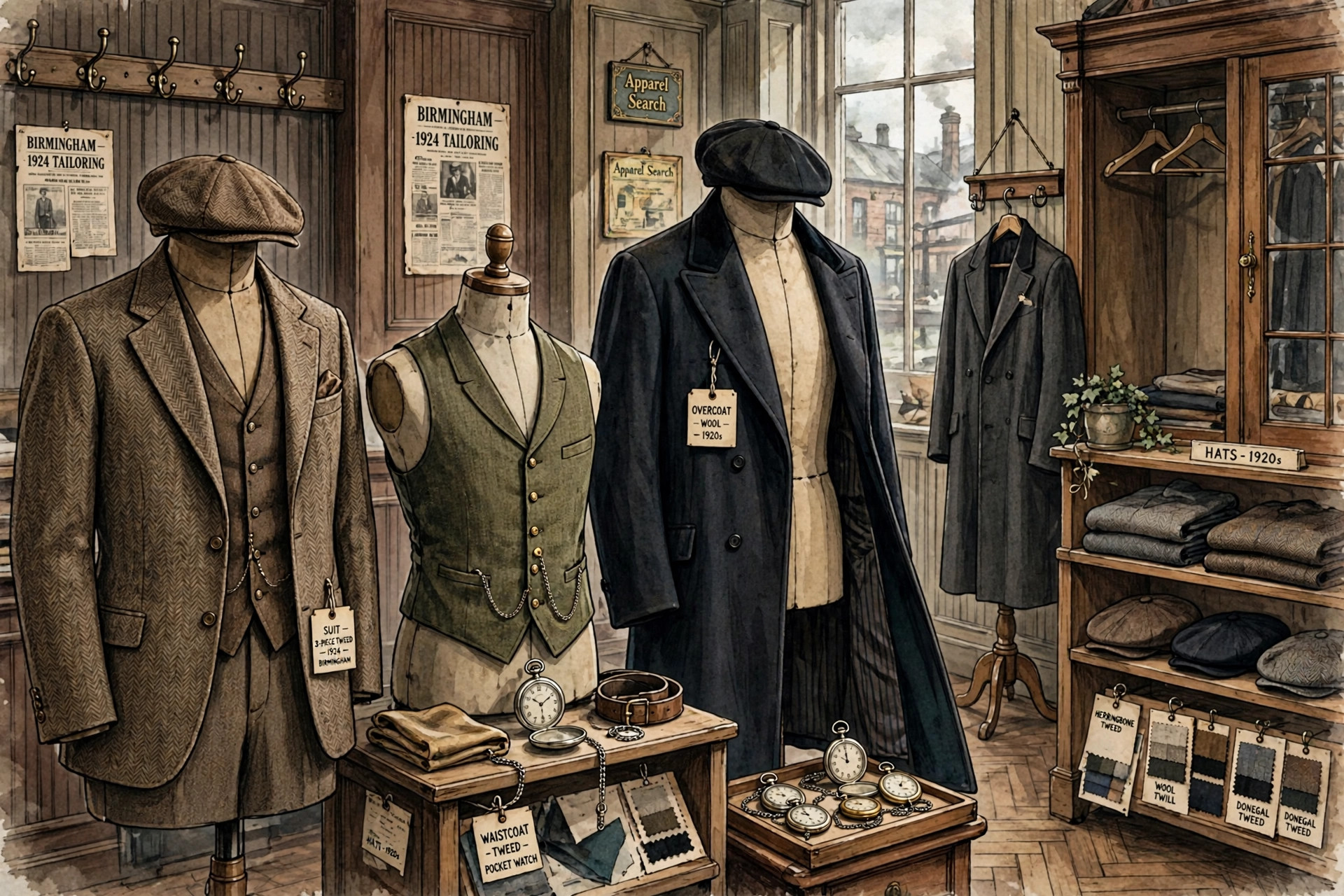
The flat cap. The signature above all signatures. The Shelby brothers' peaked flat caps — worn low, sharp-edged in the show's mythology — turned a working-class staple into the most copied menswear accessory of the streaming era. Its genius as a fashion export is its accessibility: unlike a tailored suit, a cap costs little, fits everyone and transforms an ordinary outfit instantly. The show's title itself rides on the cap, and the cap repaid the compliment by becoming the revival's logo.
The three-piece suit. Jacket, waistcoat and trousers in matching or near-matching tweed and wool: the full set, worn as everyday dress, is the wardrobe's central statement. In 1919 the three-piece was ordinary; the show made it extraordinary again by fit and attitude — close tailoring, high fastenings, nothing sloppy — and by context, dressing men of violence with the care of men of business. Modern menswear's renewed love of the waistcoat starts, measurably, in these frames.
The overcoat. Long, heavy and dark, the Shelby overcoat does the silhouette's outer work: a moving column of wool that reads as authority at any distance. Worn over the three pieces with the cap, it completes the outline that fancy-dress parties, wedding parties and high-street mannequins would all reproduce — proof that the design's power is architectural. Change nothing but the coat and cap, and a modern man is halfway to Small Heath.
Shirts, collars and the watch chain. The details reward the close-looking streaming audience: penny-collar and detachable-collar shirts, ties kept narrow or absent, and the waistcoat's watch chain catching the light. These are the touches that separate a costume from a uniform, and they gave menswear writers a vocabulary — grandad collars, chain loops, textured wool — to sell the look piece by piece to readers who would never buy a whole suit.
The women. The Shelby women dress as the family's other government. Polly Gray's wardrobe — tailored, dark, increasingly luxurious — maps her authority as the business's treasurer and conscience, while the younger women's dresses track the family's rise from street to society, flapper silhouettes and evening wear arriving as the money does. The design never treats the women's clothes as decoration; they are the ledger of the family's ascent, kept in silk.
Character in Clothes
Dressing Above Your Station, On Purpose
Costume design rarely gets a thesis this clear: in Peaky Blinders, dressing well is a hostile act. The Shelbys are Romani, working-class, criminal — three reasons the England of 1919 expects them in rags — and they answer with tailoring. Every immaculate suit is a refusal, and the series shoots them accordingly, the gang moving through smoke and mud like a board of directors that happens to carry razors. Collie's founding wardrobe built that argument; McCosh's continuation kept it honest by letting prosperity show gradually, so the audience could watch class being seized one garment at a time.
"Sparked a fashion revival that extended from the high street to designer collections."
That verdict, from the release accompanying the series' costume sales, is quoted in the effect section below — but its roots are in this character work. A revival needs a look that means something, and the Peaky look means ambition. Men who bought the cap and the three-piece in the show's wake were not dressing as gangsters, exactly; they were dressing as men who had decided to be taken seriously. Television costume had sold glamour and aspiration before, but rarely to men, and never through working-class tailoring. Peaky Blinders made a tweed waistcoat carry the same charge that a designer dress carries elsewhere — and menswear, a category long considered immune to screen influence, discovered it was not.
The design also respects its period more than its imitators do. The real Birmingham gangs of the era were themselves noted for dressing sharply — the series' creator built the Shelbys from family stories of that world — and the wardrobe's best pieces stay inside 1919's possibilities: the fabrics, the collars, the boots. The stylisation is in the consistency and the camera's love, not in invention. That grounding is why the revival could run from fancy dress to designer capsule without breaking: the look was always real clothes, worn with unusual intent.
The Succession
Two Designers, One Continuous Uniform
Long-running series test costume departments differently from films: the wardrobe must survive cast changes, time jumps and its own success. Peaky Blinders ran from 2013 to 2022, its story climbing through the 1920s, and its design leadership passed from originator Stephanie Collie to Alison McCosh, who continued to evolve the visual style through the later series. The handover is the craft story here. Collie set the codes — cap, coat, three pieces, polish against grit — and McCosh's seasons kept those codes while dressing a family transformed by money and power, so that a viewer shown any series can place it in the ascent by clothes alone.
That kind of continuity is an institutional achievement, not just a personal one: patterns kept, suppliers held, a house style documented well enough to outlast its author. It is also the precondition of everything in the next section. Fashion revivals attach to looks that stay still long enough to be learned. Six series of one evolving-but-stable uniform gave the audience time to learn it, want it and finally buy it — the slow fuse that film costume, gone in two hours, can rarely light.
The Fashion Effect
A Revival From the High Street to Designer Collections
The assessment quoted earlier deserves its full weight. The work of the series' designers, in the words of the Christie Charity and Omega Auctions release on the costumes, "sparked a fashion revival that extended from the high street to designer collections." Both ends of that range are documented. At the high-street end, the cap-and-three-piece formula became a retail staple during the show's run — wedding parties, race days and Halloween rails all stocking the Small Heath outline — while at the designer end, the revival produced a named, dated capsule: in 2019, David Beckham's Kent & Curwen launched the Peaky-inspired "Garrison Collection," a capsule explicitly built on the show's tailoring codes. A heritage menswear label, fronted by one of the most famous dressers alive, selling a television gang's uniform as a collection: that is the fashion effect with a label and a launch date.
The revival's shape is instructive. It was menswear-led in an industry that assumed screen fashion meant womenswear; it was driven by tailoring in a decade of casualisation; and its entry piece was an accessory — the flat cap — that let any budget join. Our Fashion on Television overview places Peaky Blinders in the medium's longer fashion history, and its role there is distinctive: it is the proof that a period drama, set a century back, in wool and tweed, could move contemporary men's retail as powerfully as any contemporary-set fashion series moved women's.
The costumes' afterlife underlined the point. When pieces from the production reached auction, the sale was covered as a fashion event, not merely a memorabilia sale — the clothes had become design artefacts in their own right, the originals of a revival millions had already worn in copy. Few television wardrobes earn that double life: first as influence, then as collectible.
Legacy
What Peaky Blinders Changed
First, the series reset menswear's relationship with television. Before Peaky Blinders, the documented screen-fashion economy — the searches, the capsules, the sell-outs — ran overwhelmingly through women's wardrobes. The Shelby uniform showed that a men's look, repeated over six series with discipline, could do the same work, and the Kent & Curwen Garrison Collection gave the industry its citable proof. Menswear briefs have chased that formula since: a stable silhouette, an accessible signature piece, time to let it spread.
Second, it revived a garment vocabulary. The flat cap, the waistcoat, the grandad collar and the long overcoat all re-entered ordinary menswear from a standing start, carried by a show set in 1919. That is the deepest kind of costume influence — not a trend season but a restoration, returning pieces to the working wardrobe that fashion had retired. A man in a flat cap in 2026 is not necessarily dressing as a Shelby; he may simply be wearing what the revival made normal again, which is what revivals are for.
Finally, the Collie-to-McCosh succession stands as the section's quiet lesson, and it is why this guide insists on the correct order. Originators found looks; successors keep them alive long enough to matter. Crediting Collie with the founding and McCosh with the evolution is not bookkeeping — it is the accurate shape of how television fashion actually happens, one designer's codes carried by another's craft until the audience makes them immortal. The whole history in our Fashion on Television hub runs on handovers like this one.
Common Questions
Questions & Answers
Who designed Peaky Blinders' costumes?
Stephanie Collie was the original costume designer, creating the Shelby look for Series 1. Alison McCosh succeeded her and continued to evolve the visual style through the later series. Lorna Marie Mugan and Alexandra Caulfield also carry costume design credits in series listings, but no award or trade source pins their exact series, so no precise split is published for them.
What makes up the Peaky Blinders look?
The Shelby uniform: a peaked flat cap, a three-piece suit in tweed or wool with the waistcoat worn as everyday dress, a long heavy overcoat, period shirts with penny or detachable collars, and a watch chain across the waistcoat. The design's force is the contrast — immaculate working-class tailoring, worn as armor by men dressing above their station on purpose.
What fashion impact did Peaky Blinders have?
The designers' work, in the words of the Christie Charity and Omega Auctions release, sparked a fashion revival that extended from the high street to designer collections. Its named proof is the Garrison Collection, the Peaky-inspired capsule launched in 2019 by Kent & Curwen, David Beckham's label — a heritage menswear brand selling a television gang's tailoring codes as a collection.
In This Series
The Fashion on Television hub this guide belongs to, the parent film section, and two sister guides — the era's other great British period wardrobe and the modern masterclass in quiet luxury.
Search Apparel Search